Anti-KAT2A / GCN5 抗体 [AT3G13]
Anti-KAT2A / GCN5 antibody [AT3G13]
- KO Validated
- 詳細を見る
Be the first to review this product! Submit a review
|
(6 Publications)
Knockout Tested Mouse Monoclonal KAT2A / GCN5 antibody. Suitable for WB, ICC/IF and reacts with Human samples. Cited in 6 publications. Immunogen corresponding to Recombinant Fragment Protein within Human KAT2A aa 400-850.
別名を表示する
GCN5, GCN5L2, KAT2A, Histone acetyltransferase KAT2A, General control of amino acid synthesis protein 5-like 2, Histone acetyltransferase GCN5, Histone glutaryltransferase KAT2A, Histone succinyltransferase KAT2A, Lysine acetyltransferase 2A, STAF97, hGCN5
- ICC/IF
Supplier Data
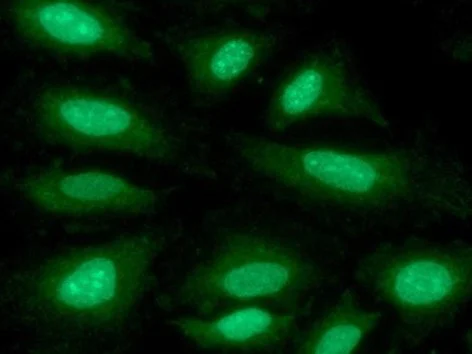
Immunocytochemistry/ Immunofluorescence - Anti-KAT2A / GCN5 antibody [AT3G13] (AB208097)
Immunofluorescent analysis of HeLa cells labeling KAT2A / GCN5 with ab208097 at 1/500 dilution.
- WB
Lab
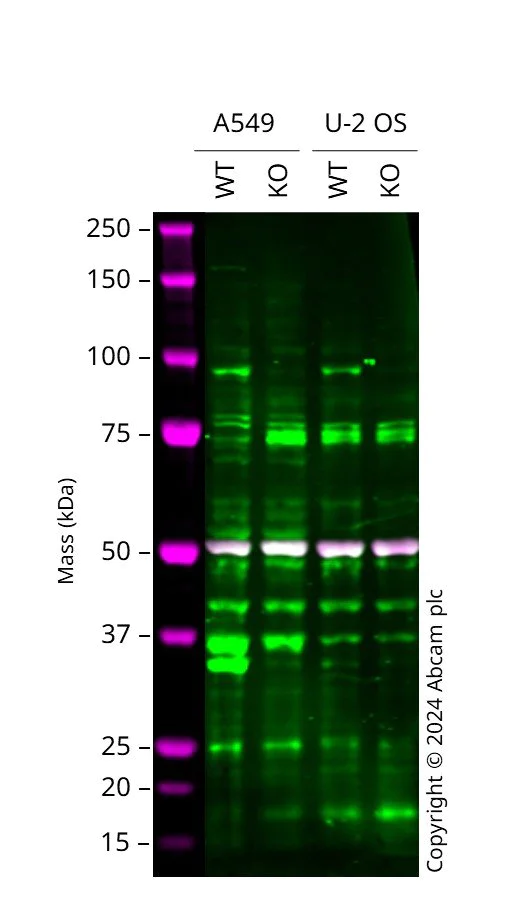
Western blot - Anti-KAT2A / GCN5 antibody [AT3G13] (AB208097)
Western blot : Anti-KAT2A antibody [AT3G13] (ab208097) staining at 1/1000 dilution, shown in green; Rabbit anti-alpha Tubulin antibody [EP1332Y] (ab52866) loading control staining at 1/20000 dilution, shown in magenta. In Western blot, ab208097 was shown to bind specifically to KAT2A. A band was observed at 95 kDa in wild-type A549 cell lysates with no signal observed at this size in KAT2A knockout cell line. To generate this image, wild-type and KAT2A knockout A549 cell lysates were analysed. First, samples were run on an SDS-PAGE gel then transferred onto a nitrocellulose membrane. Membranes were blocked in fluorescent western blot (TBS-based) blocking solution before incubation with primary antibodies overnight at 4 °C. Blots were washed four times in TBS-T, incubated with secondary antibodies for 1 h at room temperature, washed again four times then imaged. Secondary antibodies used were Goat anti-Mouse IgG H&L 800CW and Goat anti-Rabbit IgG H&L 680RD at 1/20000 dilution.
All lanes:
Western blot - Anti-KAT2A / GCN5 antibody [AT3G13] (ab208097) at 1/1000 dilution
Lane 1:
Wild-type A549 cell lysate at 20 µg
Lane 2:
KAT2A knockout A549 cell lysate at 20 µg
Lane 3:
Wild-type U-2 OS cell lysate at 20 µg
Lane 4:
GCN5 knockout U-2 OS cell lysate at 20 µg
Secondary
All lanes:
Goat anti-Mouse IgG H&L 800CW and Goat anti-Rabbit IgG H&L 680RD at 1/20000 dilution
false
代替製品
Primary Antibodies
AB217876
Anti-KAT2A / GCN5 antibody [EPR21146] - ChIP Grade
20ul selling size|KO Validated|RabMAb|Recombinant
- 0
- 0
Primary Antibodies
AB231075
Anti-KAT2A / GCN5 antibody [EPR21146] - BSA and Azide free
RabMAb|Recombinant|KO Validated

- 0
- 0
組合せ製品
Primary Antibodies
AB4729
Anti-Histone H3 (acetyl K27) antibody - ChIP Grade
BOND RX™ Validated

- 5
- 85
Primary Antibodies
AB1791
Anti-Histone H3 antibody - Nuclear Marker and ChIP Grade
Lab Essentials

- 5
- 234
Primary Antibodies
AB275378
Anti-KAT3B / p300 antibody [EPR23495-268] - ChIP Grade
RabMAb|Recombinant|KO Validated|20ul selling size

- 4
- 1
Primary Antibodies
AB52946
Anti-Histone H3 (acetyl K14) antibody [EP964Y] - ChIP Grade
20ul selling size|BOND RX™ Validated|RabMAb|Recombinant|Advanced Validation
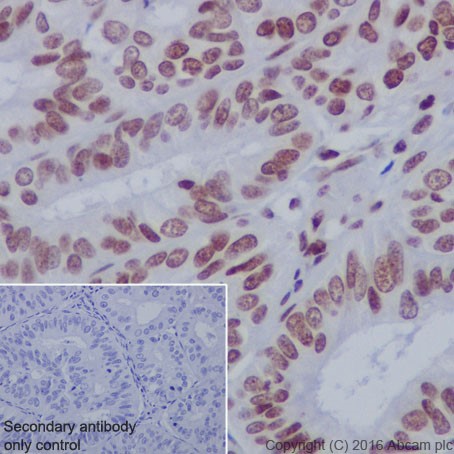
- 5
- 12
Reactivity data
製品の詳細
Derived from hybridization of mouse F0 myeloma cells.
This product was changed from ascites to tissue culture supernatant on 28/02/19. Please note that the dilutions may need to be adjusted accordingly. If you have any questions, please do not hesitate to contact our scientific support team.
出荷温度及び保存条件
製品の状態
精製方法
バッファー組成
出荷温度
短期保存期間
短期保存温度
長期保存温度
分注に関する情報
保管に関する情報
補足情報
This supplementary information is collated from multiple sources and compiled automatically.
Biological function summary
KAT2A/GCN5 participates in several cellular processes as part of larger protein complexes. It is a component of the SAGA (Spt-Ada-Gcn5 acetyltransferase) and TFTC (TBP-free TAF-containing complex) both involved in transcription regulation. Through these complexes KAT2A influences gene expression by acetylating histone residues which in turn affects the recruitment of other transcriptional activators or repressors. This activity also links it to non-histone substrates that support DNA damage repair and cellular senescence.
Pathways
KAT2A/GCN5 is integrally connected to the regulation of transcription and chromatin remodeling pathways. It interacts closely with the transcription factor c-Myc assisting in cell cycle regulation and proliferation. Additionally its presence in the p53 signaling pathway highlights its involvement in controlling cell growth and apoptosis. KAT2A/GCN5 activity influences downstream events in these pathways by affecting the acetylation state of specific histones and non-histone proteins.
製品プロトコール
- Visit the General protocols
- Visit the Troubleshooting
ターゲットの情報
文献 (6)
Recent publications for all applications. Explore the full list and refine your search
Nature communications 16:2345 PubMed40057495
2025
Applications
Unspecified application
Species
Unspecified reactive species
The Journal of biological chemistry 299:103020 PubMed36791914
2023
Applications
Unspecified application
Species
Unspecified reactive species
Clinical and translational medicine 12:e699 PubMed35184403
2022
Applications
Unspecified application
Species
Unspecified reactive species
Scientific reports 10:2044 PubMed32029792
2020
Applications
Unspecified application
Species
Unspecified reactive species
Molecular psychiatry 24:1013-1026 PubMed30742007
2019
Applications
Unspecified application
Species
Unspecified reactive species
The Journal of biological chemistry 293:15947-15961 PubMed30158244
2018
Applications
Unspecified application
Species
Unspecified reactive species
Abcam product promise
Please note: All products are 'FOR RESEARCH USE ONLY. NOT FOR USE IN DIAGNOSTIC OR THERAPEUTIC PROCEDURES'.
For licensing inquiries, please contact partnerships@abcam.com