JavaScript is disabled in your browser. Please enable JavaScript to view this website.
AB238004

Anti-IgG 抗体 [rIG266]

Anti-IgG antibody [rIG266]

Be the first to review this product! Submit a review

|

(5 Publications)

Mouse Monoclonal IGHG1 antibody. Suitable for Protein Array, IHC-P and reacts with Recombinant full length protein - Human, Human samples. Cited in 5 publications.

別名を表示する

Immunoglobulin heavy constant gamma 1, Ig gamma-1 chain C region, Ig gamma-1 chain C region EU, Ig gamma-1 chain C region KOL, Ig gamma-1 chain C region NIE, IGHG1
2 Images
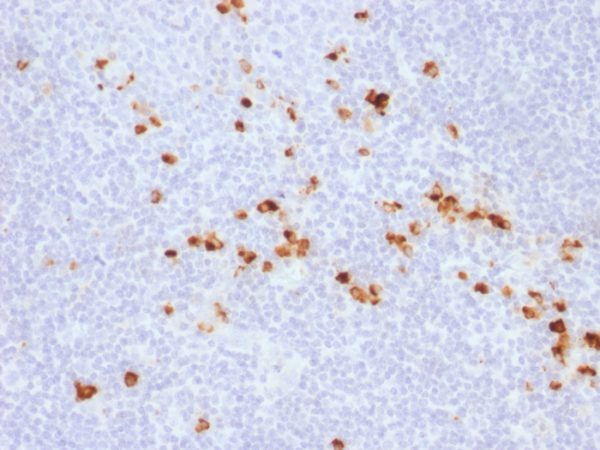
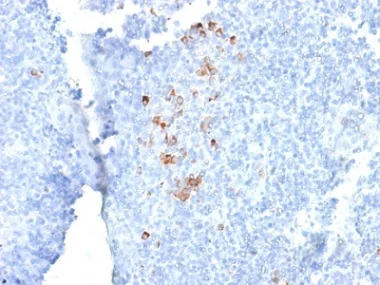
Immunohistochemistry (Formalin/PFA-fixed paraffin-embedded sections) - Anti-IgG antibody [rIG266] (AB238004)
  • IHC-P

Supplier Data

Immunohistochemistry (Formalin/PFA-fixed paraffin-embedded sections) - Anti-IgG antibody [rIG266] (AB238004)

Formalin-fixed, paraffin-embedded human tonsil tissue stained for IgG using ab238004 at 1 μg/ml in immunohistochemical analysis.
Protein Array - Anti-IgG antibody [rIG266] (AB238004)
  • Protein Array

Unknown

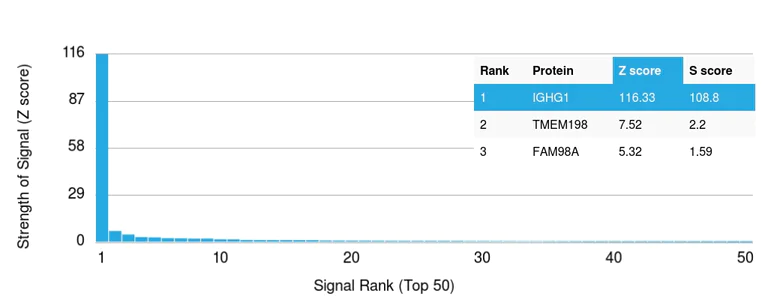
Protein Array - Anti-IgG antibody [rIG266] (AB238004)

ab238004 was tested in protein array against over 19000 different full-length human proteins.
Z- and S- Score : The Z-score represents the strength of a signal that a monoclonal antibody (MAb) (in combination with a fluorescently-tagged anti-IgG secondary antibody) produces when binding to a particular protein on the HuProtTM array. Z-scores are described in units of standard deviations (SD's) above the mean value of all signals generated on that array. If targets on HuProtTM are arranged in descending order of the Z-score, the S-score is the difference (also in units of SD's) between the Z-score. S-score therefore represents the relative target specificity of a MAb to its intended target.
A MAb is specific to its intended target if the MAb has an S-score of at least 2.5. For example, if a MAb binds to protein X with a Z-score of 43 and to protein Y with a Z-score of 14, then the S-score for the binding of that MAb to protein X is equal to 29.

Key facts

宿主種

Mouse

クローン性

Monoclonal

クローン番号

rIG266

アイソタイプ

IgG1

キャリアフリー

No

交差種

Human

アプリケーション

IHC-P, Protein Array

applications

Reactivity data

{ "title": "Reactivity Data", "filters": { "stats": ["", "Species", "Dilution Info", "Notes"], "tabs": { "all-applications": {"fullname" : "All Applications", "shortname": "All Applications"}, "ProteinArray" : {"fullname" : "Protein Array", "shortname":"Protein Array"}, "IHCP" : {"fullname" : "Immunohistochemistry (Formalin/PFA-fixed paraffin-embedded sections)", "shortname":"IHC-P"} }, "product-promise": { "all": "all", "testedAndGuaranteed": "tested", "guaranteed": "expected", "predicted": "predicted", "notRecommended": "not-recommended" } }, "values": { "Human": { "ProteinArray-species-checked": "guaranteed", "ProteinArray-species-dilution-info": "", "ProteinArray-species-notes": "", "IHCP-species-checked": "testedAndGuaranteed", "IHCP-species-dilution-info": "0.5-1 µg/mL", "IHCP-species-notes": "<p>Incubate with primary antibody for 30 minutes at RT.</p> Perform heat-mediated antigen retrieval with citrate buffer pH 6 before commencing with IHC staining protocol." }, "Recombinant full length protein - Human": { "ProteinArray-species-checked": "testedAndGuaranteed", "ProteinArray-species-dilution-info": "", "ProteinArray-species-notes": "<p></p>", "IHCP-species-checked": "notRecommended", "IHCP-species-dilution-info": "", "IHCP-species-notes": "" } } }

出荷温度及び保存条件

製品の状態
Liquid
精製方法
Affinity purification Protein A/G
精製に関する特記事項
Purified from Bioreactor Concentrate by Protein A/G.
バッファー組成
pH: 7.2 - 7.4 Preservative: 0.05% Sodium azide Constituents: PBS, 0.05% BSA
出荷温度
Blue Ice
短期保存期間
1-2 weeks
短期保存温度
+4°C
長期保存温度
-20°C
分注に関する情報
Upon delivery aliquot
保管に関する情報
Avoid freeze / thaw cycle

製品プロトコール

For this product, it's our understanding that no specific protocols are required. You can visit:

ターゲットの情報

Constant region of immunoglobulin (Ig) heavy chains. Igs are membrane-bound or secreted glycoproteins produced by B lymphocytes. In the recognition phase of humoral immunity, the membrane-bound Igs serve as receptors, which upon binding to a specific antigen trigger the clonal expansion and differentiation of B lymphocytes into Ig-secreting plasma cells. Secreted Igs known as antibodies mediate the effector phase of humoral immunity by blocking the interaction of infectious antigens with cellular receptors (via the antigen-binding region) and eliciting effector mechanisms that lead to pathogen neutralization (via the constant region) (PubMed : 17576170, PubMed : 20176268, PubMed : 22158414). The antigen-binding region is formed by the variable domain of one heavy chain paired with the variable domain of its associated light chain. Each Ig molecule has two antigen-binding sites with remarkable affinity for a particular antigen due to V-(D)-J rearrangement, somatic hypermutations and affinity maturation of the variable domains upon antigen exposure (PubMed : 17576170, PubMed : 20176268, PubMed : 22158414). The constant region defines the Ig isotype that perform distinct sets of effector functions. B cells diversify and rearrange their Ig constant regions through class-switch recombination, a process by which the constant region is switched from one Ig isotype to another, namely from IgM and IgD to IgG, IgA and IgE (PubMed : 17576170, PubMed : 20176268, PubMed : 22158414). The constant region of Ig gamma-1 (IgG1) isotype interacts (via the fragment crystallizable, Fc) with receptors on innate immune cells and the complement system to mediate humoral effector functions, including antibody-dependent cellular cytotoxicity or phagocytosis, complement-dependent cytotoxicity and inflammatory responses.
See full target information IGHG1

文献 (5)

Recent publications for all applications. Explore the full list and refine your search

International journal of molecular sciences 25: PubMed38674016

2024

The CaMK Family Differentially Promotes Necroptosis and Mouse Cardiac Graft Injury and Rejection.

Applications

Unspecified application

Species

Unspecified reactive species

Haitao Lu,Jifu Jiang,Jeffery Min,Xuyan Huang,Patrick McLeod,Weihua Liu,Aaron Haig,Lakshman Gunaratnam,Anthony M Jevnikar,Zhu-Xu Zhang

Journal of translational medicine 22:55 PubMed38218866

2024

Metabolic reprogramming based on RNA sequencing of gemcitabine-resistant cells reveals the FASN gene as a therapeutic for bladder cancer.

Applications

Unspecified application

Species

Unspecified reactive species

Lijie Zhou,Kaixuan Du,Yiheng Dai,Youmiao Zeng,Yongbo Luo,Mengda Ren,Wenbang Pan,Yuanhao Liu,Lailai Zhang,Ronghui Zhu,Dapeng Feng,Fengyan Tian,Chaohui Gu

Oncology reports 48: PubMed36222298

2022

Glutathione peroxidase 2 overexpression promotes malignant progression and cisplatin resistance of KRAS‑mutated lung cancer cells.

Applications

Unspecified application

Species

Unspecified reactive species

Mei Wang,Xu Chen,Guang Fu,Mingjian Ge

International journal of oncology 59: PubMed34278448

2021

Exosomal transfer of miR‑25‑3p promotes the proliferation and temozolomide resistance of glioblastoma cells by targeting FBXW7.

Applications

Unspecified application

Species

Unspecified reactive species

Jianxin Wang,Tianxiao Li,Bin Wang

Artificial cells, nanomedicine, and biotechnology 47:2343-2351 PubMed31184227

2019

Ras-ERK signalling represses H1.4 phosphorylation at serine 36 to promote non-small-cell lung carcinoma cells growth and migration.

Applications

Unspecified application

Species

Unspecified reactive species

Shaomin Shi,Jingzhe Zhang,Meihan Liu,Hang Dong,Ning Li
View all publications

Abcam product promise

当社は、高品質な試薬を通じてお客様の研究を力強くサポートすることをお約束いたします。ご使用いただく各段階で、常にお客様をサポートできる体制を整えております。万が一、製品が期待通りに機能しない場合は、「Abcam Product Promise」による当社保証制度に基づき、安心してご利用いただけます。
保証に関する詳細については利用規約をご確認ください。

Please note: All products are 'FOR RESEARCH USE ONLY. NOT FOR USE IN DIAGNOSTIC OR THERAPEUTIC PROCEDURES'.

For licensing inquiries, please contact partnerships@abcam.com