Anti-GRSF1 抗体 [EPR16678]
Anti-GRSF1 antibody [EPR16678]
- 20ul selling size
- RabMAb
- Recombinant
- 詳細を見る
Be the first to review this product! Submit a review
|
(11 Publications)
Rabbit Recombinant Monoclonal GRSF1 antibody. Suitable for IP, WB, ICC/IF, Flow Cyt (Intra) and reacts with Human, Mouse, Rat samples. Cited in 11 publications.
別名を表示する
G-rich sequence factor 1, GRSF-1, GRSF1
- ICC/IF
Supplier Data
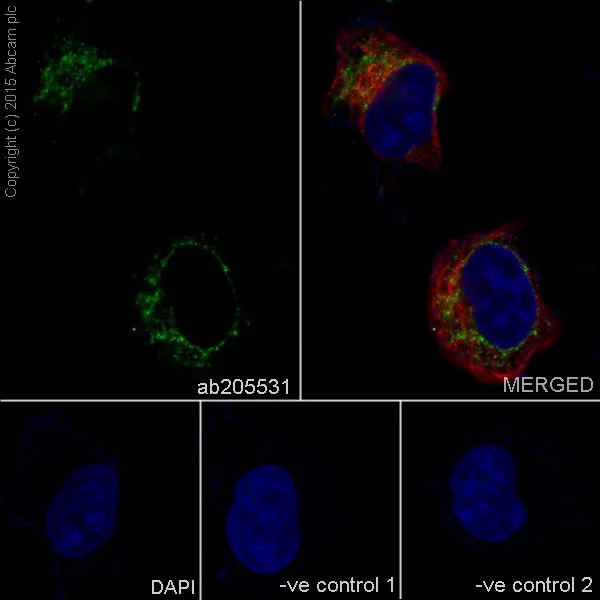
Immunocytochemistry/ Immunofluorescence - Anti-GRSF1 antibody [EPR16678] (AB205531)
Immunofluorescent analysis of 4% paraformaldehyde-fixed, 0.1% Triton X-100 permeabilized HeLa (Human epithelial cell line from cervix adenocarcinoma) cells labeling GRSF1 with ab205531 at 1/250 dilution, followed by Goat Anti-Rabbit IgG (Alexa Fluor® 488) (ab150077) secondary antibody at 1/1000 dilution (green). Confocal image showing cytoplasmic staining on HeLa cell line.
The nuclear counter stain is DAPI (blue). Tubulin is detected with Anti-alpha Tubulin mouse MAb (ab7291) at 1/1000 dilution, followed by Goat Anti-Mouse IgG H&L (Alexa Fluor® 594) (ab150120) secondary antibody at 1/1000 dilution (red).
The negative controls are as follows :
-ve control 1 : ab205531 at 1/250 dilution, followed by Goat Anti-Mouse IgG H&L (Alexa Fluor® 594) (ab150120) secondary antibody at 1/1000 dilution.
-ve control 2 : Anti-alpha Tubulin mouse MAb (ab7291) at 1/1000 dilution, followed by Goat Anti-Rabbit IgG H&L (Alexa Fluor® 488) (ab150077) secondary antibody at 1/1000 dilution.
- Flow Cyt (Intra)
Supplier Data
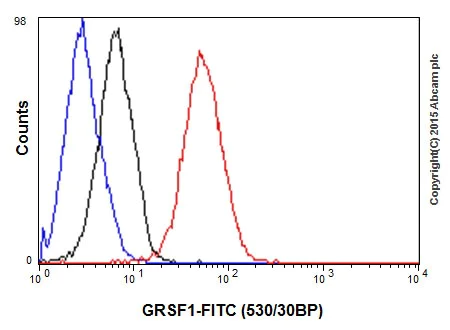
Flow Cytometry (Intracellular) - Anti-GRSF1 antibody [EPR16678] (AB205531)
Intracellular flow cytometric analysis of 4% paraformaldehyde-fixed HeLa (Human epithelial cell line from cervix adenocarcinoma) cells labeling GRSF1 with ab205531 at 1/150 dilution (red) compared with a rabbit monoclonal IgG isotype control (ab172730; black) and an unlabelled control (cells without incubation with primary antibody and secondary antibody; blue). Goat anti rabbit IgG (FITC)at 1/500 dilution was used as the secondary antibody.

- ICC/IF
Supplier Data
Immunocytochemistry/ Immunofluorescence - Anti-GRSF1 antibody [EPR16678] (AB205531)
Immunofluorescent analysis of 100% Methanol-fixed, 0.1% Triton X-100 permeabilized Jurkat (Human T cell leukemia cell line from peripheral blood) cells labeling GRSF1 with ab205531 at 1/250 dilution, followed by Goat Anti-Rabbit IgG (Alexa Fluor® 488) (ab150077) secondary antibody at 1/1000 dilution (green). Confocal image showing cytoplasmic staining on Jurkat cell line.
The nuclear counter stain is DAPI (blue). Tubulin is detected with Anti-alpha Tubulin mouse MAb (ab7291) at 1/1000 dilution, followed by Goat Anti-Mouse IgG H&L (Alexa Fluor® 594) (ab150120) secondary antibody at 1/1000 dilution (red).
The negative controls are as follows :
-ve control 1 : ab205531 at 1/250 dilution, followed by Goat Anti-Mouse IgG H&L (Alexa Fluor® 594) (ab150120) secondary antibody at 1/1000 dilution.
-ve control 2 : Anti-alpha Tubulin mouse MAb (ab7291) at 1/1000 dilution, followed by Goat Anti-Rabbit IgG H&L (Alexa Fluor® 488) (ab150077) secondary antibodyat 1/1000 dilution.
- IP
Supplier Data
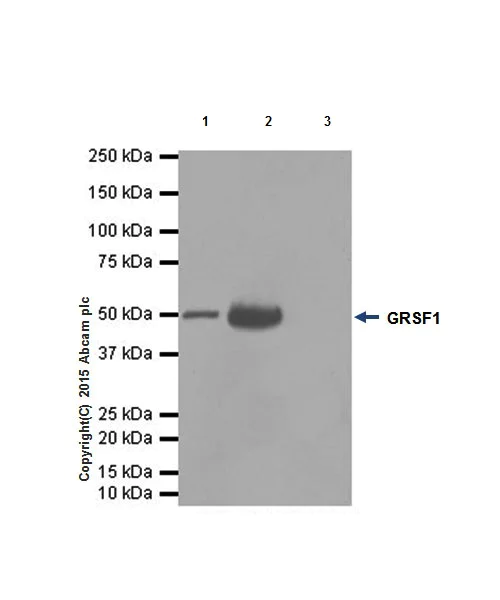
Immunoprecipitation - Anti-GRSF1 antibody [EPR16678] (AB205531)
GRSF1 was immunoprecipitated from 1mg of HeLa (Human epithelial cell line from cervix adenocarcinoma) whole cell lysate with ab205531 at 1/50 dilution. Western blot was performed from the immunoprecipitate using ab205531 at 1/5000 dilution. VeriBlot for IP Detection Reagent (HRP) (ab131366), was used for detection at 1/10000 dilution.
Lane 1 : HeLa whole cell lysate 10μg (Input).
Lane 2 : ab205531 IP in HeLa whole cell lysate.
Lane 3 : Rabbit monoclonal IgG (ab172730) instead of ab205531 in HeLa whole cell lysate.
Blocking and dilution buffer and concentration : 5% NFDM/TBST.
Exposure time : 5 seconds.
All lanes:
Immunoprecipitation - Anti-GRSF1 antibody [EPR16678] (ab205531)
Predicted band size: 53 kDa
false
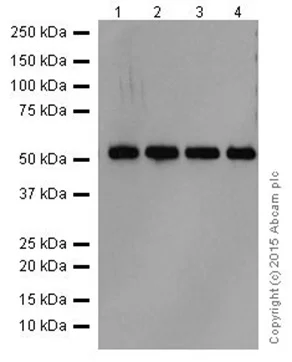
- WB
Supplier Data
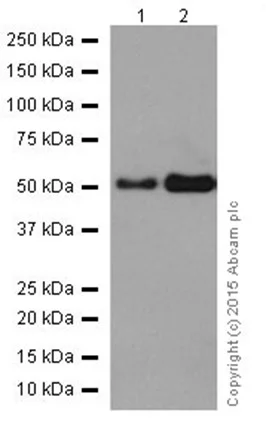
Western blot - Anti-GRSF1 antibody [EPR16678] (AB205531)
Blocking/Dilution buffer : 5% NFDM/TBST.
All lanes:
Western blot - Anti-GRSF1 antibody [EPR16678] (ab205531) at 1/1000 dilution
Lane 1:
Human fetal brain lysate at 10 µg
Lane 2:
Human fetal heart lysate at 10 µg
Secondary
All lanes:
Anti-Rabbit IgG (HRP), specific to the non-reduced form of IgG at 1/10000 dilution
Predicted band size: 53 kDa
Observed band size: 53 kDa
false
Exposure time: 30s
- WB
Supplier Data
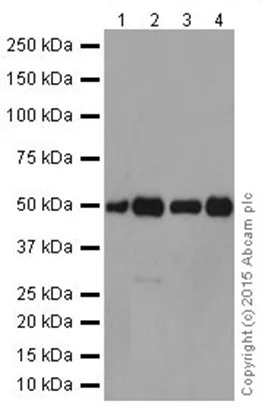
Western blot - Anti-GRSF1 antibody [EPR16678] (AB205531)
Blocking/Dilution buffer : 5% NFDM/TBST.
All lanes:
Western blot - Anti-GRSF1 antibody [EPR16678] (ab205531) at 1/1000 dilution
Lane 1:
HeLa (Human epithelial cell line from cervix adenocarcinoma) whole cell lysate at 20 µg
Lane 2:
HEK-293 (Human epithelial cell line from embryonic kidney) whole cell lysate at 20 µg
Lane 3:
HepG2 (Human liver hepatocellular carcinoma cell line) whole cell lysate at 20 µg
Lane 4:
Jurkat (Human T cell leukemia cell line from peripheral blood) whole cell lysate at 20 µg
Secondary
All lanes:
Western blot - Goat Anti-Rabbit IgG H&L (HRP) (<a href='/products/secondary-antibodies/goat-rabbit-igg-h-l-hrp-ab97051'>ab97051</a>) at 1/100000 dilution
Predicted band size: 53 kDa
Observed band size: 53 kDa
false
Exposure time: 2s
- WB
Supplier Data
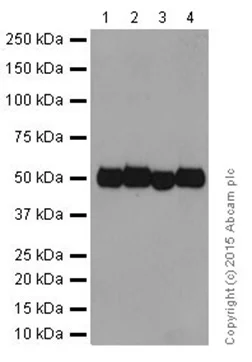
Western blot - Anti-GRSF1 antibody [EPR16678] (AB205531)
Blocking/Dilution buffer : 5% NFDM/TBST.
All lanes:
Western blot - Anti-GRSF1 antibody [EPR16678] (ab205531) at 1/1000 dilution
Lane 1:
Mouse brain lysate at 10 µg
Lane 2:
Mouse kidney lysate at 10 µg
Lane 3:
Rat brain lysate at 10 µg
Lane 4:
Rat heart lysate at 10 µg
Secondary
All lanes:
Western blot - Goat Anti-Rabbit IgG H&L (HRP) (<a href='/products/secondary-antibodies/goat-rabbit-igg-h-l-hrp-ab97051'>ab97051</a>) at 1/100000 dilution
Predicted band size: 53 kDa
Observed band size: 53 kDa
false
Exposure time: 30s
- WB
Supplier Data
Western blot - Anti-GRSF1 antibody [EPR16678] (AB205531)
Blocking/Dilution buffer : 5% NFDM/TBST.
All lanes:
Western blot - Anti-GRSF1 antibody [EPR16678] (ab205531) at 1/1000 dilution
Lane 1:
C6 (Rat glial tumor cell line) whole cell lysate at 10 µg
Lane 2:
RAW 264.7 (Mouse macrophage cell line transformed with Abelson murine leukemia virus ) whole cell lysate at 10 µg
Lane 3:
PC-12 (Rat adrenal gland pheochromocytoma cell line) whole cell lysate at 10 µg
Lane 4:
NIH/3T3 (Mouse embryonic fibroblast cell line) whole cell lysate at 10 µg
Secondary
All lanes:
Western blot - Goat Anti-Rabbit IgG H&L (HRP) (<a href='/products/secondary-antibodies/goat-rabbit-igg-h-l-hrp-ab97051'>ab97051</a>) at 1/100000 dilution
Predicted band size: 53 kDa
Observed band size: 53 kDa
false
Exposure time: 30s
関連する標識済み抗体及び組成の異なる製品 (6)
-
Anti-GRSF1 antibody [EPR16678] - BSA and Azide free
-
660 APC
APC Anti-GRSF1 antibody [EPR16678]
-
565 Alexa Fluor® 555
Alexa Fluor® 555 Anti-GRSF1 antibody [EPR16678]
-
617 Alexa Fluor® 594
Alexa Fluor® 594 Anti-GRSF1 antibody [EPR16678]
-
665 Alexa Fluor® 647
Alexa Fluor® 647 Anti-GRSF1 antibody [EPR16678]
-
578 PE
PE Anti-GRSF1 antibody [EPR16678]
代替製品

組合せ製品
Primary Antibodies
AB186735
Anti-TOMM20 antibody [EPR15581-54] - Mitochondrial Marker
RabMAb|Recombinant|Lab Essentials|20ul selling size

- 5
- 16

Primary Antibodies
AB240098
Anti-SDHA antibody [EPR9043(B)] - BSA and Azide free
RabMAb|Recombinant|KO Validated

- 5
- 2
Reactivity data
製品の詳細
Patented technology
Our RabMAb® technology is a patented hybridoma-based technology for making rabbit monoclonal antibodies. For details on our patents, please refer to RabMAb® patents.
What are the advantages of a recombinant monoclonal antibody?
This product is a recombinant monoclonal antibody, which offers several advantages including:
- - High batch-to-batch consistency and reproducibility
- - Improved sensitivity and specificity
- - Long-term security of supply
- - Animal-free batch production
For more information, read more on recombinant antibodies.
出荷温度及び保存条件
製品の状態
精製方法
バッファー組成
出荷温度
短期保存期間
短期保存温度
長期保存温度
分注に関する情報
保管に関する情報
補足情報
This supplementary information is collated from multiple sources and compiled automatically.
Biological function summary
The GRSF1 operates as an important player in mitochondrial RNA metabolism. It is known to interact within ribonucleoprotein complexes facilitating the regulation of mitochondrial gene expression. GRSF1 contributes to the maturation and processing of mitochondrial RNA impacting the proper synthesis of components essential for mitochondrial function. It ensures that mitochondrial encoded proteins are synthesized accurately aiding overall cellular energy production.
Pathways
GRSF1 engagement with organellar RNA processing integrates into mitochondrial biogenesis and maintenance pathways. This protein significantly influences the electron transport chain by ensuring the precise maturation of mitochondrial RNAs required for encoding electron transport chain components. It connects with proteins like LRPPRC as part of RNA granules coordinating gene expression regulation to support cellular respiration and energy conversion pathways.
製品プロトコール
- Visit the General protocols
- Visit the Troubleshooting
ターゲットの情報
文献 (11)
Recent publications for all applications. Explore the full list and refine your search
Life science alliance 8: PubMed40523799
2025
Applications
Unspecified application
Species
Unspecified reactive species
Life science alliance 8: PubMed39622621
2024
Applications
Unspecified application
Species
Unspecified reactive species
Journal of biochemical and molecular toxicology 38:e70062 PubMed39575578
2024
Applications
Unspecified application
Species
Unspecified reactive species
Cell death & disease 14:717 PubMed37923734
2023
Applications
Unspecified application
Species
Unspecified reactive species
Cell 186:3307-3324.e30 PubMed37385249
2023
Applications
Unspecified application
Species
Unspecified reactive species
Molecules (Basel, Switzerland) 28: PubMed37241859
2023
Applications
Unspecified application
Species
Unspecified reactive species
Frontiers in pharmacology 13:948128 PubMed36120303
2022
Applications
Unspecified application
Species
Unspecified reactive species
Frontiers in pharmacology 13:879870 PubMed35600863
2022
Applications
Unspecified application
Species
Unspecified reactive species
Nature communications 12:4980 PubMed34404792
2021
Applications
Unspecified application
Species
Unspecified reactive species
Aging 13:14557-14570 PubMed34078750
2021
Applications
Unspecified application
Species
Unspecified reactive species
Abcam product promise
Please note: All products are 'FOR RESEARCH USE ONLY. NOT FOR USE IN DIAGNOSTIC OR THERAPEUTIC PROCEDURES'.
For licensing inquiries, please contact partnerships@abcam.com