Anti-GPCR GPR48/LGR4 抗体 [EPR26351-175]
Anti-GPCR GPR48/LGR4 antibody [EPR26351-175]
- KD Validated
- 20ul selling size
- Recombinant
- RabMAb
- 詳細を見る
Be the first to review this product! Submit a review
|
(2 Publications)
Rabbit Recombinant Monoclonal GPCR GPR48/LGR4 antibody. Suitable for WB and reacts with Recombinant fragment - Human, Human, Mouse samples. Cited in 2 publications.
別名を表示する
GPR48, LGR4, Leucine-rich repeat-containing G-protein coupled receptor 4, G-protein coupled receptor 48
- WB
Supplier Data
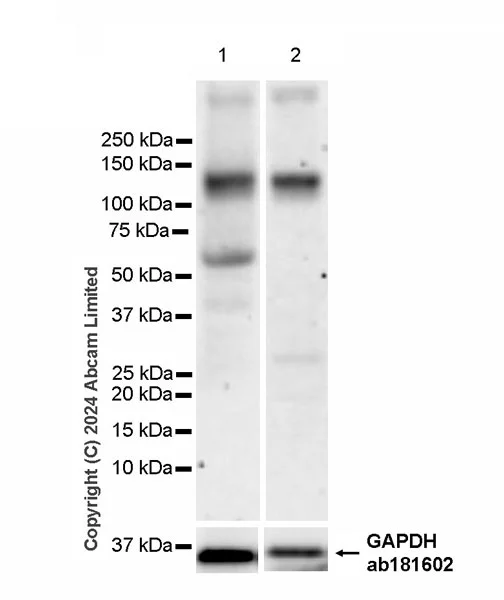
Western blot - Anti-GPCR GPR48/LGR4 antibody [EPR26351-175] (AB321789)
Blocking and diluting buffer and concentration : 5% NFDM/TBST.
The expression profile/ molecular weight observed is consistent with what has been described in the literature (PMID : 24205130, PMID : 11401528).
Lane 2 is applied with Goat Anti-Rabbit IgG, (H+L), Peroxidase conjugated (ab97051) at 1/20000 and lane 1 is applied with Goat Anti-Rabbit IgG (HRP) with minimal cross-reactivity with human IgG at 1/2000.
Samples are non-boiled as boiling may cause protein aggregation.
The identity of the lower MW band at approximately 60 kDa (in lane 1) is unknown.
The lane 1 was developed using a high sensitivity ECL substrate.
The high-sensitivity ECL substrate allows for the detection of proteins in the mid-femtogram range.
In Western blot, Anti-GAPDH antibody [EPR16891] - Loading Control (ab181602) staining at 1/200000 dilution.
All lanes:
Western blot - Anti-GPCR GPR48/LGR4 antibody [EPR26351-175] (ab321789) at 1/1000 dilution
Lane 1:
Human placenta tissue lysate at 50 µg
Lane 2:
Mouse adrenal gland tissue lysate at 50 µg
Secondary
Lane 1:
Goat Anti-Rabbit IgG (HRP) with minimal cross-reactivity with human IgG at 1/2000 dilution
Lane 2:
Western blot - Goat Anti-Rabbit IgG H&L (HRP) (<a href='/products/secondary-antibodies/goat-rabbit-igg-h-l-hrp-ab97051'>ab97051</a>) at 1/20000 dilution
Observed band size: 110-120 kDa,36 kDa
false
Exposure time: 180s
- WB
Supplier Data
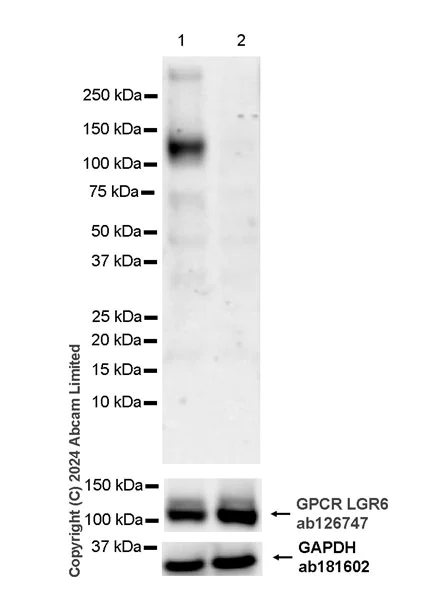
Western blot - Anti-GPCR GPR48/LGR4 antibody [EPR26351-175] (AB321789)
Blocking and diluting buffer and concentration : 5% NFDM/TBST.
This antibody is specific to GPCR GPR48/LGR4 and does not cross react with endogenous GPCR LGR6.
The expression profile/ molecular weight observed is consistent with what has been described in the literature (PMID : 24205130, PMID : 11401528).
Samples are non-boiled as boiling may cause protein aggregation.
In Western blot, Anti-GPCR LGR6 antibody [EPR6874] (ab126747) - Total protein control staining at 1/1000 dilution.
In Western blot, Anti-GAPDH antibody [EPR16891] - Loading Control (ab181602) staining at 1/200000 dilution.
The high-sensitivity ECL substrate allows for the detection of proteins in the mid-femtogram range.
All lanes:
Western blot - Anti-GPCR GPR48/LGR4 antibody [EPR26351-175] (ab321789) at 1/1000 dilution
Lane 1:
A549 (human lung carcinoma epithelial cell) transfected with scrambled siRNA control whole cell lysate at 40 µg
Lane 2:
A549 transfected with siRNA specifically targeting GPCR GPR48/LGR4 whole cell lysate at 40 µg
Secondary
All lanes:
Western blot - Goat Anti-Rabbit IgG H&L (HRP) (<a href='/products/secondary-antibodies/goat-rabbit-igg-h-l-hrp-ab97051'>ab97051</a>) at 1/20000 dilution
Observed band size: 110-120 kDa,36 kDa,104 kDa
true
Exposure time: 180s
- WB
Supplier Data
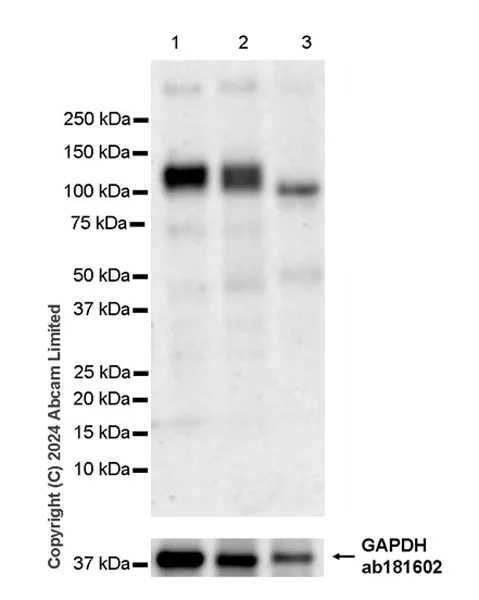
Western blot - Anti-GPCR GPR48/LGR4 antibody [EPR26351-175] (AB321789)
Blocking and diluting buffer and concentration : 5% NFDM/TBST.
GPCR GPR48/LGR4 is a glycoprotein of approximately 110-120 kDa and detected as a 100-kDa band after treated with Peptide : N-glycosidase F (PNGase F).
The expression profile/ molecular weight observed is consistent with what has been described in the literature (PMID : 24205130, PMID : 11401528).
Samples are non-boiled as boiling may cause protein aggregation.
In Western blot, Anti-GAPDH antibody [EPR16891] - Loading Control (ab181602) staining at 1/200000 dilution.
All lanes:
Western blot - Anti-GPCR GPR48/LGR4 antibody [EPR26351-175] (ab321789) at 1/1000 dilution
Lane 1:
NIH:OVCAR-3 (human ovary adenocarcinoma epithelial cell) whole cell lysate at 50 µg
Lane 2:
Untreated A549 (human lung carcinoma epithelial cell) whole cell lysate at 50 µg
Lane 3:
A549 treated with Peptide:N-glycosidase F (PNGase F) whole cell lysate at 50 µg
Secondary
All lanes:
Western blot - Goat Anti-Rabbit IgG H&L (HRP) (<a href='/products/secondary-antibodies/goat-rabbit-igg-h-l-hrp-ab97051'>ab97051</a>) at 1/20000 dilution
Observed band size: 110-120 kDa,36 kDa,100 kDa
false
Exposure time: 180s
- WB
Supplier Data
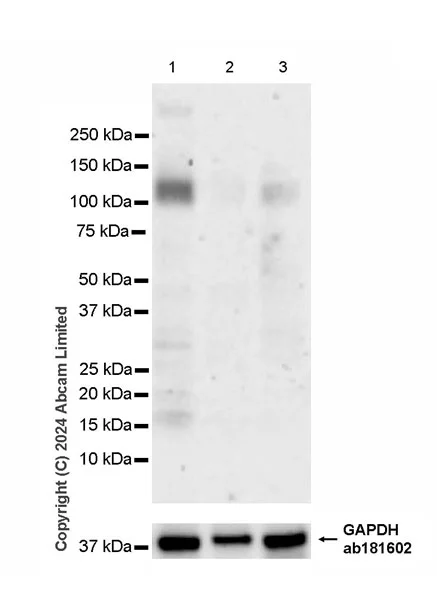
Western blot - Anti-GPCR GPR48/LGR4 antibody [EPR26351-175] (AB321789)
Blocking and diluting buffer and concentration : 5% NFDM/TBST.
Low expression : 4T1, Neuro-2a.
The expression profile/ molecular weight observed is consistent with what has been described in the literature (PMID : 24205130, PMID : 11401528).
Samples are non-boiled as boiling may cause protein aggregation.
In Western blot, Anti-GAPDH antibody [EPR16891] - Loading Control (ab181602) staining at 1/200000 dilution.
All lanes:
Western blot - Anti-GPCR GPR48/LGR4 antibody [EPR26351-175] (ab321789) at 1/1000 dilution
Lane 1:
F9 (mouse embryonal carcinoma epithelial cell) whole cell lysate at 50 µg
Lane 2:
4T1 (mouse mammary gland carcinoma epithelial cell) whole cell lysate at 50 µg
Lane 3:
Neuro-2a (mouse neuroblastoma neuroblast) whole cell lysate at 50 µg
Secondary
All lanes:
Western blot - Goat Anti-Rabbit IgG H&L (HRP) (<a href='/products/secondary-antibodies/goat-rabbit-igg-h-l-hrp-ab97051'>ab97051</a>) at 1/20000 dilution
Observed band size: 110-120 kDa,36 kDa
false
Exposure time: 180s
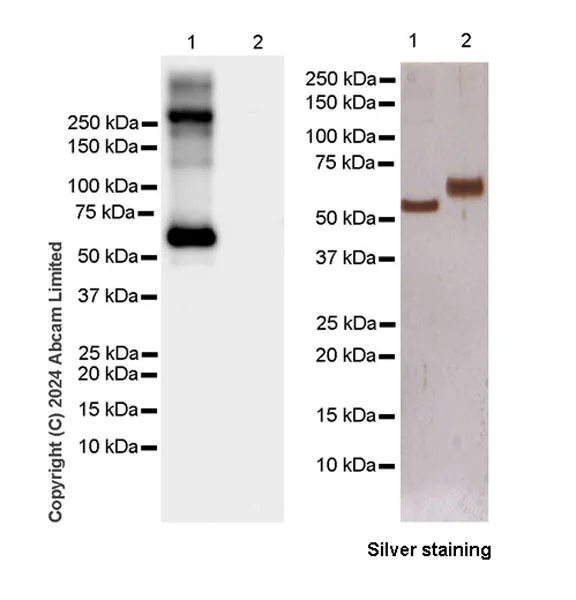
- WB
Supplier Data
Western blot - Anti-GPCR GPR48/LGR4 antibody [EPR26351-175] (AB321789)
Blocking and diluting buffer and concentration : 5% NFDM/TBST.
This antibody does not cross-react with human GPCR LGR5.
Samples are non-boiled as boiling may cause protein aggregation.
All lanes:
Western blot - Anti-GPCR GPR48/LGR4 antibody [EPR26351-175] (ab321789) at 1/1000 dilution
Lane 1:
His-tagged human GPCR GPR48/LGR4 fragment at 10 ng
Lane 2:
Human GPCR LGR5 fragment at 10 ng
Secondary
All lanes:
Western blot - Goat Anti-Rabbit IgG H&L (HRP) (<a href='/products/secondary-antibodies/goat-rabbit-igg-h-l-hrp-ab97051'>ab97051</a>) at 1/100000 dilution
Observed band size: 60 kDa,300 kDa
false
Exposure time: 15s
関連する標識済み抗体及び組成の異なる製品 (1)
-
Anti-GPCR GPR48/LGR4 antibody [EPR26351-175] - BSA and Azide free
組合せ製品
Primary Antibodies
AB126747
Anti-GPCR LGR6 antibody [EPR6874]
KD Validated|BOND RX™ Validated|RabMAb|Recombinant|20ul selling size
- 4
- 1
Primary Antibodies
AB314114
Anti-RSPO2 antibody [EPR26083-79]
20ul selling size|RabMAb|Recombinant
- 0
- 0
Primary Antibodies
AB213480
Anti-PD-L1/CD274 antibody [EPR20529]
RabMAb|Recombinant|KO Validated|20ul selling size

- 5
- 5
Reactivity data
製品の詳細
Patented technology
Our RabMAb® technology is a patented hybridoma-based technology for making rabbit monoclonal antibodies. For details on our patents, please refer to RabMAb® patents.
What are the advantages of a recombinant monoclonal antibody?
This product is a recombinant monoclonal antibody, which offers several advantages including:
- - High batch-to-batch consistency and reproducibility
- - Improved sensitivity and specificity
- - Long-term security of supply
- - Animal-free batch production
For more information, read more on recombinant antibodies.
出荷温度及び保存条件
製品の状態
精製方法
バッファー組成
出荷温度
短期保存期間
短期保存温度
長期保存温度
分注に関する情報
保管に関する情報
補足情報
This supplementary information is collated from multiple sources and compiled automatically.
Biological function summary
The receptor engages in a wide range of functions through its interactions with specific ligands influencing cell proliferation differentiation and survival. LGR4 does not act alone but forms complexes with other receptors or signaling molecules to perform specific activities. It significantly impacts the development of the reproductive system and plays a role in bone formation and remodeling. The receptor contributes to cellular signaling that drives essential biological processes by modulating the activity of various downstream components.
Pathways
The LGR4 receptor is actively involved in the Wnt signaling pathway and RANKL pathway both essential pathways for development and tissue homeostasis. Within the Wnt signaling pathway LGR4 interacts with proteins like LRP6 and Frizzled receptors to regulate gene expression and cellular proliferation. In the RANKL pathway it orchestrates osteoclast differentiation which is important for bone metabolism. The receptor's ability to modulate these pathways highlights its intricate role in maintaining cellular and structural integrity in the body.
製品プロトコール
- Visit the General protocols
- Visit the Troubleshooting
ターゲットの情報
文献 (2)
Recent publications for all applications. Explore the full list and refine your search
Molecular biology reports 52:995 PubMed41065962
2025
Applications
Unspecified application
Species
Unspecified reactive species
The clinical respiratory journal 19:e70080 PubMed40364562
2025
Applications
Unspecified application
Species
Unspecified reactive species
Abcam product promise
Please note: All products are 'FOR RESEARCH USE ONLY. NOT FOR USE IN DIAGNOSTIC OR THERAPEUTIC PROCEDURES'.
For licensing inquiries, please contact partnerships@abcam.com