JavaScript is disabled in your browser. Please enable JavaScript to view this website.
AB75579

Anti-GPCR GPR31 抗体

Anti-GPCR GPR31 antibody

Be the first to review this product! Submit a review

|

(6 Publications)

Rabbit Polyclonal GPCR GPR31 antibody. Suitable for WB and reacts with Human samples. Cited in 6 publications.

別名を表示する

12-(S)-HETE receptor, 12-HETER, G-protein coupled receptor 31, GPR31/12-HETER, GPR31
1 Images
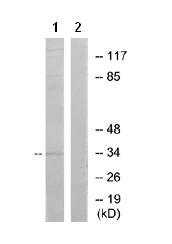
Western blot - Anti-GPCR GPR31 antibody (AB75579)
  • WB

Unknown

Western blot - Anti-GPCR GPR31 antibody (AB75579)

All lanes:

Western blot - Anti-GPCR GPR31 antibody (ab75579) at 1/500 dilution

Lane 1:

Extracts from COLO cells at 5 µg

Lane 2:

Extracts from COLO cells at 5 µg with Immunising peptide

Predicted band size: 35 kDa

Observed band size: 35 kDa

false

Key facts

宿主種

Rabbit

クローン性

Polyclonal

アイソタイプ

IgG

キャリアフリー

No

交差種

Human

アプリケーション

WB

applications

免疫原

The exact immunogen used to generate this antibody is proprietary information.

Reactivity data

{ "title": "Reactivity Data", "filters": { "stats": ["", "Species", "Dilution Info", "Notes"], "tabs": { "all-applications": {"fullname" : "All Applications", "shortname": "All Applications"}, "WB" : {"fullname" : "Western blot", "shortname":"WB"} }, "product-promise": { "all": "all", "testedAndGuaranteed": "tested", "guaranteed": "expected", "predicted": "predicted", "notRecommended": "not-recommended" } }, "values": { "Human": { "WB-species-checked": "testedAndGuaranteed", "WB-species-dilution-info": "1/500 - 1/1000", "WB-species-notes": "<p></p>" } } }

出荷温度及び保存条件

製品の状態
Liquid
精製方法
Affinity purification Immunogen
精製に関する特記事項
ab75579 was affinity purified from rabbit antiserum by affinity chromatography using epitope specific immunogen.
バッファー組成
pH: 7.4 Preservative: 0.02% Sodium azide Constituents: PBS, 50% Glycerol (glycerin, glycerine), 0.87% Sodium chloride
出荷温度
Blue Ice
短期保存温度
+4°C
長期保存温度
-20°C
分注に関する情報
Upon delivery aliquot
保管に関する情報
Avoid freeze / thaw cycle

補足情報

This supplementary information is collated from multiple sources and compiled automatically.

GPR31 also known as G protein-coupled receptor 31 is a member of the GPCR family. This receptor has a mass of approximately 35 kDa. It is widely expressed in human tissues with notable expression in the brain liver and immune cells. GPR31 plays a significant role in transmitting extracellular signals through the cell membrane activating intracellular G proteins and triggering various signaling pathways.
Biological function summary

GPR31 influences cellular processes such as growth and response to environmental changes. It does not associate with a specific complex but interacts with several intracellular signaling molecules. Its function in immune cells suggests a role in immunoregulation and inflammation. Additionally GPR31 might have effects on cell proliferation and migration especially in liver and cancer cells.

Pathways

GPR31 directly influences the arachidonic acid and leukotriene B4 signaling pathways. These pathways regulate inflammation and immune responses. GPR31 interacts with specific proteins like GPR120 and CB2 receptors. Its role within these pathways suggests potential implications in inflammatory diseases and conditions linked to overactive immune responses.

GPR31 has significant relevance to liver cancer and inflammatory bowel disease. Research links GPR31 to the progression of liver cancer by affecting cancer cell proliferation and migration. It also plays a role in the dysregulation of inflammatory responses in bowel diseases via its interaction with CB2 receptors and pathways influenced by inflammation.

製品プロトコール

For this product, it's our understanding that no specific protocols are required. You can visit:

ターゲットの情報

High-affinity receptor for 12-(S)-hydroxy-5,8,10,14-eicosatetraenoic acid (12-S-HETE), with much lower affinities for other HETE isomers (PubMed : 21712392, PubMed : 29227475). 12-S-HETE is a eicosanoid, a 12-lipoxygenase (ALOX12) metabolite of arachidonic acid, involved in many physiologic and pathologic processes (PubMed : 26965684, PubMed : 28619714, PubMed : 29227475). 12-S-HETE-binding leads to activation of ERK1/2 (MAPK3/MAPK1), MEK, and NF-kappa-B pathways leading to cell growth (PubMed : 21712392, PubMed : 29227475). Plays a crucial role for proliferation, survival and macropinocytosis of KRAS-dependent cancer cells by mediating the translocation of KRAS from the endoplasmic reticulum to the plasma membrane (PM) and its association with the PM (PubMed : 28619714). Contributes to enhanced immune responses by inducing dendrite protrusion of small intestinal CX3CR1(+) phagocytes for the uptake of luminal antigens (By similarity). Acts also as a key receptor for 12-(S)-HETE-mediated liver ischemia reperfusion injury (PubMed : 29227475).. Proton-sensing G protein-coupled receptor.
See full target information 12-(S)-hydroxy-5,8,10,14-eicosatetraenoic acid receptor

文献 (6)

Recent publications for all applications. Explore the full list and refine your search

The Journal of clinical investigation 135: PubMed40892510

2025

Integrated screening identifies GPR31 as a key driver and druggable target for metabolic dysfunction-associated steatohepatitis.

Applications

Unspecified application

Species

Unspecified reactive species

Xiao-Jing Zhang,Jiajun Fu,Xu Cheng,Hong Shen,Hailong Yang,Kun Wang,Wei Li,Han Tian,Tian Tian,Junjie Zhou,Song Tian,Zhouxiang Wang,Juan Wan,Lan Bai,Hongfei Duan,Xin Zhang,Ruifeng Tian,Haibo Xu,Rufang Liao,Toujun Zou,Jing Shi,Weiyi Qu,Liang Fang,Jingjing Cai,Peng Zhang,Zhi-Gang She,Jingwei Jiang,Yufeng Hu,Yibin Wang,Hongliang Li

Molecular cancer 21:147 PubMed35842613

2022

LINE-1 promotes tumorigenicity and exacerbates tumor progression via stimulating metabolism reprogramming in non-small cell lung cancer.

Applications

Unspecified application

Species

Unspecified reactive species

Zeguo Sun,Rui Zhang,Xiao Zhang,Yifei Sun,Pengpeng Liu,Nancy Francoeur,Lei Han,Wan Yee Lam,Zhengzi Yi,Robert Sebra,Martin Walsh,Jinpu Yu,Weijia Zhang

Cells 11: PubMed35011589

2021

Expression of Proton-Sensitive GPR31, GPR151, TASK1 and TASK3 in Common Skin Tumors.

Applications

Unspecified application

Species

Unspecified reactive species

Antonia Förch,Susanne Wallner,Florian Zeman,Tobias Ettl,Christoph Brochhausen,Stephan Schreml

The Journal of clinical investigation 130:4999-5010 PubMed32584793

2020

12(S)-HETE mediates diabetes-induced endothelial dysfunction by activating intracellular endothelial cell TRPV1.

Applications

Unspecified application

Species

Unspecified reactive species

Mandy Otto,Clarissa Bucher,Wantao Liu,Melanie Müller,Tobias Schmidt,Marina Kardell,Marvin Noel Driessen,Jan Rossaint,Eric R Gross,Nana-Maria Wagner

Journal of experimental & clinical cancer research 38:489 PubMed31831037

2019

Ischemia reperfusion injury promotes recurrence of hepatocellular carcinoma in fatty liver via ALOX12-12HETE-GPR31 signaling axis.

Applications

Unspecified application

Species

Unspecified reactive species

Faji Yang,Yuheng Zhang,Haozhen Ren,Jinglin Wang,Longcheng Shang,Yang Liu,Wei Zhu,Xiaolei Shi

American journal of physiology. Heart and circulatory physiology 304:H382-92 PubMed23203967

2012

Endothelial 12(S)-HETE vasorelaxation is mediated by thromboxane receptor inhibition in mouse mesenteric arteries.

Applications

WB

Species

Mouse

Lawan Siangjong,Kathryn M Gauthier,Sandra L Pfister,Emer M Smyth,William B Campbell
View all publications

Abcam product promise

当社は、高品質な試薬を通じてお客様の研究を力強くサポートすることをお約束いたします。ご使用いただく各段階で、常にお客様をサポートできる体制を整えております。万が一、製品が期待通りに機能しない場合は、「Abcam Product Promise」による当社保証制度に基づき、安心してご利用いただけます。
保証に関する詳細については利用規約をご確認ください。

Please note: All products are 'FOR RESEARCH USE ONLY. NOT FOR USE IN DIAGNOSTIC OR THERAPEUTIC PROCEDURES'.

For licensing inquiries, please contact partnerships@abcam.com