Anti-Glutaminase 抗体 [EP7212]
Anti-Glutaminase antibody [EP7212]
- 20ul selling size
- RabMAb
- Recombinant
- KO Validated
- 詳細を見る
4
(4 Reviews)
|
(120 Publications)
Anti-Glutaminase antibody [EP7212] (ab156876) is a rabbit monoclonal antibody detecting Glutaminase in Western Blot. Suitable for Human.
- KO validated for confirmed specificity
- Biophysical QC for unrivalled batch-batch consistency
- Over 90 publications
別名を表示する
GLS1, KIAA0838, GLS, K-glutaminase, L-glutamine amidohydrolase

- IHC-P
Lab
Immunohistochemistry (Formalin/PFA-fixed paraffin-embedded sections) - Anti-Glutaminase antibody [EP7212] (AB156876)
Immunohistochemistry (Formalin/PFA-fixed paraffin-embedded sections) analysis of human glioma tissue labelling Glutaminase with purified ab156876 at a dilution of 1/100. Heat mediated antigen retrieval was performed using Tris/EDTA buffer pH 9. ab97051, a HRP-conjugated goat anti-rabbit IgG (H+L) was used as the secondary antibody (1/500). Negative control using PBS instead of primary antibody. Counterstained with hematoxylin.
- WB
Lab
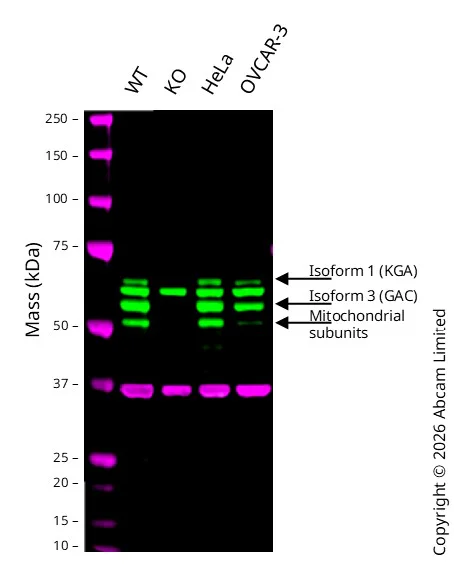
Western blot - Anti-Glutaminase antibody [EP7212] (AB156876)
Western blot : Anti-Glutaminase antibody [EP7212] ab156876 staining at 1/1000 dilution, shown in green; Mouse anti GAPDH ab8245 loading control staining at 1/20000 dilution, shown in magenta. Three specific bands are detected by ab156876. We believe these correspond to isoform 1 (KGA), isoform 3 (GAC) and the mature mitochondrial subunits. Bands were observed at 68, 60 and 55 kDa in Wild-type MCF7 cell lysates with no signal observed at this size in GLS knockout MCF7 cell line. To generate this image, samples were run on an SDS-PAGE gel then transferred onto a nitrocellulose membrane. Membranes were blocked in 5 % Milk in TBS-0.1 % Tween® 20 (TBS-T) before incubation with primary antibodies overnight at 4 °C. Blots were washed four times in TBS-T, incubated with secondary antibodies for 1 h at room temperature, washed again four times then imaged. Secondary antibodies used were Goat anti-Rabbit 800CW and Goat anti-Mouse 680RD at 1/20,000 dilution.
All lanes:
Western blot - Anti-Glutaminase antibody [EP7212] (ab156876) at 1/1000 dilution
Lane 1:
Wild-type MCF7 cell lysates at 20 µg
Lane 2:
Western blot - Human GLS knockout MCF7 cell line (<a href='/products/cell-lines/human-gls-knockout-mcf7-cell-line-ab287444'>ab287444</a>) at 20 µg
Lane 3:
HeLa cell lysates at 20 µg
Lane 4:
OVCAR-3 cell lysates at 20 µg
Secondary
All lanes:
Goat anti-Rabbit 800CW & Goat anti-Mouse 680RD at 1/20000 dilution
Predicted band size: 73 kDa
Observed band size: 68 kDa,60 kDa,55 kDa
false

- WB
Lab
Western blot - Anti-Glutaminase antibody [EP7212] (AB156876)
Lane 1 : Wild type HAP1 whole cell lysate (20 μg) Lane 2 : GLS knockout HAP1 whole cell lysate (20 μg) Lane 3 : HeLa whole cell lysate (20 μg) Lane 4 : HEK293 whole cell lysate (20 μg) Lanes 1 - 4 : Merged signal (red and green). Green - ab156876 observed at 62 kDa. Red - loading control, ab8245, observed at 37 kDa.
ab156876 was shown to recognize GLS in wild-type HAP1 cells as signal was lost at the expected MW in HAP1 knockout cells. Additional cross-reactive bands were observed in the wild-type and knockout cells. Wild-type and GLS knockout samples were subjected to SDS-PAGE. ab156876 and ab8245 (Mouse anti GAPDH loading control) were incubated overnight at 4°C at 1/1000 dilution and 1/10,000 dilution respectively. Blots were developed with Goat anti-Rabbit IgG H&L (IRDye® 800CW) preabsorbed (ab216773) and Goat anti-Mouse IgG H&L (IRDye® 680RD) preabsorbed (ab216776) secondary antibodies at 1/10,000 dilution for 1hr at room temperature before imaging.
Blue arrow corresponds to isoform 1 KGA.
Red arrow corresponds to isoform 3 GAC.
All lanes:
Western blot - Anti-Glutaminase antibody [EP7212] (ab156876)
Predicted band size: 73 kDa
false

- WB
Lab
Western blot - Anti-Glutaminase antibody [EP7212] (AB156876)
Blocking and diluting buffer and concentration : 5% NFDM/TBST.
All lanes:
Western blot - Anti-Glutaminase antibody [EP7212] (ab156876) at 1/1000 dilution
Lane 1:
HEK-293 (Human embryonic kidney epithelial cell) whole cell lysate at 20 µg
Lane 2:
HeLa (Human cervix adenocarcinoma epithelial cell) whole cell lysate at 20 µg
Secondary
All lanes:
Western blot - Goat Anti-Rabbit IgG H&L (HRP) (<a href='/products/secondary-antibodies/goat-rabbit-igg-h-l-hrp-ab97051'>ab97051</a>) at 1/20000 dilution
Predicted band size: 73 kDa
Observed band size: 65 kDa
true
Exposure time: 1s

- WB
Lab
Western blot - Anti-Glutaminase antibody [EP7212] (AB156876)
Blocking and diluting buffer and concentration : 5% NFDM/TBST.
All lanes:
Western blot - Anti-Glutaminase antibody [EP7212] (ab156876) at 1/1000 dilution
Lane 1:
Human kidney tissue lysate at 20 µg
Lane 2:
HeLa (Human cervix adenocarcinoma epithelial cell) whole cell lysate at 20 µg
Secondary
All lanes:
Western blot - Goat Anti-Rabbit IgG H&L (HRP) (<a href='/products/secondary-antibodies/goat-rabbit-igg-h-l-hrp-ab97051'>ab97051</a>) at 1/20000 dilution
Predicted band size: 73 kDa
Observed band size: 65 kDa
true
Exposure time: 1s
関連する標識済み抗体及び組成の異なる製品 (2)
-
Anti-Glutaminase antibody [EP7212] - BSA and Azide free
-
HRP Anti-Glutaminase antibody [EP7212]
代替製品

組合せ製品

Primary Antibodies
AB125066
Anti-Glutathione Peroxidase 4 antibody [EPNCIR144]
BOND RX™ Validated|KO Validated|RabMAb|Recombinant|Lab Essentials

- 5
- 13

Primary Antibodies
AB237704
Anti-SLC1A5/ASCT2 antibody [CAL33]
BOND RX™ Validated|20ul selling size|KO Validated|RabMAb|Recombinant

- 0
- 0
Primary Antibodies
AB16667
BOND RX™ Validated|KO Validated|RabMAb|Advanced Validation|Recombinant|20ul selling size

- 5
- 133
Reactivity data
製品の詳細
What is this antibody validated in?
Anti-Glutaminase antibody [EP7212] (ab156876) is a rabbit recombinant monoclonal antibody and is validated for use in Western Blot (WB) in Human samples.
What is the molecular weight of Glutaminase?
Anti-Glutaminase [EP7212] (ab156876) specifically detects a band for Glutaminase (UniProt: O94925) at a molecular weight of 73kDa.
Trusted by the scientific community
Anti-Glutaminase [EP7212] (ab156876) was first used in a scientific publication in 2013 and has been cited over 90 times in peer-reviewed journals.
Specificity confirmed
The specificity of Anti-Glutaminase antibody [EP7212] (ab156876) has been confirmed by Western blot testing in GLS Knockout HAP1 cells.
Other related products
We have a range of other formats of antibody clone [EP7212] also available for your convenience: ab156876, HRP - ab200408, Carrier free - ab214802
Patented technology
Our RabMAb® technology is a patented hybridoma-based technology for making rabbit monoclonal antibodies. For details on our patents, please refer to RabMAb® patents.
Trial sizes available!
Test your antibody or perform pre-screening before committing to a larger quantity. Sold in 20µl. Discover our selection of trial-size antibodies.
出荷温度及び保存条件
製品の状態
精製方法
バッファー組成
出荷温度
短期保存期間
短期保存温度
長期保存温度
分注に関する情報
保管に関する情報
補足情報
This supplementary information is collated from multiple sources and compiled automatically.
Biological function summary
Glutaminase plays a central role in cellular processes by facilitating the production of glutamate which is an important neurotransmitter in the brain and a precursor for the synthesis of gamma-aminobutyric acid (GABA). It is not part of a larger complex but acts independently in the mitochondrial matrix where it performs the glutaminase reaction. The activity of this enzyme is monitored closely because it affects multiple cellular functions and has implications in many diseases.
Pathways
Glutaminase is instrumental in the glutaminolysis and tricarboxylic acid (TCA) cycles. These pathways are essential for cellular energy production and biosynthesis. GLS1 activity influences other proteins such as alanine transaminase (ALT) and aspartate transaminase (AST) which also play roles in amino acid metabolism and energy production. Glutaminase inhibitors have been explored as potential therapeutic agents by disrupting the glutaminolysis pathway in cancer cells leading to decreased tumor growth.
製品プロトコール
- Visit the General protocols
- Visit the Troubleshooting
ターゲットの情報
文献 (120)
Recent publications for all applications. Explore the full list and refine your search
BMC musculoskeletal disorders 26:935 PubMed41063122
2025
Applications
Unspecified application
Species
Unspecified reactive species
Fundamental & clinical pharmacology 39:e70044 PubMed40784667
2025
Applications
Unspecified application
Species
Unspecified reactive species
Bioactive materials 52:63-72 PubMed40530412
2025
Applications
Unspecified application
Species
Unspecified reactive species
Research (Washington, D.C.) 8:0706 PubMed40405912
2025
Applications
Unspecified application
Species
Unspecified reactive species
Frontiers in immunology 16:1582587 PubMed40308578
2025
Applications
Unspecified application
Species
Unspecified reactive species
Acta biochimica et biophysica Sinica 57:1670-1683 PubMed40264416
2025
Applications
Unspecified application
Species
Unspecified reactive species
Brain sciences 15: PubMed40002461
2025
Applications
Unspecified application
Species
Unspecified reactive species
Alzheimer's & dementia : the journal of the Alzheimer's Association 21:e14504 PubMed39737731
2024
Applications
Unspecified application
Species
Unspecified reactive species
BMC infectious diseases 24:1171 PubMed39420255
2024
Applications
Unspecified application
Species
Unspecified reactive species
Nature communications 15:5620 PubMed38965208
2024
Applications
Unspecified application
Species
Unspecified reactive species
Abcam product promise
Please note: All products are 'FOR RESEARCH USE ONLY. NOT FOR USE IN DIAGNOSTIC OR THERAPEUTIC PROCEDURES'.
For licensing inquiries, please contact partnerships@abcam.com