JavaScript is disabled in your browser. Please enable JavaScript to view this website.
AB156001

Anti-GIT1 抗体 [EPR10367]

Anti-GIT1 antibody [EPR10367]

4

(1 Review)

|

(2 Publications)

Rabbit Recombinant Monoclonal GIT1 antibody. Suitable for WB, Flow Cyt (Intra) and reacts with Human samples. Cited in 2 publications.

別名を表示する

ARF GTPase-activating protein GIT1, ARF GAP GIT1, Cool-associated and tyrosine-phosphorylated protein 1, G protein-coupled receptor kinase-interactor 1, GRK-interacting protein 1, p95-APP1, CAT-1, CAT1, GIT1
3 Images
Flow Cytometry (Intracellular) - Anti-GIT1 antibody [EPR10367] (AB156001)
  • Flow Cyt (Intra)

Unknown

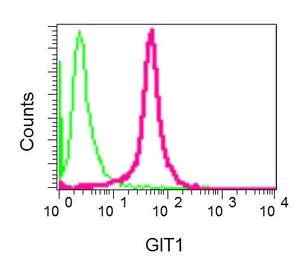
Flow Cytometry (Intracellular) - Anti-GIT1 antibody [EPR10367] (AB156001)

Intracellular flow cytometric analysis of permeabilized 293T cells labeling GIT1 with ab156001 at 1/100 dilution (red) compared to a rabbit IgG negative control (green).
Western blot - Anti-GIT1 antibody [EPR10367] (AB156001)
  • WB

Lab

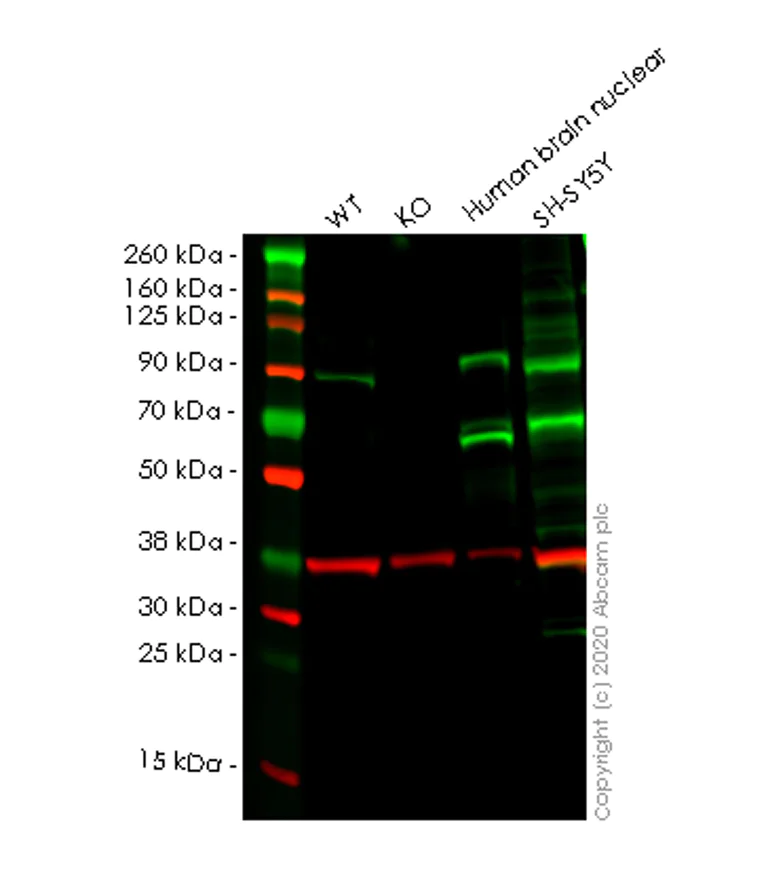
Western blot - Anti-GIT1 antibody [EPR10367] (AB156001)

Lanes 1-4 : Merged signal (red and green). Green - ab156001 observed at 98 kDa. Red - loading control ab8245 observed at 36 kDa.

ab156001 Anti-GIT1 antibody [EPR10367] was shown to specifically react with GIT1 in wild-type HeLa cells. Loss of signal was observed when knockout cell line ab265230 (knockout cell lysate ab257965) was used. Wild-type and GIT1 knockout samples were subjected to SDS-PAGE. ab156001 and Anti-GAPDH antibody [6C5] - Loading Control (ab8245) were incubated overnight at 4°C at 1 in 1000 dilution and 1 in 20000 dilution respectively. Blots were developed with Goat anti-Rabbit IgG H&L (IRDye® 800CW) preadsorbed (ab216773) and Goat anti-Mouse IgG H&L (IRDye® 680RD) preadsorbed (ab216776) secondary antibodies at 1 in 20000 dilution for 1 hour at room temperature before imaging.

All lanes:

Western blot - Anti-GIT1 antibody [EPR10367] (ab156001) at 1/1000 dilution

Lane 1:

Wild-type HeLa (Human epithelial cell line from cervix adenocarcinoma) whole cell lysate at 20 µg

Lane 2:

G1T1 knockout HeLa (Human epithelial cell line from cervix adenocarcinoma) whole cell lysate at 20 µg

Lane 2:

Western blot - Human GIT1 knockout HeLa cell line (<a href='/products/cell-lines/human-git1-knockout-hela-cell-line-ab265230'>ab265230</a>)

Lane 3:

Human brain tissue nuclear fraction lysate at 20 µg

Lane 4:

SH-SY5Y (Human neuroblastoma cell line from bone marrow) whole cell lysate at 20 µg

Secondary

All lanes:

Western blot - Goat anti-Rabbit IgG H&L (IRDye® 800CW) preadsorbed (<a href='/products/secondary-antibodies/goat-rabbit-igg-h-l-irdye-800cw-preadsorbed-ab216773'>ab216773</a>) at 1/10000 dilution

Predicted band size: 84 kDa

Observed band size: 98 kDa

false
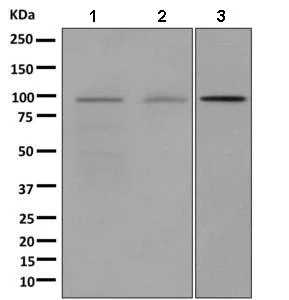
Western blot - Anti-GIT1 antibody [EPR10367] (AB156001)
  • WB

Unknown

Western blot - Anti-GIT1 antibody [EPR10367] (AB156001)

All lanes:

Western blot - Anti-GIT1 antibody [EPR10367] (ab156001) at 1/1000 dilution

Lane 1:

HeLa cell lysate at 10 µg

Lane 2:

293T cell lysate at 10 µg

Lane 3:

Fetal brain lysate at 10 µg

Secondary

All lanes:

HRP labelled goat anti-rabbit at 1/2000 dilution

Predicted band size: 84 kDa

false

関連する標識済み抗体及び組成の異なる製品 (1)

  • Carrier free

    Anti-GIT1 antibody [EPR10367] - BSA and Azide free

Key facts

宿主種

Rabbit

クローン性

Monoclonal

クローン番号

EPR10367

アイソタイプ

IgG

キャリアフリー

No

交差種

Human

アプリケーション

WB, Flow Cyt (Intra)

applications

免疫原

The exact immunogen used to generate this antibody is proprietary information.

Reactivity data

{ "title": "Reactivity Data", "filters": { "stats": ["", "Species", "Dilution Info", "Notes"], "tabs": { "all-applications": {"fullname" : "All Applications", "shortname": "All Applications"}, "ICCIF" : {"fullname" : "Immunocytochemistry/ Immunofluorescence", "shortname":"ICC/IF"}, "IP" : {"fullname" : "Immunoprecipitation", "shortname":"IP"}, "WB" : {"fullname" : "Western blot", "shortname":"WB"}, "IHCP" : {"fullname" : "Immunohistochemistry (Formalin/PFA-fixed paraffin-embedded sections)", "shortname":"IHC-P"}, "FlowCytIntra" : {"fullname" : "Flow Cytometry (Intracellular)", "shortname":"Flow Cyt (Intra)"} }, "product-promise": { "all": "all", "testedAndGuaranteed": "tested", "guaranteed": "expected", "predicted": "predicted", "notRecommended": "not-recommended" } }, "values": { "Human": { "ICCIF-species-checked": "notRecommended", "ICCIF-species-dilution-info": "", "ICCIF-species-notes": "<p></p>", "IP-species-checked": "notRecommended", "IP-species-dilution-info": "", "IP-species-notes": "<p></p>", "WB-species-checked": "testedAndGuaranteed", "WB-species-dilution-info": "1/1000 - 1/10000", "WB-species-notes": "<p></p>", "IHCP-species-checked": "notRecommended", "IHCP-species-dilution-info": "", "IHCP-species-notes": "<p></p>", "FlowCytIntra-species-checked": "testedAndGuaranteed", "FlowCytIntra-species-dilution-info": "1/100 - 1/500", "FlowCytIntra-species-notes": "<p><a href='/products/primary-antibodies/rabbit-igg-monoclonal-epr25a-isotype-control-ab172730'>ab172730</a> - Rabbit monoclonal IgG, is suitable for use as an isotype control with this antibody.</p>" }, "Mouse": { "ICCIF-species-checked": "notRecommended", "ICCIF-species-dilution-info": "", "ICCIF-species-notes": "", "IP-species-checked": "notRecommended", "IP-species-dilution-info": "", "IP-species-notes": "", "WB-species-checked": "predicted", "WB-species-dilution-info": "", "WB-species-notes": "", "IHCP-species-checked": "notRecommended", "IHCP-species-dilution-info": "", "IHCP-species-notes": "", "FlowCytIntra-species-checked": "predicted", "FlowCytIntra-species-dilution-info": "", "FlowCytIntra-species-notes": "" }, "Rat": { "ICCIF-species-checked": "notRecommended", "ICCIF-species-dilution-info": "", "ICCIF-species-notes": "", "IP-species-checked": "notRecommended", "IP-species-dilution-info": "", "IP-species-notes": "", "WB-species-checked": "predicted", "WB-species-dilution-info": "", "WB-species-notes": "", "IHCP-species-checked": "notRecommended", "IHCP-species-dilution-info": "", "IHCP-species-notes": "", "FlowCytIntra-species-checked": "predicted", "FlowCytIntra-species-dilution-info": "", "FlowCytIntra-species-notes": "" } } }

製品の詳細

Patented technology
Our RabMAb® technology is a patented hybridoma-based technology for making rabbit monoclonal antibodies. For details on our patents, please refer to RabMAb® patents.

What are the advantages of a recombinant monoclonal antibody?
This product is a recombinant monoclonal antibody, which offers several advantages including:

  • - High batch-to-batch consistency and reproducibility
  • - Improved sensitivity and specificity
  • - Long-term security of supply
  • - Animal-free batch production

For more information, read more on recombinant antibodies.

出荷温度及び保存条件

製品の状態
Liquid
精製方法
Affinity purification Protein A
バッファー組成
pH: 7.2 - 7.4 Preservative: 0.01% Sodium azide Constituents: PBS, 40% Glycerol (glycerin, glycerine), 0.05% BSA
出荷温度
Conditional Ambient
短期保存温度
+4°C
長期保存温度
-20°C

補足情報

This supplementary information is collated from multiple sources and compiled automatically.

GIT1 also known as G protein-coupled receptor kinase interacting protein 1 is a multi-domain protein with a mass of approximately 90 kDa. It plays a central role in cellular signaling processes. GIT1 contains a GTPase-activating protein (GAP) domain and a number of other domains that interact with protein partners. This protein is expressed ubiquitously in various tissues with higher expression levels in the brain and heart. Its presence in different cell types indicates its involvement in numerous cellular functions.
Biological function summary

GIT1 interacts with several proteins to form multi-protein complexes essential for cellular dynamics. It functions in regulating the actin cytoskeleton impacting cell adhesion migration and membrane trafficking. GIT1 participates in the reorganization of the cytoskeleton by activating small GTPases which are important for these processes. Additionally it interacts with paxillin and ARF GTPases further playing a role in focal adhesion signaling.

Pathways

GIT1 serves an important role in the ERK and JNK signaling pathways. It acts as a scaffolding protein facilitating the assembly of signaling complexes that promote the transfer of signals from the membrane to the nucleus. GIT1 modulates the activity of proteins such as MEK1/2 and paxillin which ultimately regulate cellular responses like proliferation and differentiation. This function positions GIT1 at an important junction of pathways controlling cellular architecture and stress responses.

GIT1 has been linked to cardiovascular diseases and neurological disorders. Dysregulation of GIT1 and its associated pathways can lead to pathological changes in the heart contributing to conditions such as cardiac hypertrophy. In the nervous system altered GIT1 activity can affect synaptic functions associated with disorders like schizophrenia. In these contexts interactions between GIT1 and other proteins such as beta-arrestins become significant impacting disease progression and therapeutic targeting.

製品プロトコール

For this product, it's our understanding that no specific protocols are required. You can visit:

ターゲットの情報

GTPase-activating protein for ADP ribosylation factor family members, including ARF1. Multidomain scaffold protein that interacts with numerous proteins and therefore participates in many cellular functions, including receptor internalization, focal adhesion remodeling, and signaling by both G protein-coupled receptors and tyrosine kinase receptors (By similarity). Through PAK1 activation, positively regulates microtubule nucleation during interphase (PubMed : 27012601). Plays a role in the regulation of cytokinesis; for this function, may act in a pathway also involving ENTR1 and PTPN13 (PubMed : 23108400). May promote cell motility both by regulating focal complex dynamics and by local activation of RAC1 (PubMed : 10938112, PubMed : 11896197). May act as scaffold for MAPK1/3 signal transduction in focal adhesions. Recruits MAPK1/3/ERK1/2 to focal adhesions after EGF stimulation via a Src-dependent pathway, hence stimulating cell migration (PubMed : 15923189). Plays a role in brain development and function. Involved in the regulation of spine density and synaptic plasticity that is required for processes involved in learning (By similarity). Plays an important role in dendritic spine morphogenesis and synapse formation (PubMed : 12695502, PubMed : 15800193). In hippocampal neurons, recruits guanine nucleotide exchange factors (GEFs), such as ARHGEF7/beta-PIX, to the synaptic membrane. These in turn locally activate RAC1, which is an essential step for spine morphogenesis and synapse formation (PubMed : 12695502). May contribute to the organization of presynaptic active zones through oligomerization and formation of a Piccolo/PCLO-based protein network, which includes ARHGEF7/beta-PIX and FAK1 (By similarity). In neurons, through its interaction with liprin-alpha family members, may be required for AMPA receptor (GRIA2/3) proper targeting to the cell membrane (By similarity). In complex with GABA(A) receptors and ARHGEF7, plays a crucial role in regulating GABA(A) receptor synaptic stability, maintaining GPHN/gephyrin scaffolds and hence GABAergic inhibitory synaptic transmission, by locally coordinating RAC1 and PAK1 downstream effector activity, leading to F-actin stabilization (PubMed : 25284783). May also be important for RAC1 downstream signaling pathway through PAK3 and regulation of neuronal inhibitory transmission at presynaptic input (By similarity). Required for successful bone regeneration during fracture healing (By similarity). The function in intramembranous ossification may, at least partly, exerted by macrophages in which GIT1 is a key negative regulator of redox homeostasis, IL1B production, and glycolysis, acting through the ERK1/2/NRF2/NFE2L2 axis (By similarity). May play a role in angiogenesis during fracture healing (By similarity). In this process, may regulate activation of the canonical NF-kappa-B signal in bone mesenchymal stem cells by enhancing the interaction between NEMO and 'Lys-63'-ubiquitinated RIPK1/RIP1, eventually leading to enhanced production of VEGFA and others angiogenic factors (PubMed : 31502302). Essential for VEGF signaling through the activation of phospholipase C-gamma and ERK1/2, hence may control endothelial cell proliferation and angiogenesis (PubMed : 19273721).
See full target information GIT1

文献 (2)

Recent publications for all applications. Explore the full list and refine your search

The International journal of biological markers 36:36-46 PubMed33752480

2021

Exosomal miR-122-5p inhibits tumorigenicity of gastric cancer by downregulating .

Applications

Unspecified application

Species

Unspecified reactive species

Yigang Jiao,Li Zhang,Jun Li,Yuqi He,Xin Zhang,Jingzhe Li

Journal of immunology (Baltimore, Md. : 1950) 194:4099-111 PubMed25821222

2015

Microtubule nucleation in mouse bone marrow-derived mast cells is regulated by the concerted action of GIT1/βPIX proteins and calcium.

Applications

Unspecified application

Species

Unspecified reactive species

Vadym Sulimenko,Zuzana Hájková,Markéta Černohorská,Tetyana Sulimenko,Vladimíra Sládková,Lubica Dráberová,Stanislav Vinopal,Eduarda Dráberová,Pavel Dráber
View all publications

Abcam product promise

当社は、高品質な試薬を通じてお客様の研究を力強くサポートすることをお約束いたします。ご使用いただく各段階で、常にお客様をサポートできる体制を整えております。万が一、製品が期待通りに機能しない場合は、「Abcam Product Promise」による当社保証制度に基づき、安心してご利用いただけます。
保証に関する詳細については利用規約をご確認ください。

Please note: All products are 'FOR RESEARCH USE ONLY. NOT FOR USE IN DIAGNOSTIC OR THERAPEUTIC PROCEDURES'.

For licensing inquiries, please contact partnerships@abcam.com