Anti-G-protein coupled receptor 30 抗体
Anti-G-protein coupled receptor 30 antibody
3
(11 Reviews)
|
(121 Publications)
Anti-G-protein coupled receptor 30 antibody (ab39742) is a rabbit polyclonal antibody detecting G-protein coupled receptor 30 in Western Blot. Suitable for Human.
- Over 100 publications
- Trusted since 2008
別名を表示する
CEPR, CMKRL2, DRY12, GPER, GPR30, GPER1, G-protein coupled estrogen receptor 1, Chemoattractant receptor-like 2, Flow-induced endothelial G-protein coupled receptor 1, G protein-coupled estrogen receptor 1, G-protein coupled receptor 30, GPCR-Br, IL8-related receptor DRY12, Lymphocyte-derived G-protein coupled receptor, Membrane estrogen receptor, FEG-1, LYGPR, mER

- WB
Project
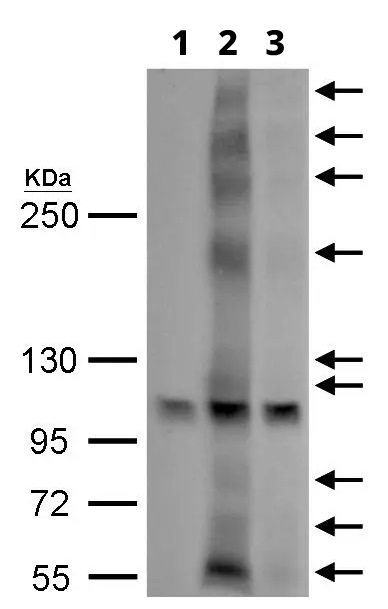
Western blot - Anti-G-protein coupled receptor 30 antibody (AB39742)
GPR30 contains a number of potential glycosylation sites (SwissProt) which may explain its migration at a higher molecular weight than predicted.
All lanes:
Western blot - Anti-G-protein coupled receptor 30 antibody (ab39742) at 1 µg/mL
All lanes:
Human brain normal tissue lysate - membrane extract (<a href='/products/unavailable/human-brain-normal-tissue-lysate-membrane-extract-ab29456'>ab29456</a>) at 10 µg
Secondary
All lanes:
Goat polyclonal to Rabbit IgG - H&L - Pre-Adsorbed (HRP) at 1/3000 dilution
Predicted band size: 42 kDa
Observed band size: 55 kDa
true

- ICC
Unknown
Immunocytochemistry - Anti-G-protein coupled receptor 30 antibody (AB39742)
ICC/IF image of ab39742 stained U87-MG cells. The cells were 4% formaldehyde fixed (10 min) and then incubated in 1%BSA / 10% normal goat serum / 0.3M glycine in 0.1% PBS-Tween for 1h to permeabilise the cells and block non-specific protein-protein interactions. The cells were then incubated with the antibody ab39742 at 5μg/ml overnight at +4°C. The secondary antibody (green) was DyLight® 488 goat anti- rabbit (ab96899) IgG (H+L) used at a 1/1000 dilution for 1h. Alexa Fluor® 594 WGA was used to label plasma membranes (red) at a 1/200 dilution for 1h. DAPI was used to stain the cell nuclei (blue) at a concentration of 1.43μM.

- ICC
AbReview28171****
Immunocytochemistry - Anti-G-protein coupled receptor 30 antibody (AB39742)
ab39742 staining cultured rat primary astrocytes by ICC/IF. The cultured cells were fixed with 4% paraformaldehyde for 5 minutes and blocked with 10% donkey serum in 0.1% PBS-0.3% TritonX for 30 minutes at 24°C. The cultured cells were then stained with ab39742 at 1/500 in 0.3% TritonX with 0.1% PBS and 10% donkey serum for 4h at 24°C. An Alexa Fluro 488 donkey anti-rabbit polyclonal antibody at 1/1000 was used as the secondary antibody. Nuclei were stained with 1.43μM Hoechst and can be observed in blue. In red astrocytes can be observed (monoclonal anti GFAP).
This image is courtesy of an Abreview submitted by Ruma Raha-Chowdhury

- ICC
Lab
Immunocytochemistry - Anti-G-protein coupled receptor 30 antibody (AB39742)
ab39742 staining G-protein coupled receptor 30 in primary rat neurons/glia, DIV14 (prepared from E18 rat hippocampal brain area, obtained from Transnetyx Tissue by BrainBits, LLC, cat.no. SDHEP) cells. The cells were fixed with 100% methanol (5 min), permeabilized with 0.1% PBS-Tween for 5 minutes and then blocked with 1% BSA/10% normal goat serum/0.3M glycine in 0.1%PBS-Tween for 1h. The cells were then incubated overnight at 4°C with ab39742 at 1µg/ml and ab7291, Mouse monoclonal [DM1A] to alpha Tubulin - Loading Control. Cells were then incubated with ab150081, Goat polyclonal Secondary Antibody to Rabbit IgG - H&L (Alexa Fluor® 488), pre-adsorbed at 1/1000 dilution (shown in green) and ab150120, Goat polyclonal Secondary Antibody to Mouse IgG - H&L (Alexa Fluor® 594), pre-adsorbed at 1/1000 dilution (shown in pseudocolour red). Nuclear DNA was labelled with DAPI (shown in blue).
Also suitable in cells fixed with 4% paraformaldehyde (10 min).
Image was acquired with a high-content analyser (Operetta CLS, Perkin Elmer) and a maximum intensity projection of confocal sections is shown.
代替製品
Primary Antibodies
AB260033
Anti-G-protein coupled receptor 30 antibody [EPR23701-79]
BOND RX™ Validated|RabMAb|Recombinant|20ul selling size

- 5
- 1


組合せ製品
Primary Antibodies
AB32063
Anti-Estrogen Receptor alpha antibody [E115] - ChIP Grade
BOND RX™ Validated|RabMAb|Recombinant|KO Validated|Lab Essentials|Advanced Validation|20ul selling size

- 4
- 21

Primary Antibodies
AB181602
Anti-GAPDH antibody [EPR16891] - Loading Control
RabMAb|Recombinant|Lab Essentials|20ul selling size

- 5
- 23

Reactivity data
製品の詳細
Anti-G-protein coupled receptor 30 antibody (ab39742) is a rabbit polyclonal antibody and is validated for use in Western Blot (WB) in Human samples.
What is the molecular weight of G-protein coupled receptor 30?
Anti-G-protein coupled receptor 30 (ab39742) specifically detects a band for G-protein coupled receptor 30 (UniProt: Q99527) at a molecular weight of 42kDa.
Trusted by the scientific community
Anti-G-protein coupled receptor 30 (ab39742) was first used in a scientific publication in 2008 and has been cited over 100 times in peer-reviewed journals.
Reviewed by scientists
Anti-G-protein coupled receptor 30 (ab39742) has over 10 independent reviews from customers.
出荷温度及び保存条件
製品の状態
精製方法
バッファー組成
出荷温度
短期保存期間
短期保存温度
長期保存温度
分注に関する情報
保管に関する情報
製品プロトコール
- Visit the General protocols
- Visit the Troubleshooting
ターゲットの情報
文献 (121)
Recent publications for all applications. Explore the full list and refine your search
The Journal of biological chemistry 301:108312 PubMed39955059
2025
Applications
Unspecified application
Species
Unspecified reactive species
Journal of biochemical and molecular toxicology 39:e70129 PubMed39878097
2025
Applications
Unspecified application
Species
Unspecified reactive species
JBMR plus 8:ziae041 PubMed38644978
2024
Applications
Unspecified application
Species
Unspecified reactive species
iScience 27:109125 PubMed38420594
2024
Applications
Unspecified application
Species
Unspecified reactive species
Journal of neurochemistry 168:2423-2442 PubMed37924265
2023
Applications
Unspecified application
Species
Unspecified reactive species
The Journal of clinical investigation 133: PubMed37712419
2023
Applications
Unspecified application
Species
Unspecified reactive species
Current issues in molecular biology 45:7336-7351 PubMed37754248
2023
Applications
Unspecified application
Species
Unspecified reactive species
Anatomia, histologia, embryologia 52:1016-1028 PubMed37661709
2023
Applications
Unspecified application
Species
Unspecified reactive species
Immunity, inflammation and disease 11:e940 PubMed37506161
2023
Applications
Unspecified application
Species
Unspecified reactive species
Phytotherapy research : PTR 37:4706-4721 PubMed37421324
2023
Applications
Unspecified application
Species
Unspecified reactive species
Abcam product promise
Please note: All products are 'FOR RESEARCH USE ONLY. NOT FOR USE IN DIAGNOSTIC OR THERAPEUTIC PROCEDURES'.
For licensing inquiries, please contact partnerships@abcam.com