JavaScript is disabled in your browser. Please enable JavaScript to view this website.
AB68950

FITC Anti-Staphylococcus aureus 抗体

FITC Anti-Staphylococcus aureus antibody

Be the first to review this product! Submit a review

|

(7 Publications)

Anti-Staphylococcus aureus antibody conjugated to FITC is a rabbit polyclonal antibody suitable for ICC/IF, IHC-Fr.

別名を表示する

IgG binding protein A, Immunoglobulin G binding protein A

Key facts

宿主種

Rabbit

クローン性

Polyclonal

アイソタイプ

IgG

標識

FITC

励起波長/蛍光波長

Ex: 495nm, Em: 519nm

キャリアフリー

No

交差種

Staphylococcus aureus

アプリケーション

ICC/IF, IHC-Fr

applications

免疫原

The exact immunogen used to generate this antibody is proprietary information.

Reactivity data

{ "title": "Reactivity Data", "filters": { "stats": ["", "Species", "Dilution Info", "Notes"], "tabs": { "all-applications": {"fullname" : "All Applications", "shortname": "All Applications"}, "ICCIF" : {"fullname" : "Immunocytochemistry/ Immunofluorescence", "shortname":"ICC/IF"}, "IHCFr" : {"fullname" : "Immunohistochemistry (Frozen sections)", "shortname":"IHC-Fr"} }, "product-promise": { "all": "all", "testedAndGuaranteed": "tested", "guaranteed": "expected", "predicted": "predicted", "notRecommended": "not-recommended" } }, "values": { "Staphylococcus aureus": { "ICCIF-species-checked": "guaranteed", "ICCIF-species-dilution-info": "", "ICCIF-species-notes": "<p></p>", "IHCFr-species-checked": "guaranteed", "IHCFr-species-dilution-info": "", "IHCFr-species-notes": "<p></p>" } } }

製品の詳細

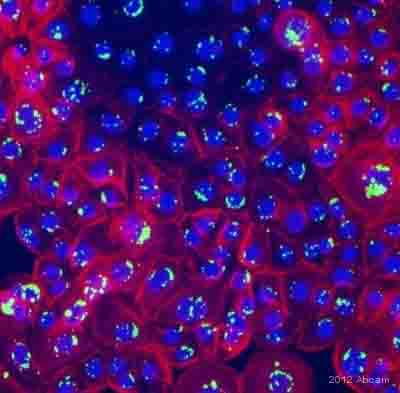
This antibody reacts with Staphylococcus aureus in bacterial and infected tissue samples.

出荷温度及び保存条件

製品の状態
Liquid
精製方法
Proprietary technique
バッファー組成
pH: 7.2 Preservative: 0.1% Sodium azide Constituents: PBS, 1% BSA
出荷温度
Blue Ice
短期保存温度
+4°C
長期保存温度
+4°C

補足情報

This supplementary information is collated from multiple sources and compiled automatically.

Staphylococcus aureus also known as "aureus" or "staph" is a gram-positive bacterium with a molecular mass ranging around 2.8 million daltons. It is found mainly in the nasal passages and on the skin of humans. This bacterium has a thick peptidoglycan layer making it resistant to certain environmental pressures. The structure of its proteins like Protein A plays an important role in immune evasion. Staphylococcus aureus also expresses a variety of toxins and enzymes that aid in its survival and pathogenicity.
Biological function summary

Staphylococcus aureus acts as an opportunistic pathogen that can cause infections when the host's immune system is weakened. It is not part of a specific protein complex but utilizes a range of virulence factors to establish infections. The bacterium produces biofilms which provide a protective environment against host defenses and antimicrobial agents. Its ability to quickly adapt to different environments makes it a major cause of both nosocomial and community-acquired infections.

Pathways

The metabolic activities of Staphylococcus aureus are involved in two significant pathways: the peptidoglycan biosynthesis and the toxin production pathway. Peptidoglycan biosynthesis is essential for cell wall integrity while toxin production pathways lead to the synthesis of critical virulence factors like alpha-hemolysin. Key proteins involved in these pathways include PBP2a which is significant for methicillin resistance and hemolysins that damage host tissues.

Staphylococcus aureus is connected to skin infections and pneumonia. The bacterium is notorious for causing conditions such as MRSA (methicillin-resistant Staphylococcus aureus) infections which are challenging to treat due to antibiotic resistance. Protein A interaction with the Fc region of immunoglobulin contributes to the evasion of immune responses and chronic infection persistence. These properties make staph infections a significant concern in both hospital and community settings.

製品プロトコール

For this product, it's our understanding that no specific protocols are required. You can visit:

文献 (7)

Recent publications for all applications. Explore the full list and refine your search

BMC microbiology 25:12 PubMed39799329

2025

Phagocytosis by macrophages decreases the radiance of bioluminescent Staphylococcus aureus.

Applications

Unspecified application

Species

Unspecified reactive species

Elles C Boonstra,Liliana Agresti,Henny C van der Mei,Paul C Jutte,Jelmer Sjollema

Regenerative biomaterials 10:rbad046 PubMed37287896

2023

A multifunctional nanocomposite hydrogel with controllable release behavior enhances bone regeneration.

Applications

Unspecified application

Species

Unspecified reactive species

Yingji Mao,Yiwen Zhang,Ying Wang,Tao Zhou,Bingxu Ma,Pinghui Zhou

PloS one 15:e0231276 PubMed32275737

2020

Boron doped silver-copper alloy nanoparticle targeting intracellular S. aureus in bone cells.

Applications

Unspecified application

Species

Unspecified reactive species

Tahir Abdulrehman,Shahnaz Qadri,Sini Skariah,Ali Sultan,Said Mansour,Jamil Azzi,Yousef Haik

Immunology 157:122-136 PubMed30773630

2019

Daily variation in macrophage phagocytosis is clock-independent and dispensable for cytokine production.

Applications

Unspecified application

Species

Unspecified reactive species

Sarah S Geiger,Annie M Curtis,Luke A J O'Neill,Richard M Siegel

Allergy 74:560-571 PubMed30269350

2018

Staphylococcus aureus from atopic dermatitis skin accumulates in the lysosomes of keratinocytes with induction of IL-1α secretion via TLR9.

Applications

Unspecified application

Species

Unspecified reactive species

Masaya Moriwaki,Kazumasa Iwamoto,Yoshie Niitsu,Ayako Matsushima,Yuhki Yanase,Junzo Hisatsune,Motoyuki Sugai,Michihiro Hide

Wound repair and regeneration : official publication of the Wound Healing Society [and] the European Tissue Repair Society 24:657-68 PubMed27238250

2016

Ciprofloxacin-loaded keratin hydrogels reduce infection and support healing in a porcine partial-thickness thermal burn.

Applications

Unspecified application

Species

Unspecified reactive species

Daniel C Roy,Seth Tomblyn,Kameel M Isaac,Christine J Kowalczewski,David M Burmeister,Luke R Burnett,Robert J Christy

BMC research notes 9:216 PubMed27071769

2016

An optimized staining technique for the detection of Gram positive and Gram negative bacteria within tissue.

Applications

Unspecified application

Species

Unspecified reactive species

Sandra C Becerra,Daniel C Roy,Carlos J Sanchez,Robert J Christy,David M Burmeister
View all publications

Abcam product promise

当社は、高品質な試薬を通じてお客様の研究を力強くサポートすることをお約束いたします。ご使用いただく各段階で、常にお客様をサポートできる体制を整えております。万が一、製品が期待通りに機能しない場合は、「Abcam Product Promise」による当社保証制度に基づき、安心してご利用いただけます。
保証に関する詳細については利用規約をご確認ください。

Please note: All products are 'FOR RESEARCH USE ONLY. NOT FOR USE IN DIAGNOSTIC OR THERAPEUTIC PROCEDURES'.

For licensing inquiries, please contact partnerships@abcam.com