JavaScript is disabled in your browser. Please enable JavaScript to view this website.
AB233455

FITC Anti-Bone marrow stromal cell antigen 1 抗体 [SY11B5]

FITC Anti-Bone marrow stromal cell antigen 1 antibody [SY11B5]

Be the first to review this product! Submit a review

|

(3 Publications)

Anti-Bone marrow stromal cell antigen 1 antibody [SY11B5] conjugated to FITC - suitable for flow cytometry, and reacts with human samples. Clone [SY11B5] is a mouse monoclonal antibody cited in 2 publications.

Design your panel with our interactive flow cytometry panel builder. Click here.

別名を表示する

CD157, ADP-ribosyl cyclase/cyclic ADP-ribose hydrolase 2, ADP-ribosyl cyclase 2, Bone marrow stromal cell antigen 1, Cyclic ADP-ribose hydrolase 2, BST-1, cADPR hydrolase 2, BST1
1 Images
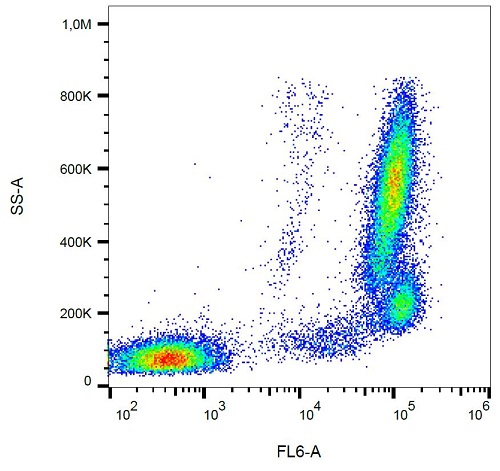
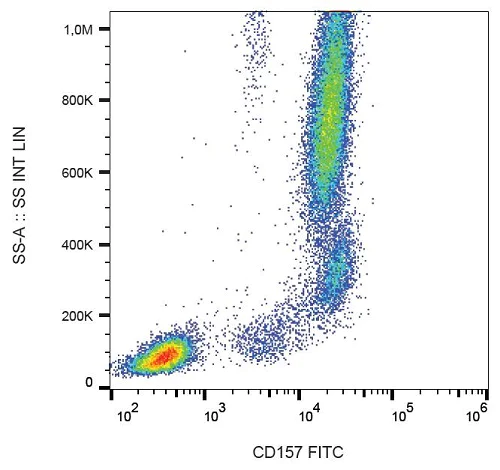
Flow Cytometry - FITC Anti-Bone marrow stromal cell antigen 1 antibody [SY11B5] (AB233455)
  • Flow Cyt

Supplier Data

Flow Cytometry - FITC Anti-Bone marrow stromal cell antigen 1 antibody [SY11B5] (AB233455)

Surface staining of human peripheral blood leukocytes with ab233455. Gated on leukocytes.

関連する標識済み抗体及び組成の異なる製品 (1)

  • Unconjugated

    Anti-Bone marrow stromal cell antigen 1 antibody [SY11B5]

Key facts

宿主種

Mouse

クローン性

Monoclonal

クローン番号

SY11B5

アイソタイプ

IgG1

標識

FITC

励起波長/蛍光波長

Ex: 495nm, Em: 519nm

キャリアフリー

No

交差種

Human, Primates

アプリケーション

Flow Cyt

applications

免疫原

Full Length Protein corresponding to Human BST1. The exact immunogen used to generate this antibody is proprietary information.

Q10588

エピトープ

extracellular

Reactivity data

{ "title": "Reactivity Data", "filters": { "stats": ["", "Species", "Dilution Info", "Notes"], "tabs": { "all-applications": {"fullname" : "All Applications", "shortname": "All Applications"}, "FlowCyt" : {"fullname" : "Flow Cytometry", "shortname":"Flow Cyt"} }, "product-promise": { "all": "all", "testedAndGuaranteed": "tested", "guaranteed": "expected", "predicted": "predicted", "notRecommended": "not-recommended" } }, "values": { "Human": { "FlowCyt-species-checked": "testedAndGuaranteed", "FlowCyt-species-dilution-info": "4 µL for 10^6 Cells", "FlowCyt-species-notes": "<p></p>" }, "Primates": { "FlowCyt-species-checked": "guaranteed", "FlowCyt-species-dilution-info": "4 µL for 10^6 Cells", "FlowCyt-species-notes": "<p></p>" } } }

出荷温度及び保存条件

製品の状態
Liquid
精製方法
Size-exclusion chromatography
バッファー組成
pH: 7.4 Preservative: 0.0975% Sodium azide Constituents: PBS
出荷温度
Blue Ice
短期保存温度
+4°C
長期保存温度
+4°C
保管に関する情報
Store in the dark

補足情報

This supplementary information is collated from multiple sources and compiled automatically.

Bone marrow stromal cell antigen 1 (BST-1) also known as CD157 is a glycosylphosphatidylinositol-anchored protein with a molecular weight of approximately 38-42 kDa. You find BST-1 expression on the surface of various cell types especially within bone marrow stromal cells and cells of the immune system such as monocytes and macrophages. This protein functions as an ecto-enzyme with ADP-ribosyl cyclase activity and is part of the NADase enzyme family. Its mechanical role involves metabolizing extracellular NAD+ influencing cellular calcium signaling and energy metabolism.
Biological function summary

BST-1 contributes to the regulation of cellular interactions and immune responses. It participates in the organization of leukocyte trafficking and the formation of signal transduction cascades. BST-1 operates as a single protein but interacts with other membrane proteins to coordinate cellular communication. You can observe its function in processes like cell adhesion and migration impacting the immune surveillance and response systems.

Pathways

BST-1 plays a role in immune signaling and calcium-signaling pathways. In the immune system pathway it associates with molecules such as integrins to modulate leukocyte adhesion and transmigration. The calcium-signaling pathway is another key area where BST-1 interacts with intracellular proteins influencing various cellular targets and affecting metabolic processes critical for cell survival and proliferation.

Scientists have linked BST-1 to various conditions such as leukemia and chronic inflammation. Its expression levels often change in these diseases emphasizing its potential role in their progression. Researchers also explore the connection between BST-1 and other proteins like CD38 in the context of leukemia where both proteins might participate in cancer cell proliferation and survival. Understanding BST-1 in disease contexts provides insights into disease mechanisms and potential therapeutic strategies.

製品プロトコール

For this product, it's our understanding that no specific protocols are required. You can visit:

ターゲットの情報

Catalyzes both the synthesis of cyclic ADP-beta-D-ribose (cADPR) from NAD(+), and its hydrolysis to ADP-D-ribose (ADPR) (PubMed : 7805847). Cyclic ADPR is known to serve as an endogenous second messenger that elicits calcium release from intracellular stores, and thus regulates the mobilization of intracellular calcium (Probable). May be involved in pre-B-cell growth (Probable).
See full target information BST1

文献 (3)

Recent publications for all applications. Explore the full list and refine your search

Journal of periodontal research 58:1235-1247 PubMed37712743

2023

Long non-coding RNA X-Inactive Specific Transcript (XIST) interacting with USF2 promotes osteogenic differentiation of periodontal ligament stem cells through regulation of WDR72 transcription.

Applications

Unspecified application

Species

Unspecified reactive species

Ke Xu,Ya-Dong Li,Liu-Yang Ren,Hai-Long Song,Qiao-Yun Yang,Dong-Liang Xu

World journal of clinical cases 9:2181-2191 PubMed33869594

2021

Iguratimod promotes transformation of mononuclear macrophages in elderly patients with rheumatoid arthritis by nuclear factor-κB pathway.

Applications

Unspecified application

Species

Unspecified reactive species

Sha Liu,Li-Ping Song,Rong-Bin Li,Le-Heng Feng,Hui Zhu

Archives of oral biology 117:104814 PubMed32574885

2020

Long noncoding RNA TUG1 promotes osteogenic differentiation of human periodontal ligament stem cell through sponging microRNA-222-3p to negatively regulate Smad2/7.

Applications

Unspecified application

Species

Unspecified reactive species

Di Wu,Lin Yin,Degang Sun,Fang Wang,Qishan Wu,Qian Xu,Bingchang Xin
View all publications

Abcam product promise

当社は、高品質な試薬を通じてお客様の研究を力強くサポートすることをお約束いたします。ご使用いただく各段階で、常にお客様をサポートできる体制を整えております。万が一、製品が期待通りに機能しない場合は、「Abcam Product Promise」による当社保証制度に基づき、安心してご利用いただけます。
保証に関する詳細については利用規約をご確認ください。

Please note: All products are 'FOR RESEARCH USE ONLY. NOT FOR USE IN DIAGNOSTIC OR THERAPEUTIC PROCEDURES'.

For licensing inquiries, please contact partnerships@abcam.com