Anti-FACL4 抗体 [EPR17587]
Anti-FACL4 antibody [EPR17587]
- RabMAb
- Recombinant
- 20ul selling size
- KO Validated
- 詳細を見る
Be the first to review this product! Submit a review
|
(6 Publications)
Rabbit Recombinant Monoclonal FACL4 antibody. Suitable for WB, ICC/IF, IHC-P and reacts with Human samples. Cited in 6 publications.
別名を表示する
ACS4, FACL4, LACS4, ACSL4, Long-chain-fatty-acid--CoA ligase 4, Arachidonate--CoA ligase, Long-chain acyl-CoA synthetase 4, LACS 4

- ICC/IF
Supplier Data
Immunocytochemistry/ Immunofluorescence - Anti-FACL4 antibody [EPR17587] (AB205197)
Immunofluorescent analysis of 4% paraformaldehyde-fixed 0.1% Triton X-100 permeabilized HepG2 (Human liver hepatocellular carcinoma) cells labeling FACL4 with ab205197 at 1/50 dilution followed by Goat anti-rabbit IgG (Alexa Fluor® 488) (ab150077) secondary antibody at 1/1000 dilution (green). Confocal image showing cytoplasmic staining on HepG2 cell line. The nuclear counter stain is DAPI (blue). Tubulin is detected with ab7291 (anti-Tubulin mouse mAb) at 1/1000 dilution and ab150120 (AlexaFluor®594 Goat anti-Mouse secondary) at 1/1000 dilution (red).
The negative controls are as follows :
-ve control 1 : ab205197 at 1/50 dilution followed by ab150120 (AlexaFluor®594 Goat anti-Mouse secondary) at 1/1000 dilution.
-ve control 2 : ab7291 (anti-Tubulin mouse mAb) at 1/1000 dilution followed by ab150077 (Alexa Fluor®488 Goat Anti-Rabbit IgG H&L) at 1/1000 dilution.

- IHC-P
Supplier Data
Immunohistochemistry (Formalin/PFA-fixed paraffin-embedded sections) - Anti-FACL4 antibody [EPR17587] (AB205197)
Immunohistochemical analysis of paraffin-embedded Human liver carcinoma tissue labeling FACL4 with ab205197 at 1/250 dilution followed by Goat Anti-Rabbit IgG H&L (HRP) (ab97051) at 1/500 dilution. Cytoplasmic staining on Human hepatocellular carcinoma tissue is observed. Counter stained with Hematoxylin.
Secondary antibody only control : Used PBS instead of primary antibody secondary antibody is Goat Anti-Rabbit IgG H&L (HRP) (ab97051) at 1/500 dilution.
Perform heat mediated antigen retrieval with Tris/EDTA buffer pH 9.0 before commencing with IHC staining protocol.

- ICC/IF
Supplier Data
Immunocytochemistry/ Immunofluorescence - Anti-FACL4 antibody [EPR17587] (AB205197)
Immunofluorescent analysis of 4% paraformaldehyde-fixed 0.1% Triton X-100 permeabilized HeLa (Human epithelial cells from cervix adenocarcinoma) cells labeling FACL4 with ab205197 at 1/50 dilution followed by Goat anti-rabbit IgG (Alexa Fluor® 488) (ab150077) secondary antibody at 1/1000 dilution (green). Confocal image showing cytoplasmic staining on HeLa cell line. The nuclear counter stain is DAPI (blue). Tubulin is detected with ab7291 (anti-Tubulin mouse mAb) at 1/1000 dilution and ab150120 (AlexaFluor®594 Goat anti-Mouse secondary) at 1/1000 dilution (red).
The negative controls are as follows :
-ve control 1 : ab205197 at 1/50 dilution followed by ab150120 (AlexaFluor®594 Goat anti-Mouse secondary) at 1/1000 dilution.
-ve control 2 : ab7291 (anti-Tubulin mouse mAb) at 1/1000 dilution followed by ab150077 (Alexa Fluor®488 Goat Anti-Rabbit IgG H&L) at 1/1000 dilution.
- WB
Lab
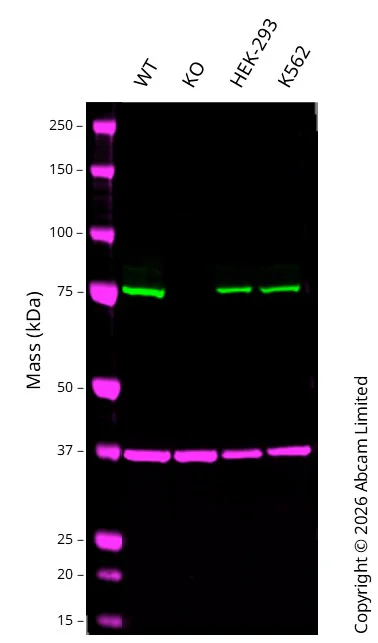
Western blot - Anti-FACL4 antibody [EPR17587] (AB205197)
Western blot : Anti-FACL4 antibody [EPR17587] ab205197 staining at 1/1000 dilution, shown in green; Mouse anti GAPDH ab8245 loading control staining at 1/20000 dilution, shown in magenta. A band was observed at 79 kDa in Wild-type A431 cell lysates with no signal observed at this size in ACSL4 knockout A431 cell line. To generate this image, samples were run on an SDS-PAGE gel then transferred onto a nitrocellulose membrane. Membranes were blocked in 3 % Milk in TBS-0.1 % Tween® 20 (TBS-T) before incubation with primary antibodies overnight at 4 °C. Blots were washed four times in TBS-T, incubated with secondary antibodies for 1 h at room temperature, washed again four times then imaged. Secondary antibodies used were Goat anti-Rabbit 800CW and Goat anti-Mouse 680RD at 1/20,000 dilution.
All lanes:
Western blot - Anti-FACL4 antibody [EPR17587] (ab205197) at 1/1000 dilution
Lane 1:
Wild-type A431 cell lysates at 20 µg
Lane 2:
Western blot - Human ACSL4 (FACL4) knockout A-431 cell line (<a href='/products/cell-lines/human-acsl4-facl4-knockout-a-431-cell-line-ab269613'>ab269613</a>) at 20 µg
Lane 3:
HEK-293 cell lysates at 20 µg
Lane 4:
K562 cell lysates at 20 µg
Secondary
All lanes:
Goat anti-Rabbit 800CW & Goat anti-Mouse 680RD at 1/20000 dilution
Predicted band size: 79 kDa
Observed band size: 79 kDa
false

- WB
Supplier Data
Western blot - Anti-FACL4 antibody [EPR17587] (AB205197)
Blocking/Dilution buffer : 5% NFDM/TBST.
All lanes:
Western blot - Anti-FACL4 antibody [EPR17587] (ab205197) at 1/1000 dilution
All lanes:
293 (Human epithelial cells from embryonic kidney) whole cell lysate at 20 µg
Secondary
All lanes:
Goat Anti-Rabbit IgG, (H+L), Peroxidase conjugated at 1/1000 dilution
Predicted band size: 79 kDa
Observed band size: 79 kDa
false
Exposure time: 3min

- WB
Supplier Data
Western blot - Anti-FACL4 antibody [EPR17587] (AB205197)
Blocking/Dilution buffer : 5% NFDM/TBST.
All lanes:
Western blot - Anti-FACL4 antibody [EPR17587] (ab205197) at 1/1000 dilution
All lanes:
Human fetal kidney tissue lysate at 10 µg
Secondary
All lanes:
Anti-Rabbit IgG (HRP), specific to the non-reduced form of IgG at 1/1000 dilution
Predicted band size: 79 kDa
Observed band size: 79 kDa
false
Exposure time: 3min

- WB
Supplier Data
Western blot - Anti-FACL4 antibody [EPR17587] (AB205197)
Blocking/Dilution buffer : 5% NFDM/TBST.
All lanes:
Western blot - Anti-FACL4 antibody [EPR17587] (ab205197) at 1/5000 dilution
Lane 1:
HeLa (Human epithelial cells from cervix adenocarcinoma) whole cell lysate at 20 µg
Lane 2:
HepG2 (Human liver hepatocellular carcinoma) whole cell lysate at 20 µg
Secondary
All lanes:
Goat Anti-Rabbit IgG, (H+L), Peroxidase conjugated at 1/1000 dilution
Predicted band size: 79 kDa
Observed band size: 79 kDa
false
Exposure time: 3min
関連する標識済み抗体及び組成の異なる製品 (1)
-
Anti-FACL4 antibody [EPR17587] - BSA and Azide free
代替製品


Primary Antibodies
AB205199
Anti-FACL4 antibody [EPR17587-42]
20ul selling size|RabMAb|Recombinant

- 0
- 0
Primary Antibodies
AB240135
Anti-FACL4 antibody [EPR8640] - BSA and Azide free
RabMAb|Recombinant

- 0
- 0


組合せ製品

Primary Antibodies
AB125066
Anti-Glutathione Peroxidase 4 antibody [EPNCIR144]
BOND RX™ Validated|KO Validated|RabMAb|Recombinant|Lab Essentials

- 5
- 13
Primary Antibodies
AB307601
Anti-xCT antibody [EPR27115-64]
BOND RX™ Validated|20ul selling size|RabMAb|Recombinant|KO Validated

- 5
- 1

Primary Antibodies
AB8227
Anti-beta Actin antibody - Loading Control
BOND RX™ Validated|Lab Essentials
- 5
- 104
Reactivity data
製品の詳細
Patented technology
Our RabMAb® technology is a patented hybridoma-based technology for making rabbit monoclonal antibodies. For details on our patents, please refer to RabMAb® patents.
What are the advantages of a recombinant monoclonal antibody?
This product is a recombinant monoclonal antibody, which offers several advantages including:
- - High batch-to-batch consistency and reproducibility
- - Improved sensitivity and specificity
- - Long-term security of supply
- - Animal-free batch production
For more information, read more on recombinant antibodies.
出荷温度及び保存条件
製品の状態
精製方法
バッファー組成
出荷温度
短期保存期間
短期保存温度
長期保存温度
分注に関する情報
保管に関する情報
補足情報
This supplementary information is collated from multiple sources and compiled automatically.
Biological function summary
FACL4 contributes significantly to lipid metabolism and is involved in the synthesis of complex lipids. It facilitates the integration of long-chain fatty acids into phospholipids and triglycerides. FACL4 often functions as part of larger lipid synthesis and modification complexes working closely with other enzymes to maintain membrane integrity and signal transduction. Its activity influences cellular responses to changes in lipid availability and metabolic demands.
Pathways
FACL4 functions within the arachidonic acid metabolism and glycerophospholipid metabolic pathways. In these pathways other proteins such as COX and LOX interact with FACL4 to regulate inflammatory responses and membrane lipid composition. The enzyme’s role in these pathways highlights its contribution to managing the balance between pro-inflammatory and anti-inflammatory metabolites which are essential for cell signaling and homeostasis.
製品プロトコール
- Visit the General protocols
- Visit the Troubleshooting
ターゲットの情報
文献 (6)
Recent publications for all applications. Explore the full list and refine your search
Frontiers in pharmacology 16:1527481 PubMed40191433
2025
Applications
Unspecified application
Species
Unspecified reactive species
Journal of nanobiotechnology 23:249 PubMed40133959
2025
Applications
Unspecified application
Species
Unspecified reactive species
Molecular medicine reports 30: PubMed39370816
2024
Applications
Unspecified application
Species
Unspecified reactive species
Thoracic cancer 14:2665-2677 PubMed37533139
2023
Applications
Unspecified application
Species
Unspecified reactive species
ESC heart failure 8:4780-4790 PubMed34725968
2021
Applications
Unspecified application
Species
Unspecified reactive species
Molecular cancer research : MCR 19:124-135 PubMed33077484
2020
Applications
Unspecified application
Species
Unspecified reactive species
Abcam product promise
Please note: All products are 'FOR RESEARCH USE ONLY. NOT FOR USE IN DIAGNOSTIC OR THERAPEUTIC PROCEDURES'.
For licensing inquiries, please contact partnerships@abcam.com