Anti-EIF2S1 抗体 [EIF2a]
Anti-EIF2S1 antibody [EIF2a]
5
(4 Reviews)
|
(76 Publications)
Anti-EIF2S1 antibody [EIF2a] (ab5369) is a mouse monoclonal antibody detecting EIF2S1 in Western Blot, IHC-P. Suitable for African green monkey, Human, Mouse, Rat.
- Over 60 publications
- Trusted since 2003
別名を表示する
EIF2A, EIF2S1, Eukaryotic translation initiation factor 2 subunit 1, Eukaryotic translation initiation factor 2 subunit alpha, eIF-2-alpha, eIF-2A, eIF-2alpha, eIF2-alpha
- WB
Supplier Data
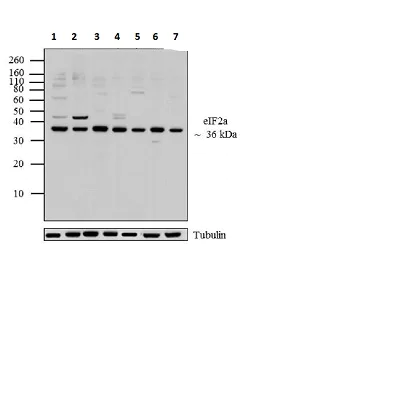
Western blot - Anti-EIF2S1 antibody [EIF2a] (AB5369)
All lanes:
Western blot - Anti-EIF2S1 antibody [EIF2a] (ab5369)
Lane 1:
COS-7 (african green monkey kidney fibroblast-like cell line) whole cell lysate at 20 µg
Lane 2:
MCF7 (human breast adenocarcinoma cell line) whole cell lysate at 20 µg
Lane 3:
PC-12 (rat adrenal gland pheochromocytoma cell line) whole cell lysate at 20 µg
Lane 4:
HeLa (human epithelial cell line from cervix adenocarcinoma) whole cell lysate
Lane 5:
Jurkat (human T cell leukemia cell line from peripheral blood) whole cell lysate
Lane 6:
NIH/3T3 (mouse embryonic fibroblast cell line) whole cell lysate
Lane 7:
A431 (human epidermoid carcinoma cell line) whole cell lysate
Secondary
Lanes 1, 2, 3, 4, 6 and 7:
Goat anti-Mouse IgG (H+L) Secondary Antibody, HRP conjugate at 1/4000 dilution
Lane 5:
Goat anti-Mouse IgG (H+L) Secondary Antibody, HRP conjugate
Predicted band size: 36 kDa
false

- IHC-P
Unknown
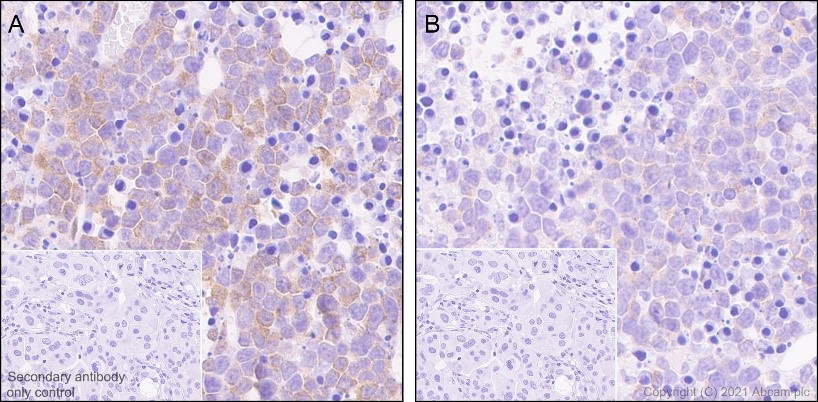
Immunohistochemistry (Formalin/PFA-fixed paraffin-embedded sections) - Anti-EIF2S1 antibody [EIF2a] (AB5369)
ab5369 staining EIF2S1 in human placenta. Staining is localised to the cytoplasm.
Left panel : with primary antibody at 2 ug/ml. Right panel : isotype control.
Sections were stained using an automated system DAKO Autostainer Plus , at room temperature. Sections were rehydrated and antigen retrieved with the Dako 3-in-1 AR buffer citrate pH 6.0 in a DAKO PT Link. Slides were peroxidase blocked in 3% H2O2 in methanol for 10 minutes. They were then blocked with Dako Protein block for 10 minutes (containing casein 0.25% in PBS), then incubated with primary antibody for 20 minutes, and detected with Dako Envision Flex amplification kit for 30 minutes. Colorimetric detection was completed with diaminobenzidine for 5 minutes. Slides were counterstained with Haematoxylin and coverslipped under DePeX. Please note that for manual staining we recommend to optimize the primary antibody concentration and incubation time (overnight incubation), and amplification may be required.

- IHC-P
Unknown
Immunohistochemistry (Formalin/PFA-fixed paraffin-embedded sections) - Anti-EIF2S1 antibody [EIF2a] (AB5369)
Immunohistochemistry analysis of EIF 2ALPHA (EIF2A) showing staining in the cytoplasm of paraffin-embedded human colon carcinoma (right) compared to a negative control without primary antibody (left). To expose target proteins, antigen retrieval was performed using 10mM sodium citrate (pH 6.0), microwaved for 8-15 min. Following antigen retrieval, tissues were blocked in 3% H2O2-methanol for 15 min at room temperature, washed with ddH2O and PBS, and then probed with ab5369.

- ICC
Unknown
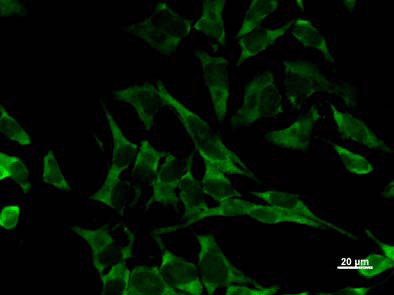
Immunocytochemistry - Anti-EIF2S1 antibody [EIF2a] (AB5369)
Immunofluorescence analysis of eIF2a was done on 70% confluent log phase A549 cells. The cells were fixed with 4% paraformaldehyde for 15 minutes, permeabilized with 0.25% Triton™ X-100 for 10 minutes, and blocked with 5% BSA for 1 hour at room temperature. The cells were labeled with ab5369 1 : 250 dilution in1% BSA and incubated for 3 hours at room temperature and then labeled with Goat anti-Mouse IgG (H+L) Superclonal Secondary Antibody, Alexa Fluor® 488 conjugate at a dilution of 1 : 2000 for 45 minutes at room temperature (Panel a : green). Nuclei (Panel b : blue) were stained with SlowFade® Gold Antifade Mountant with DAPI. F-actin (Panel c : red) was stained with Rhodamine Phalloidin (1 : 300). Panel d is a merged image showing Cytoplasmic localization. Panel e is a no primary antibody control. The images were captured at 60X magnification.

- ICC
Unknown
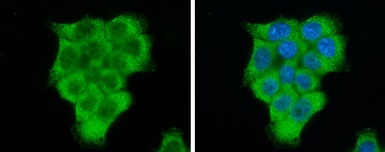
Immunocytochemistry - Anti-EIF2S1 antibody [EIF2a] (AB5369)
ICC/IF image of ab5369 stained HepG2 cells. The cells were 4% formaldehyde fixed (10 min) and then incubated in 1%BSA / 10% normal goat serum / 0.3M glycine in 0.1% PBS-Tween for 1h to permeabilise the cells and block non-specific protein-protein interactions. The cells were then incubated with the antibody (ab5369, 5µg/ml) overnight at +4°C. The secondary antibody (green) was Alexa Fluor® 488 goat anti-mouse IgG (H+L) used at a 1/1000 dilution for 1h. Alexa Fluor® 594 WGA was used to label plasma membranes (red) at a 1/200 dilution for 1h. DAPI was used to stain the cell nuclei (blue) at a concentration of 1.43µM.

- IHC-P
Supplier Data
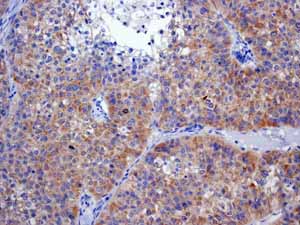
Immunohistochemistry (Formalin/PFA-fixed paraffin-embedded sections) - Anti-EIF2S1 antibody [EIF2a] (AB5369)
Immunohistochemical analysis of human colon carcinoma (right) compared to a negative control (left) using ab5369 at the dilution 1/10.
代替製品
Primary Antibodies
AB263951
Anti-EIF2S1 antibody [EPR23098-50] - BSA and Azide free
BOND RX™ Validated|RabMAb|Recombinant
- 0
- 0
Primary Antibodies
AB242148
Anti-EIF2S1 antibody [EPR23098-50]
BOND RX™ Validated|20ul selling size|RabMAb|Recombinant|Trial Size
- 0
- 0
Primary Antibodies
AB32157
Anti-EIF2S1 (phospho S51) antibody [E90]
BOND RX™ Validated|20ul selling size|RabMAb|Recombinant
- 4
- 27
Primary Antibodies
AB214434
Anti-EIF2S1 (phospho S51) antibody [E90] - BSA and Azide free
BOND RX™ Validated|RabMAb|Recombinant
- 0
- 0
組合せ製品
Primary Antibodies
AB32157
Anti-EIF2S1 (phospho S51) antibody [E90]
BOND RX™ Validated|20ul selling size|RabMAb|Recombinant
- 4
- 27
Primary Antibodies
AB229912
Anti-PERK antibody [EPR19876-294]
20ul selling size|RabMAb|Recombinant|KO Validated
- 4
- 5
Primary Antibodies
AB169528
Anti-eIF2A antibody [EPR11042]
20ul selling size|RabMAb|Recombinant|KO Validated

- 5
- 5

Reactivity data
製品の詳細
Anti-EIF2S1 antibody [EIF2a] (ab5369) is a mouse monoclonal antibody and is validated for use in Western Blot (WB), Immunohistochemistry (IHC-P) in African green monkey, Human, Mouse, Rat samples.
What is the molecular weight of EIF2S1?
Anti-EIF2S1 [EIF2a] (ab5369) specifically detects a band for EIF2S1 (UniProt: P05198) at a molecular weight of 36kDa.
Trusted by the scientific community
Anti-EIF2S1 [EIF2a] (ab5369) was first used in a scientific publication in 2003 and has been cited over 60 times in peer-reviewed journals.
出荷温度及び保存条件
製品の状態
精製方法
バッファー組成
出荷温度
短期保存温度
長期保存温度
分注に関する情報
保管に関する情報
補足情報
This supplementary information is collated from multiple sources and compiled automatically.
Biological function summary
EIF2α acts as a regulatory component of the eIF2 complex which is central to initiating translation in eukaryotic cells. Phosphorylation of eIF2α leads to inhibition of the exchange of GDP to GTP on eIF2 effectively reducing global protein synthesis while allowing the translation of specific mRNAs involved in stress responses. The eIF2α forms part of the eIF2 complex working closely with other subunits to exert its regulatory functions.
Pathways
EIF2α is involved in the integrated stress response (ISR) and other protein synthesis pathways. The phosphorylation state of eIF2α is important in ISR linking it to proteins such as PERK and GCN2 which respond to various stress signals. Phospho-eIF2α plays a significant role in modulating the translation response to cellular stress ensuring cells can adapt or initiate apoptosis depending on the conditions.
製品プロトコール
- Visit the General protocols
- Visit the Troubleshooting
ターゲットの情報
文献 (76)
Recent publications for all applications. Explore the full list and refine your search
RNA (New York, N.Y.) 31:1599-1618 PubMed40803890
2025
Applications
Unspecified application
Species
Unspecified reactive species
Science advances 11:eadt3142 PubMed40138418
2025
Applications
Unspecified application
Species
Unspecified reactive species
Scientific reports 14:23533 PubMed39384561
2024
Applications
Unspecified application
Species
Unspecified reactive species
iScience 27:110851 PubMed39310746
2024
Applications
Unspecified application
Species
Unspecified reactive species
Cell proliferation 58:e13741 PubMed39212334
2024
Applications
Unspecified application
Species
Unspecified reactive species
The EMBO journal 43:3587-3603 PubMed38951609
2024
Applications
Unspecified application
Species
Unspecified reactive species
International journal of molecular sciences 25: PubMed38612761
2024
Applications
Unspecified application
Species
Unspecified reactive species
Cancer research communications 4:986-1003 PubMed38530197
2024
Applications
Unspecified application
Species
Unspecified reactive species
Frontiers in molecular biosciences 10:1178439 PubMed37426420
2023
Applications
Unspecified application
Species
Unspecified reactive species
Genes 14: PubMed37239403
2023
Applications
Unspecified application
Species
Unspecified reactive species
Abcam product promise
Please note: All products are 'FOR RESEARCH USE ONLY. NOT FOR USE IN DIAGNOSTIC OR THERAPEUTIC PROCEDURES'.
For licensing inquiries, please contact partnerships@abcam.com