JavaScript is disabled in your browser. Please enable JavaScript to view this website.
AB78113

Anti-EBV Latent Membrane Protein 1 抗体 [CS 1-4] - BSA and Azide free

Anti-EBV Latent Membrane Protein 1 antibody [CS 1-4]

4

(4 Reviews)

|

(53 Publications)

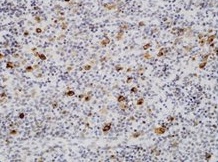
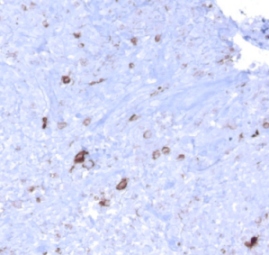
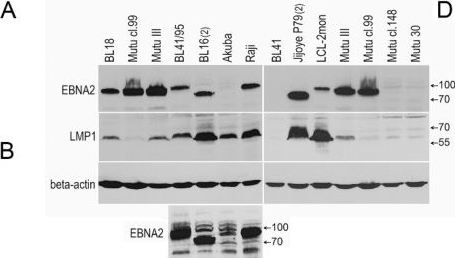
Anti-EBV Latent Membrane Protein 1 antibody [CS 1-4] (ab78113) is a mouse monoclonal antibody detecting EBV Latent Membrane Protein 1 in Western Blot, IP, IHC-P, IHC-Fr. Suitable for Epstein-Barr virus.

- Over 40 publications
- Trusted since 2009

別名を表示する

BNLF1, LMP1, Latent membrane protein 1, LMP-1, Protein p63, BNLF1, EBV, Epstein Barr virus, HHV4, Human Herpesvirus 4, Latent membrane protein 1

Key facts

宿主種

Mouse

クローン性

Monoclonal

クローン番号

CS 1-4

アイソタイプ

IgG1

軽鎖のタイプ

kappa

キャリアフリー

No

交差種

Epstein-Barr virus

アプリケーション

IHC-P, IP, WB, IHC-Fr

applications

免疫原

Recombinant Fragment Protein within Epstein-Barr Virus (Strain B95-8) LMP1. The exact immunogen used to generate this antibody is proprietary information.

P03230

特異性

This antibody is specific for Epstein-Barr virus infected cells expressing the latent membrane protein (LMP). This is in fact four pooled antibodies which collectively detect LMP's encoded by each of 20 geographically distinct EBV isolates.

Reactivity data

{ "title": "Reactivity Data", "filters": { "stats": ["", "Species", "Dilution Info", "Notes"], "tabs": { "all-applications": {"fullname" : "All Applications", "shortname": "All Applications"}, "IP" : {"fullname" : "Immunoprecipitation", "shortname":"IP"}, "WB" : {"fullname" : "Western blot", "shortname":"WB"}, "IHCP" : {"fullname" : "Immunohistochemistry (Formalin/PFA-fixed paraffin-embedded sections)", "shortname":"IHC-P"}, "IHCFr" : {"fullname" : "Immunohistochemistry (Frozen sections)", "shortname":"IHC-Fr"} }, "product-promise": { "all": "all", "testedAndGuaranteed": "tested", "guaranteed": "expected", "predicted": "predicted", "notRecommended": "not-recommended" } }, "values": { "Epstein-Barr virus": { "IP-species-checked": "guaranteed", "IP-species-dilution-info": "", "IP-species-notes": "<p></p>", "WB-species-checked": "guaranteed", "WB-species-dilution-info": "", "WB-species-notes": "<p></p>", "IHCP-species-checked": "guaranteed", "IHCP-species-dilution-info": "", "IHCP-species-notes": "<p></p>", "IHCFr-species-checked": "guaranteed", "IHCFr-species-dilution-info": "", "IHCFr-species-notes": "<p></p>" } } }

製品の詳細

What is this antibody validated in?
Anti-EBV Latent Membrane Protein 1 antibody [CS 1-4] (ab78113) is a mouse monoclonal antibody and is validated for use in Western Blot (WB), Immunoprecipitation (IP), Immunohistochemistry (IHC-P), Immunohistochemistry (IHC-Fr) in Epstein-Barr virus samples.

What is the molecular weight of EBV Latent Membrane Protein 1?
Anti-EBV Latent Membrane Protein 1 [CS 1-4] (ab78113) specifically detects a band for EBV Latent Membrane Protein 1 (UniProt: P03230) at a molecular weight of 42kDa.

Trusted by the scientific community
Anti-EBV Latent Membrane Protein 1 [CS 1-4] (ab78113) was first used in a scientific publication in 2009 and has been cited over 40 times in peer-reviewed journals.

出荷温度及び保存条件

製品の状態
Liquid
精製方法
Affinity purification Protein A
精製に関する特記事項
Affinity chromatography
バッファー組成
Preservative: 0.02% Sodium azide Constituents: PBS
出荷温度
Blue Ice
短期保存温度
+4°C
長期保存温度
-20°C
分注に関する情報
Upon delivery aliquot
保管に関する情報
Avoid freeze / thaw cycle

補足情報

This supplementary information is collated from multiple sources and compiled automatically.

EBV Latent Membrane Protein 1 also known as LMP1 is an important oncoprotein of Epstein-Barr virus (EBV). It acts mechanically to modulate cellular signaling pathways. LMP1 weighs approximately 63 kDa. This protein is highly expressed on the surface of lymphocytes and epithelial cells during latent EBV infection. LMP1 comprises several functional domains including Cytoplasmic Tail 1 (CS1) Cytoplasmic Tail 2 (CS2) and Cytoplasmic Tail 3 (CS3). Researchers often study its presence through methods like LMP1 immunohistochemistry (IHC)
Biological function summary

The protein plays a role in cellular transformation and proliferation acting as a mimic of CD40 receptor signaling. Within cells LMP1 aggregates to form oligomeric complexes that actively recruit TRAF and TRADD adapter proteins. This aggregation leads to the activation of NF-κB signaling and the MAPK pathways contributing to increased cell survival and proliferation. LMP1 functions as a major factor in sustaining EBV latency in infected cells and is essential for the virus's oncogenic potential.

Pathways

LMP1 is an integral component of the NF-κB and AP-1 signaling pathways. By engaging with the host cell machinery LMP1 recruits proteins such as IκB kinase complexes leading to the nuclear translocation of NF-κB transcription factors. This results in the transcription of genes related to cell growth and inflammation. LMP1 also interacts with p38 MAPK further enhancing pathways that contribute to EBV’s ability to foster an environment suitable for its persistence and propagation within the host.

LMP1 has strong associations with various malignancies especially nasopharyngeal carcinoma and Hodgkin's lymphoma. The protein’s role in disrupting normal cellular function relates it closely to the pathology of these cancers. It affects the expression of other proteins like c-Myc and Bcl-2 which are often found altered in malignancy. EBV antibodies particularly those targeting LMP1 are used to study the presence and progression of these diseases in infected individuals.

製品プロトコール

For this product, it's our understanding that no specific protocols are required. You can visit:

ターゲットの情報

Acts as a CD40 functional homolog to prevent apoptosis of infected B-lymphocytes and drive their proliferation. Functions as a constitutively active tumor necrosis factor receptor that induces the activation of several signaling pathways, including those of the NF-kappa-B family. LMP1 signaling leads to up-regulation of antiapoptotic proteins and provide growth signals in latently infected cells. Interacts with host UBE2I and subsequently affects the sumoylation state of several cellular proteins. For example, induces the sumoylation of host IRF7 thereby limiting its transcriptional activity and modulating the activation of innate immune responses. Also inhibits host IFN-alpha-stimulated STAT2 nuclear translocation and interferon-stimulated response element transcriptional activity by interacting with and inhibiting host TYK2. Induces SUMO expression during viral latency thereby dysregulating the host sumoylation processes (PubMed : 30659232).
See full target information LMP1

文献 (53)

Recent publications for all applications. Explore the full list and refine your search

Blood cancer journal 15:108 PubMed40514360

2025

Early growth response 1 as a key regulator of PD-L1 expression and immune evasion in extranodal NK/T-cell lymphoma.

Applications

Unspecified application

Species

Unspecified reactive species

Ji Yun Lee,Kui-Jin Kim,Woochan Park,Jeongmin Seo,Minsu Kang,Eun Hee Jung,Sang-A Kim,Koung Jin Suh,Ji-Won Kim,Se Hyun Kim,Jeong-Ok Lee,Jin Won Kim,Yu Jung Kim,Keun-Wook Lee,Jee Hyun Kim,Soo-Mee Bang,Tae Min Kim,Jin Ho Paik

PLoS pathogens 21:e1013092 PubMed40367275

2025

Epstein-Barr virus latent membrane protein 1 subverts IMPDH pathways to drive B-cell oncometabolism.

Applications

Unspecified application

Species

Unspecified reactive species

Eric M Burton,Davide Maestri,Shaowen White,Jin-Hua Liang,Bidisha Mitra,John M Asara,Benjamin E Gewurz

Hepatology communications 9: PubMed40079734

2025

EBV enhances immunotherapy sensitivity in intrahepatic cholangiocarcinoma through cGAS-STING pathway activation.

Applications

Unspecified application

Species

Unspecified reactive species

Lingli Huang,Qian Zhong,Silan Huang,Kejia Yang,Yuchen Cai,Guifang Guo

Cell reports 43:114743 PubMed39298313

2024

Epstein-Barr virus induces host shutoff extensively via BGLF5-independent mechanisms.

Applications

Unspecified application

Species

Unspecified reactive species

Alejandro Casco,Makoto Ohashi,Eric Johannsen

Frontiers in immunology 15:1379175 PubMed39086481

2024

Characterization of latently infected EBV+ antibody-secreting B cells isolated from ovarian tumors and malignant ascites.

Applications

Unspecified application

Species

Unspecified reactive species

Lixin Zhang,Mary Strange,Esther Elishaev,Syed Zaidi,Francesmary Modugno,Mackenzy Radolec,Robert P Edwards,Olivera J Finn,Anda M Vlad

Journal of medical virology 96:e29634 PubMed38682578

2024

Epstein-Barr virus-driven metabolic alterations contribute to the viral lytic reactivation and tumor progression in nasopharyngeal carcinoma.

Applications

Unspecified application

Species

Unspecified reactive species

Feng Shi,Li Shang,Min Zhou,Cong Lv,Yueshuo Li,Cheng Luo,Na Liu,Jingchen Lu,Min Tang,Xiangjian Luo,Jing Xu,Jia Fan,Jian Zhou,Qiang Gao,Weizhong Wu,Weihua Jia,Hailin Wang,Ya Cao

PLoS pathogens 20:e1012132 PubMed38620028

2024

Latent Epstein-Barr virus infection collaborates with Myc over-expression in normal human B cells to induce Burkitt-like Lymphomas in mice.

Applications

Unspecified application

Species

Unspecified reactive species

Jillian A Bristol,Scott E Nelson,Makoto Ohashi,Alejandro Casco,Mitchell Hayes,Erik A Ranheim,Abigail S Pawelski,Deo R Singh,Daniel J Hodson,Eric C Johannsen,Shannon C Kenney

Pathogens (Basel, Switzerland) 12: PubMed38133273

2023

Non-Response of Epstein-Barr Virus-Associated Breast Cancer after Primary Chemotherapy: Report of Two Cases.

Applications

Unspecified application

Species

Unspecified reactive species

Ewgenija Gutjahr,Carlo Fremd,Johanna Arnscheidt,Roland Penzel,Jürgen Wacker,Peter Sinn

BMC medicine 21:330 PubMed37649020

2023

CAR-T cells targeting CD38 and LMP1 exhibit robust antitumour activity against NK/T cell lymphoma.

Applications

Unspecified application

Species

Unspecified reactive species

Hongwen Li,Wenting Song,Jiazhuo Wu,Zhuangzhuang Shi,Yuyang Gao,Jiwei Li,Lijuan Han,Jianxiang Zhang,Zhaoming Li,Yong Li,Mingzhi Zhang

Cellular oncology (Dordrecht) 46:987-1000 PubMed36917356

2023

STIM1-regulated exosomal EBV-LMP1 empowers endothelial cells with an aggressive phenotype by activating the Akt/ERK pathway in nasopharyngeal carcinoma.

Applications

Unspecified application

Species

Unspecified reactive species

Yayan Deng,Xue Liu,Yujuan Huang,Jiaxiang Ye,Qian He,Yue Luo,Yong Chen,Qiuyun Li,Yan Lin,Rong Liang,Yongqiang Li,Jiazhang Wei,Jinyan Zhang
View all publications

Abcam product promise

当社は、高品質な試薬を通じてお客様の研究を力強くサポートすることをお約束いたします。ご使用いただく各段階で、常にお客様をサポートできる体制を整えております。万が一、製品が期待通りに機能しない場合は、「Abcam Product Promise」による当社保証制度に基づき、安心してご利用いただけます。
保証に関する詳細については利用規約をご確認ください。

Please note: All products are 'FOR RESEARCH USE ONLY. NOT FOR USE IN DIAGNOSTIC OR THERAPEUTIC PROCEDURES'.

For licensing inquiries, please contact partnerships@abcam.com