JavaScript is disabled in your browser. Please enable JavaScript to view this website.
AB306556

Anti-CDT2/RAMP 抗体 [EPR26845-75]

Anti-CDT2/RAMP antibody [EPR26845-75]

Be the first to review this product! Submit a review

|

(0 Publication)

Rabbit Recombinant Monoclonal CDT2/RAMP antibody. Suitable for WB and reacts with Human samples.

別名を表示する

CDT2, CDW1, DCAF2, L2DTL, RAMP, DTL, Denticleless protein homolog, DDB1- and CUL4-associated factor 2, Lethal(2) denticleless protein homolog, Retinoic acid-regulated nuclear matrix-associated protein
3 Images
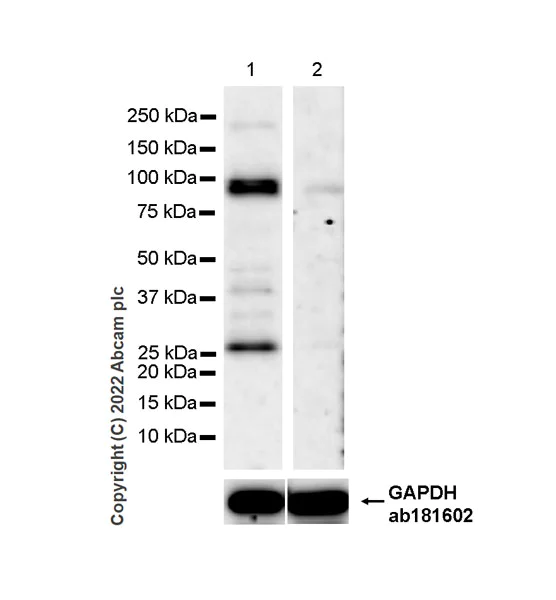
Western blot - Anti-CDT2/RAMP antibody [EPR26845-75] (AB306556)
  • WB

Supplier Data

Western blot - Anti-CDT2/RAMP antibody [EPR26845-75] (AB306556)

Blocking and diluting buffer and concentration : 5% NFDM/TBSTLow expression : human heart (PMID : 18542055). Samples are non-boiled as boiling may cause protein aggregation. The identity of the bands between 20 kDa and 70 kDa are unknown. Exposure time : 158 seconds

All lanes:

Western blot - Anti-CDT2/RAMP antibody [EPR26845-75] (ab306556) at 1/1000 dilution

Lane 1:

Human testis tissue lysate 20 μg

Lane 2:

Human heart tissue lysate 20 μg

Secondary

All lanes:

Goat Anti-Rabbit IgG (HRP) with minimal cross-reactivity with human IgG at 1/2000 dilution

Observed band size: 91 kDa

false

Exposure time: 158s
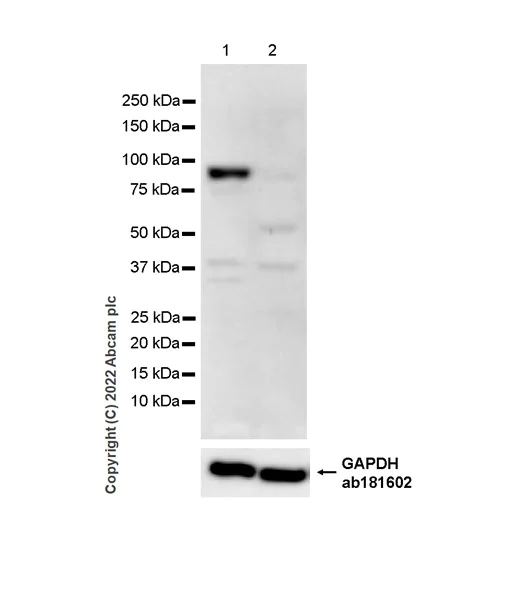
Western blot - Anti-CDT2/RAMP antibody [EPR26845-75] (AB306556)
  • WB

Supplier Data

Western blot - Anti-CDT2/RAMP antibody [EPR26845-75] (AB306556)

Blocking and diluting buffer and concentration : 5% NFDM/TBSTThe expression of CDT2/RAMP is downregulated in response to PMA treatment (PMID : 24637302). Samples are non-boiled as boiling may cause protein aggregation. Exposure time : 59 seconds

All lanes:

Western blot - Anti-CDT2/RAMP antibody [EPR26845-75] (ab306556) at 1/1000 dilution

Lane 1:

Untreated K-562 (human chronic myelogenous leukemia lymphoblast) whole cell lysate 20 µg

Lane 2:

K-562 treated with 20nM PMA for 4 days whole cell lysate 20 µg

Secondary

All lanes:

Western blot - Goat Anti-Rabbit IgG H&L (HRP) (<a href='/products/secondary-antibodies/goat-rabbit-igg-h-l-hrp-ab97051'>ab97051</a>) at 1/20000 dilution

Observed band size: 91 kDa

false

Exposure time: 59s
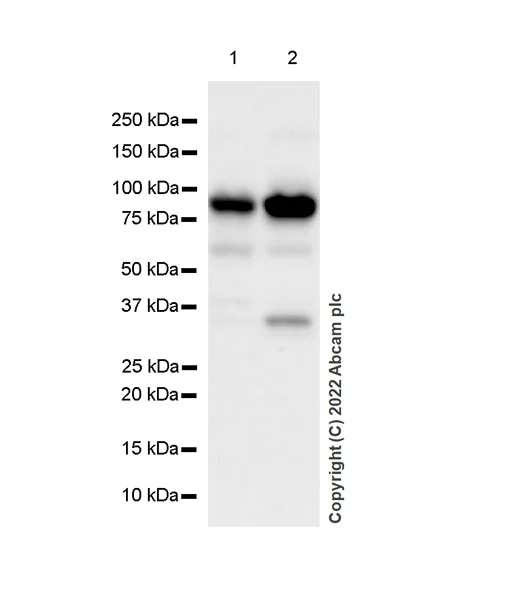
Western blot - Anti-CDT2/RAMP antibody [EPR26845-75] (AB306556)
  • WB

Supplier Data

Western blot - Anti-CDT2/RAMP antibody [EPR26845-75] (AB306556)

Blocking and diluting buffer and concentration : 5% NFDM/TBSTSamples are non-boiled as boiling may cause protein aggregation. Exposure time : Lanes 1-5 : 15 seconds, Lanes 6-7 : 81 seconds.

All lanes:

Western blot - Anti-CDT2/RAMP antibody [EPR26845-75] (ab306556) at 1/1000 dilution

Lane 1:

HeLa (human cervix adenocarcinoma epithelial cell) whole cell lysate 20 μg

Lane 2:

293T (human embryonic kidney epithelial cell) whole cell lysate 20 μg

Secondary

All lanes:

Western blot - Goat Anti-Rabbit IgG H&L (HRP) (<a href='/products/secondary-antibodies/goat-rabbit-igg-h-l-hrp-ab97051'>ab97051</a>) at 1/20000 dilution

Observed band size: 91 kDa

false

Exposure time: 26s

関連する標識済み抗体及び組成の異なる製品 (1)

  • Carrier free

    Anti-CDT2/RAMP antibody [EPR26845-75] - BSA and Azide free

Key facts

宿主種

Rabbit

クローン性

Monoclonal

クローン番号

EPR26845-75

アイソタイプ

IgG

キャリアフリー

No

交差種

Human

アプリケーション

WB

applications

免疫原

The exact immunogen used to generate this antibody is proprietary information.

Reactivity data

{ "title": "Reactivity Data", "filters": { "stats": ["", "Species", "Dilution Info", "Notes"], "tabs": { "all-applications": {"fullname" : "All Applications", "shortname": "All Applications"}, "IP" : {"fullname" : "Immunoprecipitation", "shortname":"IP"}, "FlowCytIntra" : {"fullname" : "Flow Cytometry (Intracellular)", "shortname":"Flow Cyt (Intra)"}, "ICCIF" : {"fullname" : "Immunocytochemistry/ Immunofluorescence", "shortname":"ICC/IF"}, "IHCP" : {"fullname" : "Immunohistochemistry (Formalin/PFA-fixed paraffin-embedded sections)", "shortname":"IHC-P"}, "WB" : {"fullname" : "Western blot", "shortname":"WB"} }, "product-promise": { "all": "all", "testedAndGuaranteed": "tested", "guaranteed": "expected", "predicted": "predicted", "notRecommended": "not-recommended" } }, "values": { "Human": { "IP-species-checked": "notRecommended", "IP-species-dilution-info": "", "IP-species-notes": "<p></p>", "FlowCytIntra-species-checked": "notRecommended", "FlowCytIntra-species-dilution-info": "", "FlowCytIntra-species-notes": "<p></p>", "ICCIF-species-checked": "notRecommended", "ICCIF-species-dilution-info": "", "ICCIF-species-notes": "<p></p>", "IHCP-species-checked": "notRecommended", "IHCP-species-dilution-info": "", "IHCP-species-notes": "<p></p>", "WB-species-checked": "testedAndGuaranteed", "WB-species-dilution-info": "1/1000", "WB-species-notes": "<p>Not suitable for mouse and rat.</p>" }, "Mouse": { "IP-species-checked": "notRecommended", "IP-species-dilution-info": "", "IP-species-notes": "", "FlowCytIntra-species-checked": "notRecommended", "FlowCytIntra-species-dilution-info": "", "FlowCytIntra-species-notes": "", "ICCIF-species-checked": "notRecommended", "ICCIF-species-dilution-info": "", "ICCIF-species-notes": "", "IHCP-species-checked": "notRecommended", "IHCP-species-dilution-info": "", "IHCP-species-notes": "<p></p>", "WB-species-checked": "notRecommended", "WB-species-dilution-info": "1/1000", "WB-species-notes": "<p>Not suitable for mouse and rat.</p>" }, "Rat": { "IP-species-checked": "notRecommended", "IP-species-dilution-info": "", "IP-species-notes": "", "FlowCytIntra-species-checked": "notRecommended", "FlowCytIntra-species-dilution-info": "", "FlowCytIntra-species-notes": "", "ICCIF-species-checked": "notRecommended", "ICCIF-species-dilution-info": "", "ICCIF-species-notes": "", "IHCP-species-checked": "notRecommended", "IHCP-species-dilution-info": "", "IHCP-species-notes": "<p></p>", "WB-species-checked": "notRecommended", "WB-species-dilution-info": "1/1000", "WB-species-notes": "<p>Not suitable for mouse and rat.</p>" } } }

製品の詳細

Patented technology
Our RabMAb® technology is a patented hybridoma-based technology for making rabbit monoclonal antibodies. For details on our patents, please refer to RabMAb® patents.

What are the advantages of a recombinant monoclonal antibody?
This product is a recombinant monoclonal antibody, which offers several advantages including:

  • - High batch-to-batch consistency and reproducibility
  • - Improved sensitivity and specificity
  • - Long-term security of supply
  • - Animal-free batch production

For more information, read more on recombinant antibodies.

出荷温度及び保存条件

製品の状態
Liquid
精製方法
Affinity purification Protein A
バッファー組成
pH: 7.2 - 7.4 Preservative: 0.01% Sodium azide Constituents: PBS, 40% Glycerol (glycerin, glycerine), 0.05% BSA
出荷温度
Conditional Ambient
短期保存期間
1-2 weeks
短期保存温度
+4°C
長期保存温度
-20°C
分注に関する情報
Upon delivery aliquot
保管に関する情報
Avoid freeze / thaw cycle

補足情報

This supplementary information is collated from multiple sources and compiled automatically.

CDT2 also known as RAMP (Rbx1-Associated Cullin 4-DCAF12-Dependent E3 Ligase) is part of the CRL4 complex and serves as a substrate recognition component for E3 ubiquitin ligases. The molecular weight of the CDT2 protein is approximately 85 kDa. This protein shows expression in various tissues with higher levels in actively dividing cells like those found in the testes and thymus.
Biological function summary

CDT2 regulates cell cycle progression by targeting specific cell cycle regulators for ubiquitin-mediated degradation. It functions within the CRL4 complex where it helps to ensure the timely turnover of replication licensing factors such as Cdt1 and other proteins involved in cell cycle checkpoints. This regulation is important for maintaining genomic stability by preventing inappropriate replication origin firing.

Pathways

CDT2 plays a significant role in DNA replication and cell cycle control pathways. Within these pathways the protein coordinates with Cdt1 to prevent unscheduled DNA replication. CDT2's involvement in these processes links it closely to proteins such as CUL4 which forms part of the CRL4 complex and to the ubiquitin-proteasome system a critical pathway for protein homeostasis.

CDT2 has implications in cancer and genomic instability. Aberrations in CDT2 expression or function can lead to dysregulation of cell proliferation contributing to oncogenesis. Connections between CDT2 and cancer are emphasized by its interaction with substrates like Cdt1 where misregulation may drive the development of tumors. CDT2 is also connected to p21 through its influence on cell cycle checkpoints highlighting an additional role in tumor suppression pathways.

製品プロトコール

For this product, it's our understanding that no specific protocols are required. You can visit:

ターゲットの情報

Substrate-specific adapter of a DCX (DDB1-CUL4-X-box) E3 ubiquitin-protein ligase complex required for cell cycle control, DNA damage response and translesion DNA synthesis. The DCX(DTL) complex, also named CRL4(CDT2) complex, mediates the polyubiquitination and subsequent degradation of CDT1, CDKN1A/p21(CIP1), FBH1, KMT5A and SDE2 (PubMed : 16861906, PubMed : 16949367, PubMed : 16964240, PubMed : 17085480, PubMed : 18703516, PubMed : 18794347, PubMed : 18794348, PubMed : 19332548, PubMed : 20129063, PubMed : 23478441, PubMed : 23478445, PubMed : 23677613, PubMed : 27906959). CDT1 degradation in response to DNA damage is necessary to ensure proper cell cycle regulation of DNA replication (PubMed : 16861906, PubMed : 16949367, PubMed : 17085480). CDKN1A/p21(CIP1) degradation during S phase or following UV irradiation is essential to control replication licensing (PubMed : 18794348, PubMed : 19332548). KMT5A degradation is also important for a proper regulation of mechanisms such as TGF-beta signaling, cell cycle progression, DNA repair and cell migration (PubMed : 23478445). Most substrates require their interaction with PCNA for their polyubiquitination : substrates interact with PCNA via their PIP-box, and those containing the 'K+4' motif in the PIP box, recruit the DCX(DTL) complex, leading to their degradation. In undamaged proliferating cells, the DCX(DTL) complex also promotes the 'Lys-164' monoubiquitination of PCNA, thereby being involved in PCNA-dependent translesion DNA synthesis (PubMed : 20129063, PubMed : 23478441, PubMed : 23478445, PubMed : 23677613). The DDB1-CUL4A-DTL E3 ligase complex regulates the circadian clock function by mediating the ubiquitination and degradation of CRY1 (PubMed : 26431207).
See full target information DTL

Abcam product promise

当社は、高品質な試薬を通じてお客様の研究を力強くサポートすることをお約束いたします。ご使用いただく各段階で、常にお客様をサポートできる体制を整えております。万が一、製品が期待通りに機能しない場合は、「Abcam Product Promise」による当社保証制度に基づき、安心してご利用いただけます。
保証に関する詳細については利用規約をご確認ください。

Please note: All products are 'FOR RESEARCH USE ONLY. NOT FOR USE IN DIAGNOSTIC OR THERAPEUTIC PROCEDURES'.

For licensing inquiries, please contact partnerships@abcam.com