Anti-CD90 / Thy1 抗体 [MRC OX-7] - Hematopoietic Stem Cell Marker
Anti-CD90 / Thy1 antibody [MRC OX-7] - Hematopoietic Stem Cell Marker
- Lab Essentials
- 詳細を見る
4
(12 Reviews)
|
(140 Publications)
Mouse Monoclonal CD90 / Thy1 antibody. Hematopoietic Stem Cell marker. Suitable for ICC, WB, Flow Cyt (Intra) and reacts with Rat samples. Cited in 140 publications.
別名を表示する
CD90, Thy-1, Thy1, Thy-1 membrane glycoprotein, Thy-1 antigen

- ICC
Unknown
Immunocytochemistry - Anti-CD90 / Thy1 antibody [MRC OX-7] - Hematopoietic Stem Cell Marker (AB225)
This image was kindly supplied as part of the review submitted by Nick Voilley. Rat retinal ganglion cell labelled with ab225 as a primary antibody and an anti-mouse F(ab)' 2 coupled to Alexa488 as a secondary antibody. The cell is approximately 15 micrometers in diameter. Only the cells labelled in green in the culture bear action potentials when stimulated. These three elements (reactivity to ab225, size and elecrophysiological parameters) clearly indicate the cell is a ganglion cell.

- ICC
AbReview12172****
Immunocytochemistry - Anti-CD90 / Thy1 antibody [MRC OX-7] - Hematopoietic Stem Cell Marker (AB225)
Immunocytochemistry/ Immunofluorescence analysis of rat sciatic nerve schwann cells and fibroblasts labeling CD90 / Thy1 with ab225 at 1/400 dilution. Cells were fixed in paraformaldehyde and permeabilized with 0.5% Triton X-100. The cells were blocked with 5% serum for 1 hour at 21°C, followed by staining with ab225 at 1/400 in 0.2% BSA for 1 hour at 37°C. A polyclonal goat anti-mouse Alexa Fluor® 546 secondary antibody was used at 1/500 dilution.
This image is courtesy of an anonymous abreview.

- Flow Cyt (Intra)
Unknown
Flow Cytometry (Intracellular) - Anti-CD90 / Thy1 antibody [MRC OX-7] - Hematopoietic Stem Cell Marker (AB225)
Overlay histogram showing PC12 cells stained with ab225 (red line).
The cells were fixed with 4% paraformaldehyde (10 min) and incubated in 1x PBS / 10% normal goat serum / 0.3M glycine to block non-specific protein-protein interactions. The cells were then incubated with the antibody (ab225, 0.1μg/1x106 cells) for 30 min at 22°C.
The secondary antibody used was DyLight® 488 goat anti-mouse IgG (H+L) ab96879 at 1/500 dilution for 30 min at 22°C.
Isotype control antibody (black line, mouse IgG1 [B11/6], ab91353, 1μg/1x106 cells) used under the same conditions.
Unlabelled sample (blue line). Acquisition of >5,000 events were collected using a 20mW Argon ion laser (488nm) and 525/30 bandpass filter.
ab225 gave a positive result in 80% methanol (5 min) fixed PC12 cells used under the same conditions.

- ICC
Lab
Immunocytochemistry - Anti-CD90 / Thy1 antibody [MRC OX-7] - Hematopoietic Stem Cell Marker (AB225)
ab225 staining CD90 / Thy1 in NGF-differentiated PC-12 cells. The cells were fixed with 100% methanol (5 min), permeabilized with 0.1% PBS-Tween for 5 minutes and then blocked with 1% BSA/10% normal goat serum/0.3M glycine in 0.1%PBS-Tween for 1h. The cells were then incubated overnight at 4°C with ab225 at 1µg/ml and ab6046, Rabbit polyclonal to beta Tubulin - Loading Control. Cells were then incubated with ab150121, Goat polyclonal Secondary Antibody to Mouse IgM - mu chain (Alexa Fluor® 488) at 1/1000 dilution (shown in green) and ab150080, Goat polyclonal Secondary Antibody to Rabbit IgG - H&L (Alexa Fluor® 594) at 1/1000 dilution (shown in pseudocolour red). Nuclear DNA was labelled with DAPI (shown in blue).
Image was acquired with a confocal microscope (Leica-Microsystems TCS SP8) and a single confocal section is shown.

- WB
Ap
Western blot - Anti-CD90 / Thy1 antibody [MRC OX-7] - Hematopoietic Stem Cell Marker (AB225)
Rat CD90/Thy1 is N-glycosylated at three sites, giving rise to molecules with a range of molecular masses (25-37 kDa).
All lanes:
Western blot - Anti-CD90 / Thy1 antibody [MRC OX-7] - Hematopoietic Stem Cell Marker (ab225) at 5 µg/mL
Lane 1:
Brain (Rat) Tissue Lysate at 20 µg
Lane 2:
PC12 (Rat adrenal pheochromocytoma cell line) Whole Cell Lysate at 20 µg
Secondary
All lanes:
Western blot - Goat Anti-Mouse IgG H&L (HRP) preadsorbed (<a href='/products/secondary-antibodies/goat-mouse-igg-h-l-hrp-preadsorbed-ab97040'>ab97040</a>) at 1/10000 dilution
Predicted band size: 17 kDa
Observed band size: 35-37 kDa
true
Exposure time: 20min

- ICC
AbReview28841****
Immunocytochemistry - Anti-CD90 / Thy1 antibody [MRC OX-7] - Hematopoietic Stem Cell Marker (AB225)
Immunocytochemistry/ Immunofluorescence analysis of horse adipose and bone marrow stem cells labeling CD90 / Thy1 with ab225 at 1/1000 dilution. Cells were fixed in paraformaldehyde and permeabilized with Triton x100 0.1%. The cells were blocked with 10% BSA for 30 minutes at 37°C, followed by staining with ab225 at 1/1000 for 12 hours in PBS+IGEPAL+BSA+10%NGS at 4°C. Goat F(ab')2 Anti-Mouse IgG - (Fab')2 (Biotin), pre-adsorbed (ab5886) was used as the secondary antibody at 1/400 dilution.
This image is courtesy of an abreview submitted by Vega Villar, University of Leon.
代替製品
Primary Antibodies
AB201848
Alexa Fluor® 568 Anti-CD90 / Thy1 antibody [EPR3133]
RabMAb|Recombinant

- 0
- 0
Primary Antibodies
AB202512
Alexa Fluor® 594 Anti-CD90 / Thy1 antibody [EPR3133]
RabMAb|Recombinant

- 0
- 0
Primary Antibodies
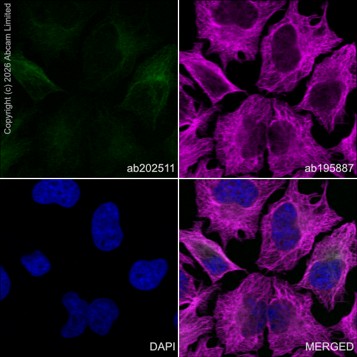
AB202511
Alexa Fluor® 555 Anti-CD90 / Thy1 antibody [EPR3133]
RabMAb|Recombinant
- 3
- 1
Primary Antibodies
AB92574
Anti-CD90 / Thy1 antibody [EPR3132]
BOND RX™ Validated|20ul selling size|RabMAb|Recombinant|KO Validated

- 5
- 6
Primary Antibodies
AB216449
Anti-CD90 / Thy1 antibody [EPR3133] - Low endotoxin, Azide free
RabMAb|Recombinant|KO Validated

- 0
- 0
Primary Antibodies
AB226123
Anti-CD90 / Thy1 antibody [EPR3133] - BSA and Azide free
RabMAb|Recombinant|KO Validated

- 5
- 1
Primary Antibodies
AB202334
Alexa Fluor® 647 Anti-CD90 / Thy1 antibody [EPR3133]
RabMAb|Recombinant

- 3
- 1
Primary Antibodies
AB181885
Anti-CD90 / Thy1 antibody [EPR3132] - BSA and Azide free
BOND RX™ Validated|RabMAb|Recombinant|KO Validated

- 5
- 2
Primary Antibodies
AB133350
Anti-CD90 / Thy1 antibody [EPR3133]
20ul selling size|RabMAb|Recombinant|KO Validated

- 4
- 6
組合せ製品
Primary Antibodies
AB281586
BOND RX™ Validated|20ul selling size|RabMAb|Recombinant

- 5
- 3
Primary Antibodies
AB81289
BOND RX™ Validated|RabMAb|Recombinant|20ul selling size

- 4
- 56
Primary Antibodies
AB189524
RabMAb|Recombinant|Lab Essentials|20ul selling size|KO Validated

- 5
- 1
Primary Antibodies
AB124964
Anti-alpha smooth muscle Actin antibody [EPR5368]
BOND RX™ Validated|RabMAb|Recombinant|KO Validated|20ul selling size

- 5
- 19
Reactivity data
製品の詳細
The affinity of the Fab' of MRC OX-7 for rat Thy-1 is 3 x 10⁹m-1 and for mouse Thy-1.1 is 3 x 10⁸m-1.
Want a custom formulation?
This antibody clone is manufactured by Abcam. If you require a custom buffer formulation or conjugation for your experiments, please contact orders@abcam.com
出荷温度及び保存条件
製品の状態
精製方法
バッファー組成
出荷温度
短期保存期間
短期保存温度
長期保存温度
分注に関する情報
保管に関する情報
補足情報
This supplementary information is collated from multiple sources and compiled automatically.
Biological function summary
CD90 plays a role in cell-cell and cell-matrix interactions contributing to cellular adhesion migration and signal transduction. It functions as part of a complex involving integrins which mediate its interaction with the extracellular matrix. This protein also influences T-cell activation reflecting its importance in immune response regulation. Its presence aids in modulating response to injury and promoting tissue repair due to its association with stem and progenitor cells.
Pathways
CD90 engagement affects focal adhesion and MAPK signaling pathways. It interacts with integrins like αvβ3 and α5β1 influencing cell movement and proliferation processes. CD90 involvement in these pathways allows it to regulate responses important for cell survival and communication within various tissues. These interactions highlight the protein's role in maintaining cellular homeostasis and regulating physiological processes.
製品プロトコール
- Visit the General protocols
- Visit the Troubleshooting
ターゲットの情報
文献 (140)
Recent publications for all applications. Explore the full list and refine your search
iScience 28:112832 PubMed40687841
2025
Applications
Unspecified application
Species
Unspecified reactive species
Pharmaceutics 16: PubMed39458645
2024
Applications
Unspecified application
Species
Unspecified reactive species
Cell proliferation 58:e13756 PubMed39358887
2024
Applications
Unspecified application
Species
Unspecified reactive species
Cellular and molecular biology (Noisy-le-Grand, France) 70:217-223 PubMed38836657
2024
Applications
Unspecified application
Species
Unspecified reactive species
Biology open 13: PubMed38742438
2024
Applications
Unspecified application
Species
Unspecified reactive species
Journal of cellular and molecular medicine 28:e18236 PubMed38509746
2024
Applications
Unspecified application
Species
Unspecified reactive species
International journal of oral science 16:3 PubMed38221531
2024
Applications
Unspecified application
Species
Unspecified reactive species
Autophagy 20:1314-1334 PubMed38174993
2024
Applications
Unspecified application
Species
Unspecified reactive species
Neural regeneration research 19:1812-1821 PubMed38103248
2023
Applications
Unspecified application
Species
Unspecified reactive species
International journal of oral science 15:48 PubMed37852994
2023
Applications
Unspecified application
Species
Unspecified reactive species
Abcam product promise
Please note: All products are 'FOR RESEARCH USE ONLY. NOT FOR USE IN DIAGNOSTIC OR THERAPEUTIC PROCEDURES'.
For licensing inquiries, please contact partnerships@abcam.com