Anti-CD63 抗体 [MX-49.129.5]
Anti-CD63 antibody [MX-49.129.5]
- BOND RX™ Validated
- Recombinant
- 詳細を見る
0
(2 Reviews)
|
(120 Publications)
Anti-CD63 antibody [MX-49.129.5] (ab193349) is a mouse monoclonal antibody detecting CD63 in Western Blot, Flow Cytometry (Intra), Flow Cytometry, IHC-P, ICC/IF. Suitable for Human.
- Over 90 publications
別名を表示する
CD63, MLA1, TSPAN30, CD63 antigen, Granulophysin, Lysosomal-associated membrane protein 3, Lysosome integral membrane protein 1, Melanoma-associated antigen ME491, OMA81H, Ocular melanoma-associated antigen, Tetraspanin-30, LAMP-3, Limp1, Tspan-30
- ICC/IF
Supplier Data
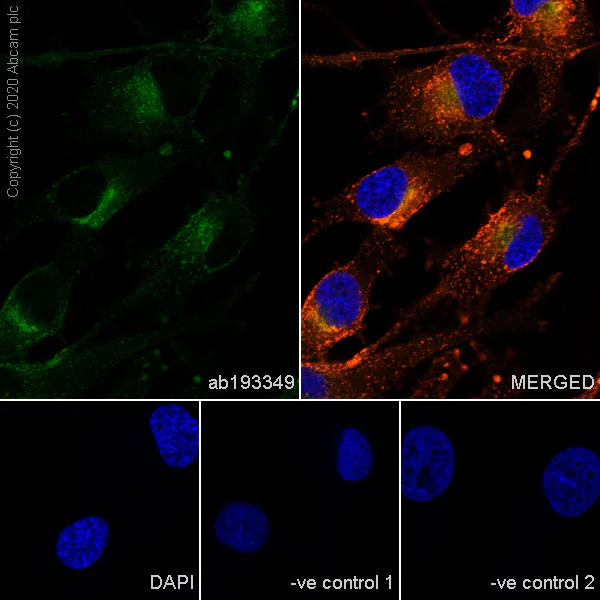
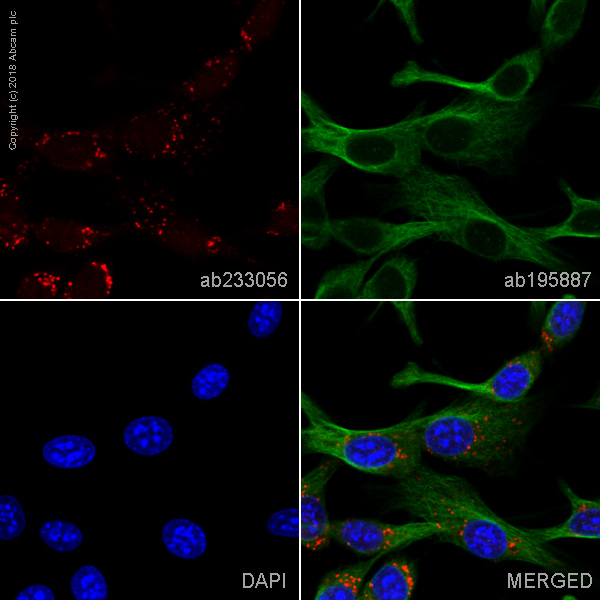
Immunocytochemistry/ Immunofluorescence - Anti-CD63 antibody [MX-49.129.5] (AB193349)
Immunofluorescent analysis of 4% paraformaldehyde-fixed, 0.1% Triton X-100 permeabilized SK-MEL-28 (Human malignant melanoma) cells labelling CD63 with ab193349 at 1/50 dilution, followed by Goat Anti-Mouse IgG H&L (Alexa Fluor® 488) (ab150113) secondary antibody at 1/1000 dilution (green). Confocal image showing cytoplasmic staining in SK-MEL-28 cell line. The nuclear counter stain is DAPI (blue).
CD63 is also detected with Rabbit monoclonal Anti-CD63 antibody [EPR22458-280] (ab252919) at 1/100 dilution, followed by Goat Anti-Rabbit IgG H&L (Alexa Fluor® 594) (ab150080) secondary antibody at 1/500 dilution (red).
The negative controls are as follows :
-ve control 1 : ab193349 at 1/50 dilution, followed by Goat Anti-Rabbit IgG H&L (Alexa Fluor® 594) (ab150080) secondary antibody at 1/500 dilution.
-ve control 2 : Anti-CD63 antibody [EPR22458-280] (ab252919) at 1/100 dilution, followed by Goat Anti-Mouse IgG H&L (Alexa Fluor® 488) (Alexa Fluor® 488) (ab150113) secondary antibody at 1/1000 dilution.
- IHC-P
Supplier Data
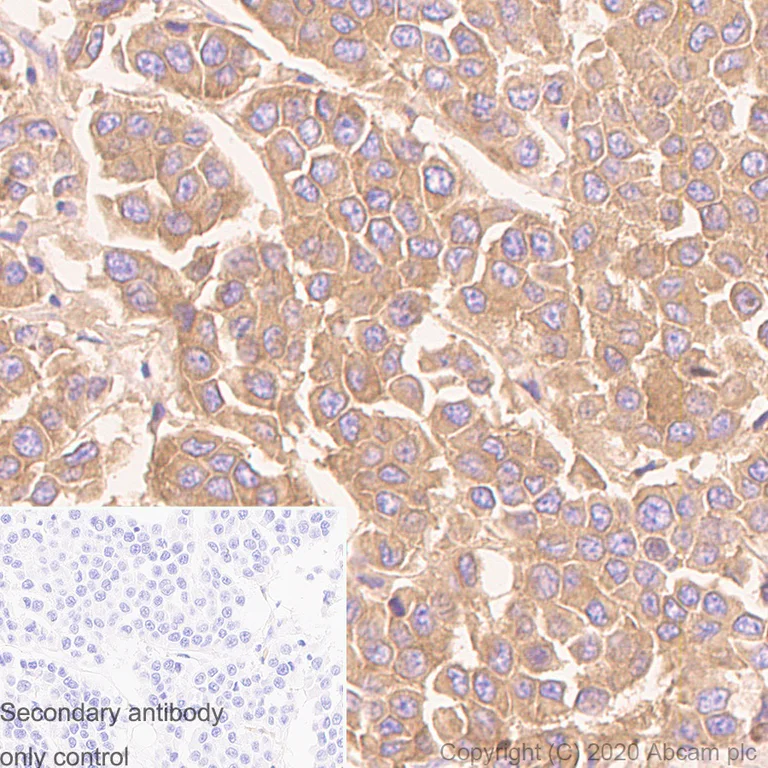
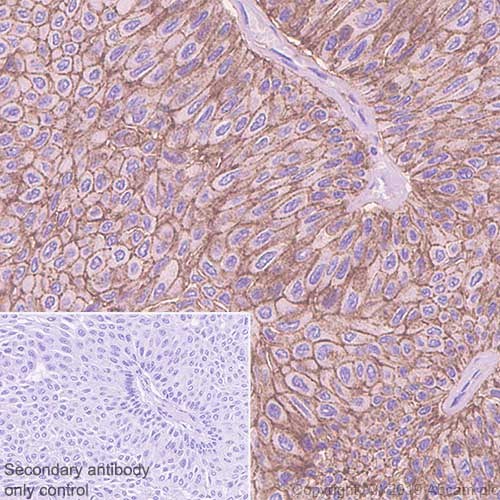
Immunohistochemistry (Formalin/PFA-fixed paraffin-embedded sections) - Anti-CD63 antibody [MX-49.129.5] (AB193349)
Immunohistochemical analysis of paraffin-embedded human melanoma tissue labelling CD63 with ab193349 at 1/5000 dilution, followed by Goat Anti-Mouse IgG H&L (HRP polymer) (ab214879) at the supplied dilution. Cytoplasmic staining on human melanoma is observed. Counter stained with Hematoxylin. Heat mediated antigen retrieval with Citrate buffer (pH 6.0, epitope retrieval solution 1) was performed for 20 mins, before the section was incubated with ab193349 for 30 mins at room temperature. The immunostaining was performed on a Leica Biosystems BOND® RX instrument.
Secondary antibody only control : Used PBS instead of primary antibody.
- IHC-P
Supplier Data
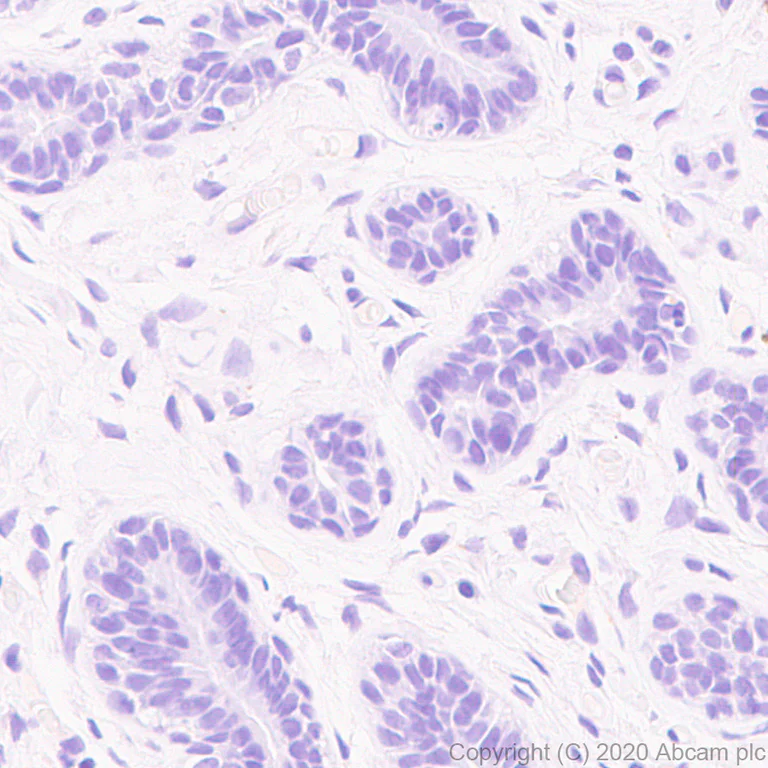
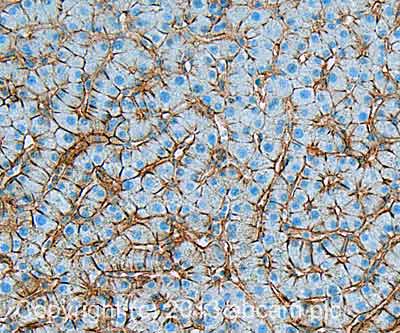
Immunohistochemistry (Formalin/PFA-fixed paraffin-embedded sections) - Anti-CD63 antibody [MX-49.129.5] (AB193349)
Negative control staining using ab193349. Immunohistochemical analysis of paraffin-embedded human breast tissue labelling CD63 with ab193349 at 1/5000 dilution, followed by Goat Anti-Mouse IgG H&L (HRP polymer) (ab214879) at the supplied dilution. No staining on human breast is observed, as expected (PMID : 22957045). Counter stained with Hematoxylin. Heat mediated antigen retrieval with Citrate buffer (pH 6.0, epitope retrieval solution 1) was performed for 20 mins, before the section was incubated with ab193349 for 30 mins at room temperature. The immunostaining was performed on a Leica Biosystems BOND® RX instrument.
- Flow Cyt
Supplier Data
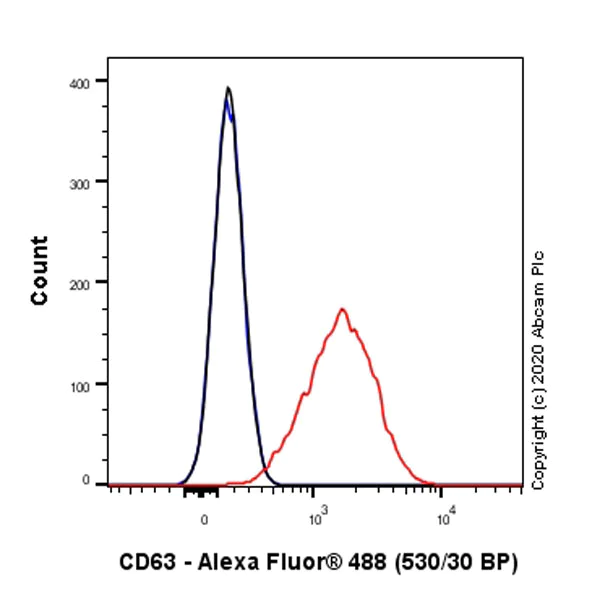
Flow Cytometry - Anti-CD63 antibody [MX-49.129.5] (AB193349)
Flow cytometric analysis of SK-MEL-28 (Human malignant melanoma) cell line labelling CD63 with ab193349 at 1/1000 dilution (red) compared with a Mouse monoclonal IgG (black) and an unlabelled control (cells without incubation with primary antibody and secondary antibody) (blue). Goat Anti-Mouse IgG H&L (Alexa Fluor® 488, ab150113) at 1/2000 dilution was used as the secondary antibody.
Gated on viable cells.
- Flow Cyt (Intra)
Supplier Data
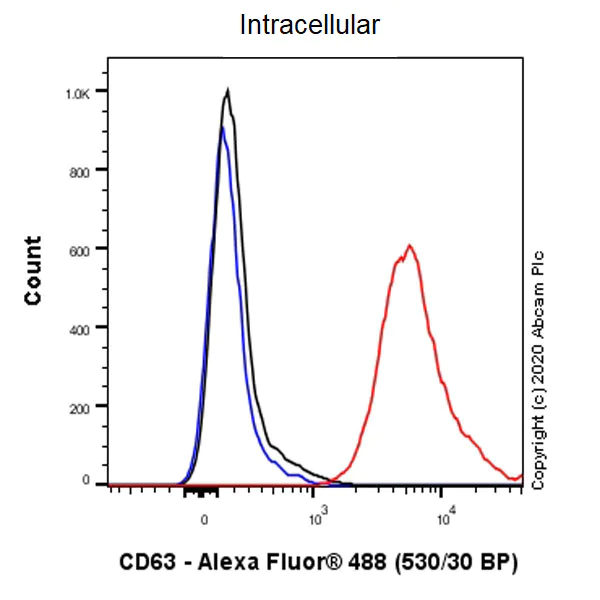
Flow Cytometry (Intracellular) - Anti-CD63 antibody [MX-49.129.5] (AB193349)
Flow cytometric (intracellular) analysis of 4% paraformaldehyde-fixed, 90% methanol permeabilised SK-MEL-28 (Human malignant melanoma) cell line labelling CD63 with ab193349 at 1/1000 dilution (red) compared with a Mouse monoclonal IgG (black) and an unlabelled control (cells without incubation with primary antibody and secondary antibody) (blue). Goat Anti-Mouse IgG H&L (Alexa Fluor® 488, ab150113) at 1/2000 dilution was used as the secondary antibody.
- Flow Cyt
Supplier Data
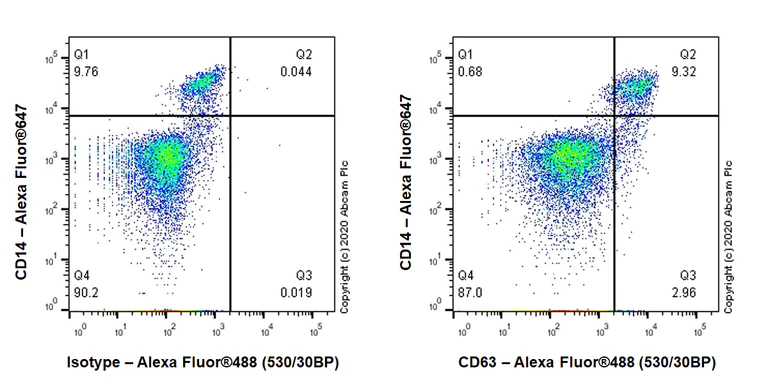
Flow Cytometry - Anti-CD63 antibody [MX-49.129.5] (AB193349)
Flow cytometric analysis of human peripheral blood mononuclear cells (PBMC) labeling CD63 with ab193349 at 1/1000 dilution (right), compared with a Mouse monoclonal IgG (left). Goat anti mouse IgG (Alexa Fluor® 488, ab150113), at 1/2000 dilution was used as the secondary antibody.
Cells were stained with mouse IgG or ab193349, then stained with anti-CD14 conjugated to Alexa Fluor® 647. Gated on viable cells.
- WB
Supplier Data
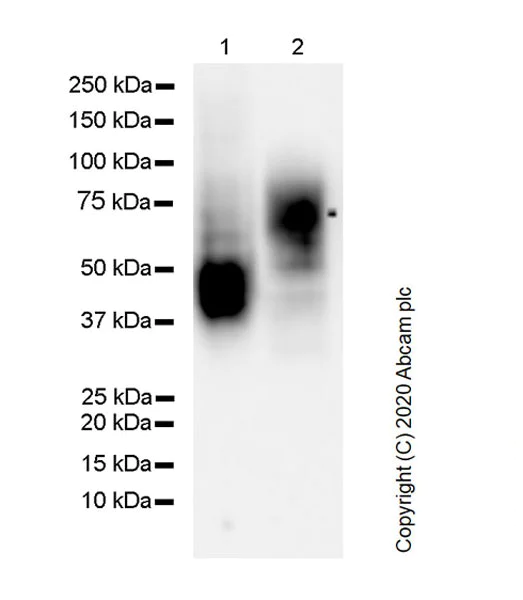
Western blot - Anti-CD63 antibody [MX-49.129.5] (AB193349)
Blocking and diluting buffer and concentration : 5% NFDM/TBST.
CD63 can undergo glycosylation as shown in lane 1 and 2 (PMID : 9890706, 28740179).
Samples are non-boiled as boiling may cause protein aggregates.
All lanes:
Western blot - Anti-CD63 antibody [MX-49.129.5] (ab193349) at 1/1000 dilution
Lane 1:
HUVEC (human umbilical vein endothelial cell), whole cell lysate at 40 µg
Lane 2:
HL-60 (human Acute Promyelocytic Leukemia promyeloblast), whole cell lysate at 40 µg
Secondary
All lanes:
Peroxidase-Conjugated Goat anti-Mouse IgG (H+L) at 1/10000 dilution
false
Exposure time: 59s
関連する標識済み抗体及び組成の異なる製品 (2)
-
Anti-CD63 antibody [MX-49.129.5] - BSA and Azide free
-
578 PE
PE Anti-CD63 antibody [MX-49.129.5]
代替製品

Primary Antibodies
AB134045
Anti-CD63 antibody [EPR5702] - Late Endosome Marker
20ul selling size|RabMAb|Recombinant|KO Validated|Lab Essentials

- 3
- 6
Primary Antibodies
AB215821
Anti-CD63 antibody [EPR5702] - BSA and Azide free
RabMAb|Recombinant|KO Validated
- 0
- 0
Primary Antibodies
AB227892
Anti-CD63 antibody [EPR21151] - BSA and Azide free
RabMAb|Recombinant
- 0
- 0
組合せ製品
Primary Antibodies
AB125011
Anti-TSG101 antibody [EPR7130(B)]
20ul selling size|BOND RX™ Validated|RabMAb|Recombinant

- 4
- 10
Primary Antibodies
AB236630
Anti-CD9 antibody [EPR23105-121]
20ul selling size|BOND RX™ Validated|RabMAb|Recombinant|KO Validated
- 5
- 4

Reactivity data
製品の詳細
What is this antibody validated in?
Anti-CD63 antibody [MX-49.129.5] (ab193349) is a mouse recombinant monoclonal antibody and is validated for use in Western Blot (WB), Flow Cytometry (Intra), Flow Cytometry (Flow Cyt), Immunohistochemistry (IHC-P), Immunocytochemistry/immunofluorescence (ICC/IF) in Human samples.
What is the molecular weight of CD63?
Anti-CD63 [MX-49.129.5] (ab193349) specifically detects a band for CD63 (UniProt: P08962) at a molecular weight of 25kDa.
Trusted by the scientific community
Anti-CD63 [MX-49.129.5] (ab193349) was first used in a scientific publication in 2014 and has been cited over 90 times in peer-reviewed journals.
Other related products
We have a range of other formats of antibody clone [MX-49.129.5] also available for your convenience: ab193349, PE - ab205540, Carrier free - ab213092
What are the advantages of a recombinant monoclonal antibody?
This product is a recombinant monoclonal antibody, which offers several advantages including:
- - High batch-to-batch consistency and reproducibility
- - Improved sensitivity and specificity
- - Long-term security of supply
- - Animal-free batch production
For more information, read more on recombinant antibodies.
出荷温度及び保存条件
製品の状態
精製方法
バッファー組成
出荷温度
短期保存期間
短期保存温度
長期保存温度
分注に関する情報
保管に関する情報
補足情報
This supplementary information is collated from multiple sources and compiled automatically.
Biological function summary
CD63 participates in various cellular processes including membrane trafficking cell adhesion and signal transduction. It associates with integrins and other tetraspanins forming complexes that influence cellular adhesion and migration. Through its role in exosome formation CD63 contributes significantly to intercellular communication by facilitating the transfer of proteins lipids and RNA between cells.
Pathways
CD63 plays a role in pathways linked to cell proliferation and migration and immune response regulation. Within the integrin-mediated signaling pathway CD63 interacts with proteins such as integrins to promote cell adhesion and migration. CD63 also links to vesicle trafficking pathways collaborating with proteins involved in exocytosis and endocytosis which affect cell membrane restructuring and intracellular transport.
製品プロトコール
- Visit the General protocols
- Visit the Troubleshooting
ターゲットの情報
文献 (120)
Recent publications for all applications. Explore the full list and refine your search
EBioMedicine 119:105884 PubMed40803203
2025
Applications
Unspecified application
Species
Unspecified reactive species
iScience 28:112862 PubMed40612503
2025
Applications
Unspecified application
Species
Unspecified reactive species
Journal of nanobiotechnology 23:278 PubMed40189497
2025
Applications
Unspecified application
Species
Unspecified reactive species
Diabetes, obesity & metabolism 27:1153-1163 PubMed39632777
2024
Applications
Unspecified application
Species
Unspecified reactive species
Journal of nanobiotechnology 22:563 PubMed39272146
2024
Applications
Unspecified application
Species
Unspecified reactive species
Journal of extracellular vesicles 13:e12482 PubMed39105261
2024
Applications
Unspecified application
Species
Unspecified reactive species
Metabolic brain disease 39:1335-1351 PubMed39088109
2024
Applications
Unspecified application
Species
Unspecified reactive species
BMC cardiovascular disorders 24:365 PubMed39014329
2024
Applications
Unspecified application
Species
Unspecified reactive species
Cancer biology & therapy 25:2364433 PubMed38926911
2024
Applications
Unspecified application
Species
Unspecified reactive species
Cell reports. Medicine 5:101588 PubMed38781961
2024
Applications
Unspecified application
Species
Unspecified reactive species
Abcam product promise
Please note: All products are 'FOR RESEARCH USE ONLY. NOT FOR USE IN DIAGNOSTIC OR THERAPEUTIC PROCEDURES'.
For licensing inquiries, please contact partnerships@abcam.com