JavaScript is disabled in your browser. Please enable JavaScript to view this website.
AB270034

Anti-CD28 抗体 [EPR23280-63] - BSA and Azide free

Anti-CD28 antibody [EPR23280-63] - BSA and Azide free

Be the first to review this product! Submit a review

|

(0 Publication)

Rabbit Recombinant Monoclonal CD28 antibody. Carrier free. Suitable for Flow Cyt and reacts with Mouse samples.

別名を表示する

CD28, T-cell-specific surface glycoprotein CD28, Cd28
1 Images
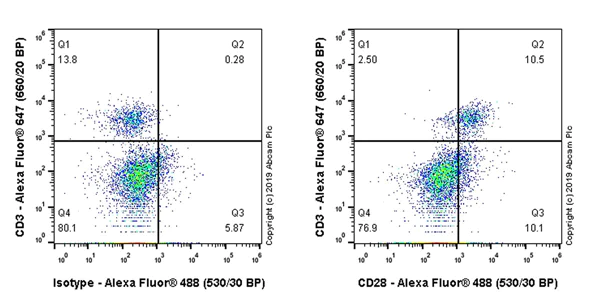
Flow Cytometry - Anti-CD28 antibody [EPR23280-63] - BSA and Azide free (AB270034)
  • Flow Cyt

Supplier Data

Flow Cytometry - Anti-CD28 antibody [EPR23280-63] - BSA and Azide free (AB270034)

Flow cytometric analysis of mouse splenocytes labelling CD28 with ab246517 at 1/500 dilution (0.1ug) (Right) compared with a Rabbit monoclonal IgG isotype control (ab172730) (Left). Goat anti rabbit IgG (Alexa Fluor® 488, ab150077) at 1/2000 dilution was used as the secondary antibody.

Cells were stained with rabbit IgG (Left) or ab246517 (Right). Then stained with anti-CD3 conjugated to Alexa Fluor® 647.

Gated on viable cells.

This data was developed using the same antibody clone in a different buffer formulation containing PBS, BSA, glycerol, and sodium azide (ab246517).

関連する標識済み抗体及び組成の異なる製品 (3)

  • Unconjugated

    Anti-CD28 antibody [EPR23280-63]

  • 665 Alexa Fluor® 647

    Alexa Fluor® 647 Anti-CD28 antibody [EPR23280-63]

  • 578 PE

    PE Anti-CD28 antibody [EPR23280-63]

Key facts

宿主種

Rabbit

クローン性

Monoclonal

クローン番号

EPR23280-63

アイソタイプ

IgG

キャリアフリー

Yes

交差種

Mouse

アプリケーション

Flow Cyt

applications

免疫原

The exact immunogen used to generate this antibody is proprietary information.

Reactivity data

{ "title": "Reactivity Data", "filters": { "stats": ["", "Species", "Dilution Info", "Notes"], "tabs": { "all-applications": {"fullname" : "All Applications", "shortname": "All Applications"}, "IP" : {"fullname" : "Immunoprecipitation", "shortname":"IP"}, "FlowCyt" : {"fullname" : "Flow Cytometry", "shortname":"Flow Cyt"}, "WB" : {"fullname" : "Western blot", "shortname":"WB"}, "IHCP" : {"fullname" : "Immunohistochemistry (Formalin/PFA-fixed paraffin-embedded sections)", "shortname":"IHC-P"}, "ICCIF" : {"fullname" : "Immunocytochemistry/ Immunofluorescence", "shortname":"ICC/IF"} }, "product-promise": { "all": "all", "testedAndGuaranteed": "tested", "guaranteed": "expected", "predicted": "predicted", "notRecommended": "not-recommended" } }, "values": { "Human": { "IP-species-checked": "notRecommended", "IP-species-dilution-info": "", "IP-species-notes": "", "FlowCyt-species-checked": "notRecommended", "FlowCyt-species-dilution-info": "", "FlowCyt-species-notes": "", "WB-species-checked": "notRecommended", "WB-species-dilution-info": "", "WB-species-notes": "<p></p>", "IHCP-species-checked": "notRecommended", "IHCP-species-dilution-info": "", "IHCP-species-notes": "<p></p>", "ICCIF-species-checked": "notRecommended", "ICCIF-species-dilution-info": "", "ICCIF-species-notes": "" }, "Mouse": { "IP-species-checked": "notRecommended", "IP-species-dilution-info": "", "IP-species-notes": "<p></p>", "FlowCyt-species-checked": "testedAndGuaranteed", "FlowCyt-species-dilution-info": "", "FlowCyt-species-notes": "<p></p>", "WB-species-checked": "notRecommended", "WB-species-dilution-info": "", "WB-species-notes": "<p></p>", "IHCP-species-checked": "notRecommended", "IHCP-species-dilution-info": "", "IHCP-species-notes": "<p></p>", "ICCIF-species-checked": "notRecommended", "ICCIF-species-dilution-info": "", "ICCIF-species-notes": "<p></p>" }, "Rat": { "IP-species-checked": "notRecommended", "IP-species-dilution-info": "", "IP-species-notes": "", "FlowCyt-species-checked": "notRecommended", "FlowCyt-species-dilution-info": "", "FlowCyt-species-notes": "", "WB-species-checked": "notRecommended", "WB-species-dilution-info": "", "WB-species-notes": "<p></p>", "IHCP-species-checked": "notRecommended", "IHCP-species-dilution-info": "", "IHCP-species-notes": "<p></p>", "ICCIF-species-checked": "notRecommended", "ICCIF-species-dilution-info": "", "ICCIF-species-notes": "" } } }

製品の詳細

ab270034 is the carrier-free version of ab246517.

Patented technology
Our RabMAb® technology is a patented hybridoma-based technology for making rabbit monoclonal antibodies. For details on our patents, please refer to RabMAb® patents.

What are the advantages of a recombinant monoclonal antibody?
This product is a recombinant monoclonal antibody, which offers several advantages including:

  • - High batch-to-batch consistency and reproducibility
  • - Improved sensitivity and specificity
  • - Long-term security of supply
  • - Animal-free batch production

For more information, read more on recombinant antibodies.

Conjugation ready
Our carrier-free antibodies are typically supplied in a PBS-only formulation, purified and free of BSA, sodium azide and glycerol. This conjugation-ready format is designed for use with fluorochromes, metal isotopes, oligonucleotides, and enzymes, which makes them ideal for antibody labelling, functional and cell-based assays, flow-based assays (e.g. mass cytometry) and Multiplex Imaging applications.

Use our conjugation kits for antibody conjugates that are ready-to-use in as little as 20 minutes with 1 minute hands-on-time and 100% antibody recovery: available for fluorescent dyes, HRP, biotin and gold.

Compatibility
This product is compatible with the Maxpar® Antibody Labeling Kit from Fluidigm, without the need for antibody preparation. Maxpar® is a trademark of Fluidigm Canada Inc.

出荷温度及び保存条件

製品の状態
Liquid
精製方法
Affinity purification Protein A
バッファー組成
pH: 7.2 - 7.4 Constituents: PBS
出荷温度
Blue Ice
短期保存温度
+4°C
長期保存温度
+4°C
保管に関する情報
Do Not Freeze

補足情報

This supplementary information is collated from multiple sources and compiled automatically.

CD28 also known as T-cell-specific surface glycoprotein CD28 or TP44 plays an important role as a co-stimulatory receptor on T cells. This glycoprotein has a molecular mass of about 44 kDa and is located mainly on the cell surface of T cells. CD28 expression also occurs on thymocytes and some B cells. It forms part of the immunoglobulin superfamily featuring in significant antibody interactions. Researchers often use anti-CD28 antibodies for various immunological assays including CD28 ELISA to study its function.
Biological function summary

CD28 co-stimulates T cells after antigen presentation. It enhances T cell proliferation survival and cytokine production. CD28 functions alongside the T cell receptor (TCR) complex mediating signals that promote full T cell activation. This interaction amplifies the immune response forming an important axis of immune system communication. CD28 interacts with its ligands B7-1 (CD80) and B7-2 (CD86) found on antigen-presenting cells (APCs) illustrating its role in immune system dynamics.

Pathways

CD28 is integral to the PI3K/Akt and MAPK/ERK signaling pathways. These pathways conduct signals critical for cellular growth and survival linking CD28 to downstream transcription factors. The interaction with another protein CTLA-4 acts as a regulatory balance for CD28 signaling preventing over-activation of T cells. This balance influences immune homeostasis and tolerance providing a framework for understanding costimulatory and inhibitory signaling.

CD28's role becomes evident in autoimmune diseases and transplant rejection. Abnormal CD28 signaling links to rheumatoid arthritis where inappropriate T cell activation occurs. Similarly CD28 activity contributes to organ transplant rejection by stimulating T cell-mediated responses against transplanted tissues. CTLA-4 through regulatory feedback can modify these effects providing therapeutic target strategies for managing such disorders. Efforts to modulate CD28 activity involve developing therapeutic agents such as anti-CD28 monoclonal antibodies.

製品プロトコール

For this product, it's our understanding that no specific protocols are required. You can visit:

ターゲットの情報

Receptor that plays a role in T-cell activation, proliferation, survival and the maintenance of immune homeostasis (PubMed : 7688139). Functions not only as an amplifier of TCR signals but delivers unique signals that control intracellular biochemical events that alter the gene expression program of T-cells. Stimulation upon engagement of its cognate ligands CD80 or CD86 increases proliferation and expression of various cytokines in particular IL2 production in both CD4(+) and CD8(+) T-cell subsets. Mechanistically, ligation induces recruitment of protein kinase C-theta/PRKCQ and GRB2 leading to NF-kappa-B activation via both PI3K/Akt-dependent and -independent pathways. In conjunction with TCR/CD3 ligation and CD40L costimulation, enhances the production of IL4 and IL10 in T-cells.
See full target information Cd28

Abcam product promise

当社は、高品質な試薬を通じてお客様の研究を力強くサポートすることをお約束いたします。ご使用いただく各段階で、常にお客様をサポートできる体制を整えております。万が一、製品が期待通りに機能しない場合は、「Abcam Product Promise」による当社保証制度に基づき、安心してご利用いただけます。
保証に関する詳細については利用規約をご確認ください。

Please note: All products are 'FOR RESEARCH USE ONLY. NOT FOR USE IN DIAGNOSTIC OR THERAPEUTIC PROCEDURES'.

For licensing inquiries, please contact partnerships@abcam.com