Anti-CD276 抗体 [SP265] - C-terminal
Anti-CD276 antibody [SP265] - C-terminal
- 20ul selling size
- RabMAb
- Recombinant
- KO Validated
- 詳細を見る
Be the first to review this product! Submit a review
|
(3 Publications)
Rabbit Recombinant Monoclonal CD276 antibody. C-terminal. Suitable for Flow Cyt, WB, ICC/IF and reacts with Human samples. Cited in 3 publications.
別名を表示する
CD276, B7H3, PSEC0249, UNQ309/PRO352, CD276 antigen, 4Ig-B7-H3, B7 homolog 3, Costimulatory molecule, B7-H3
- Flow Cyt (Intra)
Lab
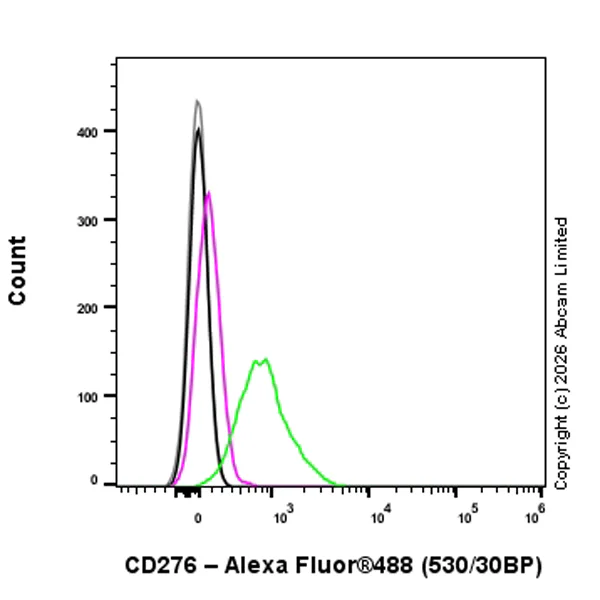
Flow Cytometry (Intracellular) - Anti-CD276 antibody [SP265] - C-terminal (AB227679)
Flow cytometric overlay histogram analysis of 4% paraformaldehyde cells labelling CD276 KO HEK293T (ED040783) (Magenta and grey) cells permeabilised with 90% methanol and Parental HEK293T (EDWT04) (Green and black) cells permeabilised with 90% methanol labelling CD276 with ab227679 at 1/20 dilution (Magenta and Green) compared with a Rabbit monoclonal IgG (ab172730) (Black and Grey) Isotype control. Goat Anti-Rabbit IgG (Alexa Fluor® 488) (ab150081), at 1/5000 dilution was used as the secondary antibody.
- ICC/IF
Lab
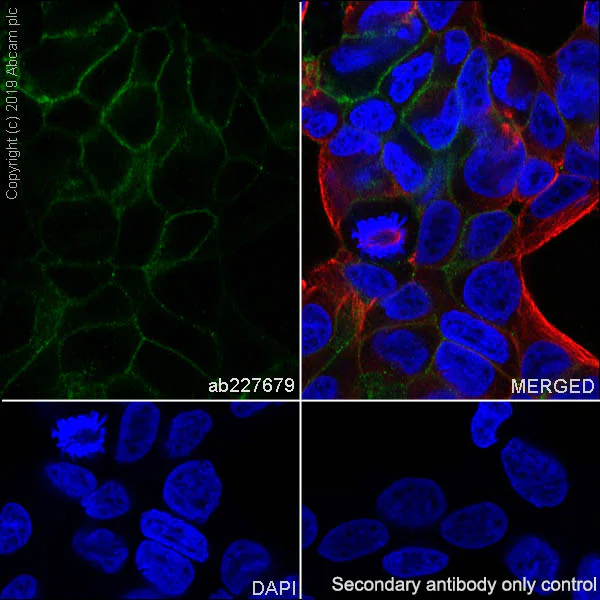
Immunocytochemistry/ Immunofluorescence - Anti-CD276 antibody [SP265] - C-terminal (AB227679)
Immunocytochemistry/ Immunofluorescence analysis of LNCaP (Human prostate carcinoma epithelial cell) cells labeling CD276 with purified ab227679 at 1/25 (9.24 μg/ml). Cells were fixed in 4% paraformaldehyde and permeabilized with 0.1% Triton X-100. Cells were counterstained with ab195889 Anti-alpha Tubulin antibody [DM1A] - Microtubule Marker (Alexa Fluor® 594) 1/200 (2.5 μg/ml). Goat anti rabbit IgG (Alexa Fluor® 488 ab150077) was used as the secondary antibody at 1/1000 (2 μg/ml) dilution. DAPI (blue) was used as nuclear counterstain. PBS instead of the primary antibody was used as the secondary antibody only control.
- Flow Cyt
Supplier Data
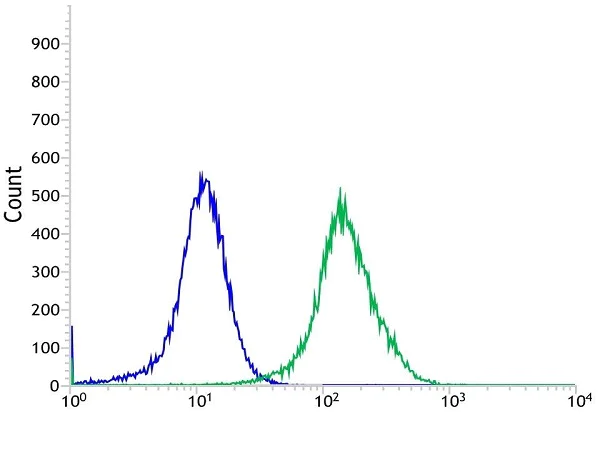
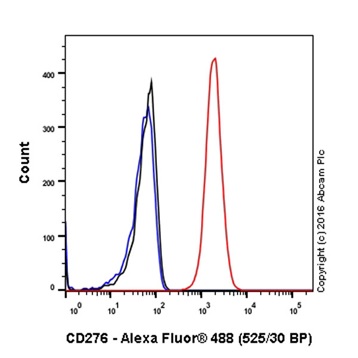
Flow Cytometry - Anti-CD276 antibody [SP265] - C-terminal (AB227679)
Flow cytometric analysis of PC-3 (human prostate adenocarcinoma cell line) cell line labeling CC276 with ab227679 at 1/400 (green) compared with a rabbit isotype control (blue).
- WB
Lab
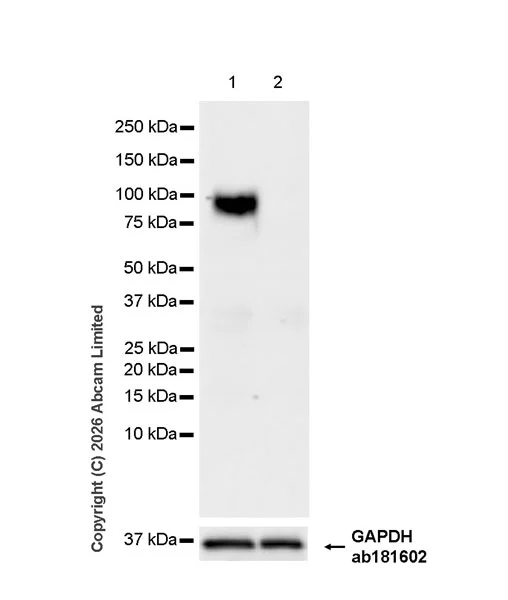
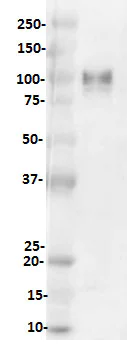
Western blot - Anti-CD276 antibody [SP265] - C-terminal (AB227679)
Blocking and diluting buffer and concentration : 5% NFDM/TBST.
Performed under reducing conditions.
In Western blot, ab227679 was shown to bind specifically to CD276. Target of interest was observed at 90-100 kDa in wild-type HEK-293T cell lysates (lane 1) with no signal observed at this size in CD276 knockout cell line (lane 2) (lane 2, knockout cell line ab266658.
All lanes:
Western blot - Anti-CD276 antibody [SP265] - C-terminal (ab227679) at 1/1000 dilution
Lane 1:
Wild-type HEK-293T (human embryonic kidney epithelial cell) whole cell lysate at 50 µg
Lane 2:
CD276 knockout HEK-293T whole cell lysate at 50 µg
Lane 2:
Western blot - Human CD276 knockout HEK-293T cell line (<a href='/products/cell-lines/human-cd276-knockout-hek-293t-cell-line-ab266658'>ab266658</a>) at 50 µg
Secondary
All lanes:
Western blot - Goat Anti-Rabbit IgG H&L (HRP) (<a href='/products/secondary-antibodies/goat-rabbit-igg-h-l-hrp-ab97051'>ab97051</a>) at 1/20000 dilution
Observed band size: 90-110 kDa,36 kDa
false
Exposure time: 26s
- WB
Supplier Data
Western blot - Anti-CD276 antibody [SP265] - C-terminal (AB227679)
All lanes:
Western blot - Anti-CD276 antibody [SP265] - C-terminal (ab227679) at 1/100 dilution
All lanes:
Hs 700T (human pancreatic adenocarcinoma cell line) cell lysate
Predicted band size: 57 kDa
true
関連する標識済み抗体及び組成の異なる製品 (10)
-
Anti-CD276 antibody [SP265] - BSA and Azide free
-
660 APC
APC Anti-CD276 antibody [SP265] (C-terminal)
-
519 Alexa Fluor® 488
Alexa Fluor® 488 Anti-CD276 antibody [SP265] - C-terminal
-
565 Alexa Fluor® 555
Alexa Fluor® 555 Anti-CD276 antibody [SP265] - C-terminal
-
603 Alexa Fluor® 568
Alexa Fluor® 568 Anti-CD276 antibody [SP265] - C-terminal
-
617 Alexa Fluor® 594
Alexa Fluor® 594 Anti-CD276 antibody [SP265] - C-terminal
-
665 Alexa Fluor® 647
Alexa Fluor® 647 Anti-CD276 antibody [SP265] - C-terminal
-
775 Alexa Fluor® 750
Alexa Fluor® 750 Anti-CD276 antibody [SP265] - C-terminal
-
HRP Anti-CD276 antibody [SP265] (C-terminal)
-
578 PE
PE Anti-CD276 antibody [SP265] (C-terminal)
代替製品
Primary Antibodies
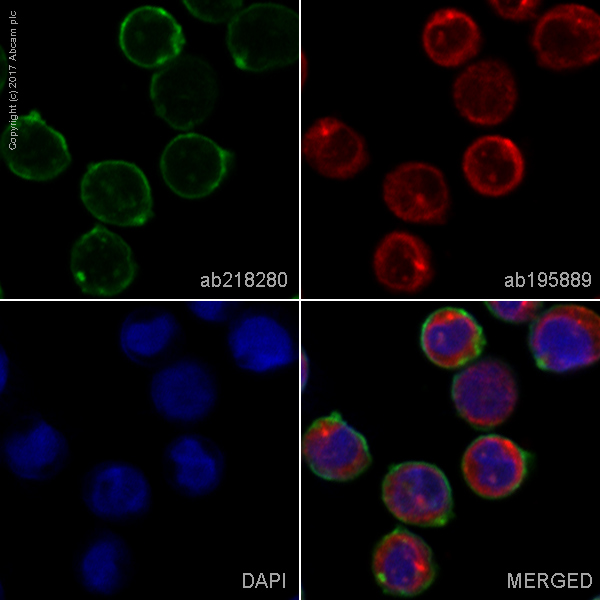
AB218280
Alexa Fluor® 488 Anti-CD276 antibody [EPNCIR122]
RabMAb|Recombinant|KO Validated
- 0
- 0

Primary Antibodies
AB134161
Anti-CD276 antibody [EPNCIR122]
RabMAb|Recombinant|KO Validated|20ul selling size

- 0
- 0
Primary Antibodies
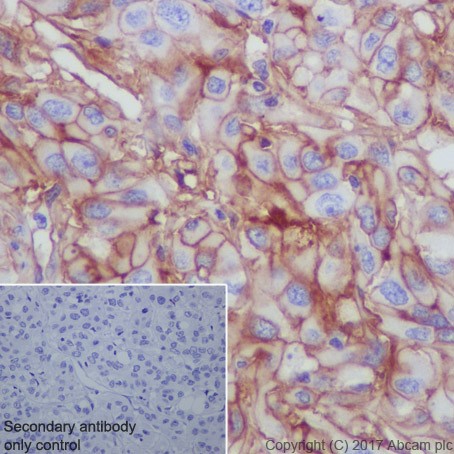
AB219648
Anti-CD276 antibody [EPR20115]
RabMAb|Recombinant|KO Validated|20ul selling size
- 4
- 1
Primary Antibodies
AB256585
Anti-CD276 antibody [EPNCIR122] - BSA and Azide free
RabMAb|Recombinant|KO Validated
- 0
- 0
Primary Antibodies
AB227670
BOND RX™ Validated|RabMAb|Recombinant|KO Validated|20ul selling size

- 5
- 1
Primary Antibodies
AB227577
Anti-CD276 antibody [EPR20115] - BSA and Azide free
RabMAb|Recombinant|KO Validated
- 0
- 1
Primary Antibodies
AB209895
Anti-CD276 antibody [EPNCIR122] - Low endotoxin, Azide free
RabMAb|Recombinant|KO Validated

- 0
- 0
組合せ製品
Primary Antibodies
AB237365
Alexa Fluor® 647 Anti-CD8 alpha antibody [EPR21769]
BOND RX™ Validated|RabMAb|Recombinant

- 0
- 0
Reactivity data
出荷温度及び保存条件
製品の状態
精製方法
精製に関する特記事項
バッファー組成
出荷温度
短期保存期間
短期保存温度
長期保存温度
分注に関する情報
保管に関する情報
補足情報
This supplementary information is collated from multiple sources and compiled automatically.
Biological function summary
CD276 modulates immune responses by acting as a co-inhibitory ligand impacting T-cell proliferation and cytokine synthesis. Not part of a known complex it plays a role in the adaptive immune system by providing negative feedback regulation that can inhibit the immune response. This capability has implications in preventing autoimmunity but may also contribute to tumor immune evasion by reducing effective anti-tumor responses. The B7-H3/CD276 interaction with receptors such as IL receptor family members suggests its diverse immunomodulatory functions.
Pathways
CD276 participates in the T-cell receptor (TCR) signaling pathways influencing immune checkpoint pathways. It interacts with other immune checkpoint proteins like PD-L1 and CTLA-4 but its exact receptor partner remains unidentified. The presence of CD276 in these pathways highlights its role in controlling T-cell activation and tolerance. By modulating TCR signals and impacting downstream effects CD276 serves as a regulatory point that can balance immune activation and inhibition critical in immune-mediated conditions.
製品プロトコール
- Visit the General protocols
- Visit the Troubleshooting
ターゲットの情報
文献 (3)
Recent publications for all applications. Explore the full list and refine your search
Cell reports 44:115089 PubMed39709604
2024
Applications
Unspecified application
Species
Unspecified reactive species
Frontiers in oncology 10:1527 PubMed32984002
2020
Applications
Unspecified application
Species
Unspecified reactive species
Theranostics 10:10498-10512 PubMed32929362
2020
Applications
Unspecified application
Species
Unspecified reactive species
Abcam product promise
Please note: All products are 'FOR RESEARCH USE ONLY. NOT FOR USE IN DIAGNOSTIC OR THERAPEUTIC PROCEDURES'.
For licensing inquiries, please contact partnerships@abcam.com