JavaScript is disabled in your browser. Please enable JavaScript to view this website.
AB283569

Anti-CD130 (gp130) 抗体 [EPR24557-5]

Anti-CD130 (gp130) antibody [EPR24557-5]

Be the first to review this product! Submit a review

|

(0 Publication)

Rabbit Recombinant Monoclonal CD130 (gp130) antibody. Suitable for Flow Cyt and reacts with Human samples.

別名を表示する

CD130, Interleukin-6 receptor subunit beta, IL-6 receptor subunit beta, IL-6R subunit beta, IL-6R-beta, IL-6RB, CDw130, Interleukin-6 signal transducer, Membrane glycoprotein 130, Oncostatin-M receptor subunit alpha, gp130, IL6ST
3 Images
Flow Cytometry - Anti-CD130 (gp130) antibody [EPR24557-5] (AB283569)
  • Flow Cyt

Supplier Data

Flow Cytometry - Anti-CD130 (gp130) antibody [EPR24557-5] (AB283569)

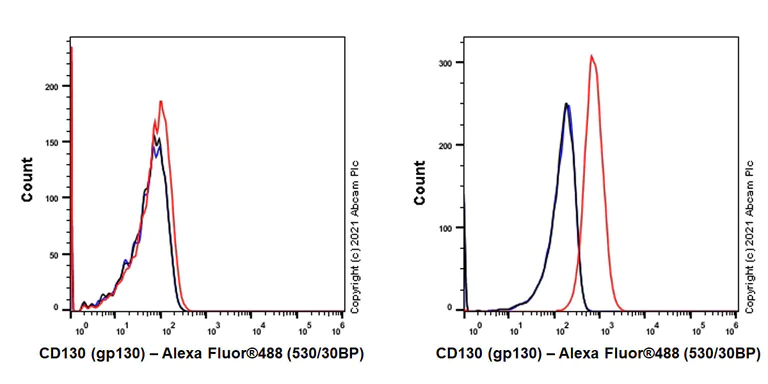
Flow cytometric analysis of Daudi (Human Burkitt's lymphoma lymphoblast) (Left) / MG-63 (human osteosarcoma fibroblast) (Right) cells labelling CD130 (gp130) with ab283569 at 1/50 dilution (1ug)/ (Red) compared with a Rabbit monoclonal IgG (ab172730) (Black) isotype control and an unlabelled control (cells without incubation with primary antibody and secondary antibody) (Blue). Goat F(ab')2 Anti-Rabbit IgG(DyLight® 488, ab98507) at 1/500 dilution was used as the secondary antibody. Gated on viable cells.

Low expression : Daudi (PMID : 2261637).
Flow Cytometry - Anti-CD130 (gp130) antibody [EPR24557-5] (AB283569)
  • Flow Cyt

Supplier Data

Flow Cytometry - Anti-CD130 (gp130) antibody [EPR24557-5] (AB283569)

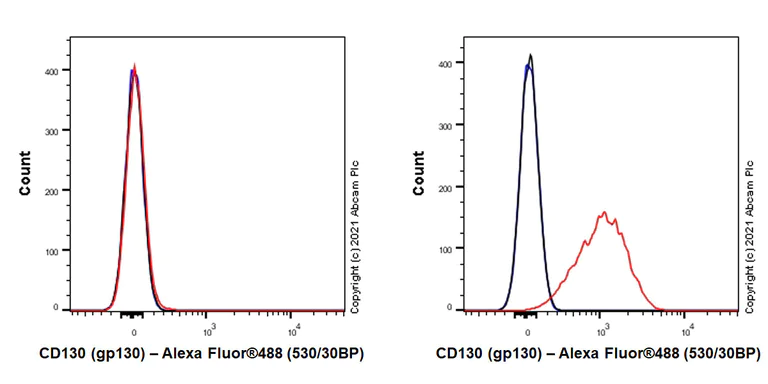
Flow cytometric analysis of Wild-type A549 (Human lung carcinoma epithelial cell) (Right) / CD130 (gp130) knockout A549 cells (Left) cells labelling CD130 (gp130) with ab283569 at 1/500 dilution (0.1ug)/ (Red) compared with a Rabbit monoclonal IgG (ab172730) (Black) isotype control and an unlabelled control (cells without incubation with primary antibody and secondary antibody) (Blue). Goat F(ab')2 Anti-Rabbit IgG(DyLight® 488, ab98507) at 1/500 dilution was used as the secondary antibody. Gated on viable cells.
Flow Cytometry - Anti-CD130 (gp130) antibody [EPR24557-5] (AB283569)
  • Flow Cyt

Lab

Flow Cytometry - Anti-CD130 (gp130) antibody [EPR24557-5] (AB283569)

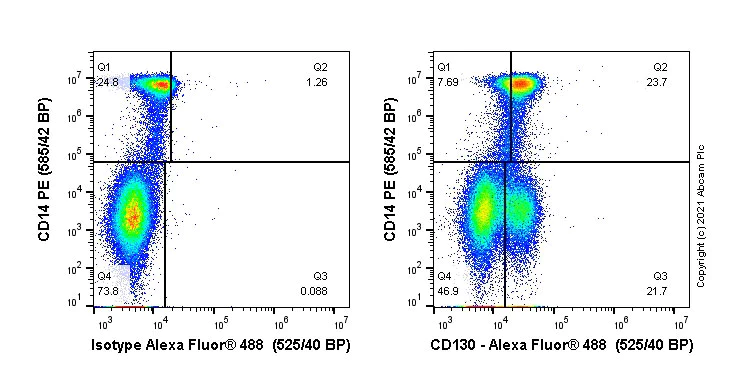
Flow cytometry staining of human peripheral blood mononuclear cells (PBMCs) with ab283569 (right) or Rabbit IgG (monoclonal) (ab172730) isotype (left). PBMCs were incubated for 30 min on ice in 1x PBS containing 10μg/ml human IgG and 10% normal goat serum to block FC receptors and non-specific protein-protein interaction followed by the antibody (ab283569) or Rabbit IgG (monoclonal) (ab172730) isotype (1x10⁶ in 100μl; with 0.01μg antibody) for 30 min on ice.

The secondary antibody Goat anti-rabbit IgG H&L (Alexa Fluor® 488, pre-adsorbed) (ab150081) was used at 1 : 2000 dilution for 30 min on ice.

The cells were simultaneously stained with CD14 PE.

Acquisition of >30000 events were collected using a 50 mW Blue laser (488nm) and 525/40 bandpass filter. Events were gated on viable cells.

関連する標識済み抗体及び組成の異なる製品 (3)

  • Carrier free

    Anti-CD130 (gp130) antibody [EPR24557-5] - BSA and Azide free

  • 665 Alexa Fluor® 647

    Alexa Fluor® 647 Anti-CD130 (gp130) antibody [EPR24557-5]

  • 578 PE

    PE Anti-CD130 (gp130) antibody [EPR24557-5]

Key facts

宿主種

Rabbit

クローン性

Monoclonal

クローン番号

EPR24557-5

アイソタイプ

IgG

キャリアフリー

No

交差種

Human

アプリケーション

Flow Cyt

applications

免疫原

The exact immunogen used to generate this antibody is proprietary information.

Reactivity data

{ "title": "Reactivity Data", "filters": { "stats": ["", "Species", "Dilution Info", "Notes"], "tabs": { "all-applications": {"fullname" : "All Applications", "shortname": "All Applications"}, "IP" : {"fullname" : "Immunoprecipitation", "shortname":"IP"}, "FlowCyt" : {"fullname" : "Flow Cytometry", "shortname":"Flow Cyt"}, "WB" : {"fullname" : "Western blot", "shortname":"WB"}, "IHCP" : {"fullname" : "Immunohistochemistry (Formalin/PFA-fixed paraffin-embedded sections)", "shortname":"IHC-P"}, "ICCIF" : {"fullname" : "Immunocytochemistry/ Immunofluorescence", "shortname":"ICC/IF"} }, "product-promise": { "all": "all", "testedAndGuaranteed": "tested", "guaranteed": "expected", "predicted": "predicted", "notRecommended": "not-recommended" } }, "values": { "Human": { "IP-species-checked": "notRecommended", "IP-species-dilution-info": "", "IP-species-notes": "<p></p>", "FlowCyt-species-checked": "testedAndGuaranteed", "FlowCyt-species-dilution-info": "1/50", "FlowCyt-species-notes": "<p></p>", "WB-species-checked": "notRecommended", "WB-species-dilution-info": "", "WB-species-notes": "<p></p>", "IHCP-species-checked": "notRecommended", "IHCP-species-dilution-info": "", "IHCP-species-notes": "<p></p>", "ICCIF-species-checked": "notRecommended", "ICCIF-species-dilution-info": "", "ICCIF-species-notes": "<p></p>" }, "Mouse": { "IP-species-checked": "notRecommended", "IP-species-dilution-info": "", "IP-species-notes": "<p></p>", "FlowCyt-species-checked": "notRecommended", "FlowCyt-species-dilution-info": "1/50", "FlowCyt-species-notes": "<p></p>", "WB-species-checked": "notRecommended", "WB-species-dilution-info": "", "WB-species-notes": "<p></p>", "IHCP-species-checked": "notRecommended", "IHCP-species-dilution-info": "", "IHCP-species-notes": "<p></p>", "ICCIF-species-checked": "notRecommended", "ICCIF-species-dilution-info": "", "ICCIF-species-notes": "<p></p>" }, "Rat": { "IP-species-checked": "notRecommended", "IP-species-dilution-info": "", "IP-species-notes": "", "FlowCyt-species-checked": "notRecommended", "FlowCyt-species-dilution-info": "1/50", "FlowCyt-species-notes": "<p></p>", "WB-species-checked": "notRecommended", "WB-species-dilution-info": "", "WB-species-notes": "<p></p>", "IHCP-species-checked": "notRecommended", "IHCP-species-dilution-info": "", "IHCP-species-notes": "<p></p>", "ICCIF-species-checked": "notRecommended", "ICCIF-species-dilution-info": "", "ICCIF-species-notes": "" } } }

製品の詳細

Patented technology
Our RabMAb® technology is a patented hybridoma-based technology for making rabbit monoclonal antibodies. For details on our patents, please refer to RabMAb® patents.

What are the advantages of a recombinant monoclonal antibody?
This product is a recombinant monoclonal antibody, which offers several advantages including:

  • - High batch-to-batch consistency and reproducibility
  • - Improved sensitivity and specificity
  • - Long-term security of supply
  • - Animal-free batch production

For more information, read more on recombinant antibodies.

出荷温度及び保存条件

製品の状態
Liquid
精製方法
Affinity purification Protein A
バッファー組成
pH: 7.2 - 7.4 Preservative: 0.01% Sodium azide Constituents: PBS, 40% Glycerol (glycerin, glycerine), 0.05% BSA
出荷温度
Conditional Ambient
短期保存期間
1-2 weeks
短期保存温度
+4°C
長期保存温度
-20°C
分注に関する情報
Upon delivery aliquot
保管に関する情報
Avoid freeze / thaw cycle

補足情報

This supplementary information is collated from multiple sources and compiled automatically.

CD130 also known as gp130 or the IL-6 signal transducer (IL6ST) is a protein weighing around 130 kDa. This receptor is encoded by the IL6ST gene and widely expressed on the surface of cells across multiple tissues. CD130 functions mechanically as a signal transducing receptor facilitating the assembly of receptor complexes necessary for the initiation of signal transduction. It plays a major role in cytokine receptor signaling particularly interacting with interleukin-6 (IL-6) family cytokines.
Biological function summary

CD130 functions as part of the high-affinity receptor complex for certain cytokines. It partners with other receptors such as CD126 to form a complex that initiates signaling pathways after ligand binding contributing to a range of immune responses. Its role is thorough across many cellular processes including differentiation proliferation and apoptosis. In addition to immune signaling CD130 is involved in several growth factor signaling pathways.

Pathways

CD130 serves a significant role in signal transduction particularly in the Janus kinase/signal transducers and activators of transcription (JAK/STAT) pathway. It works in concert with related proteins like JAK1 and STAT3 to transmit signals from extracellular cytokines to the nucleus influencing gene expression. Additionally CD130 can also be found active in the MAPK/ERK pathway which is important for cellular response to growth signals.

CD130 plays a connection especially to inflammatory conditions and certain cancers. Aberrant signaling involving CD130 has been linked to disorders like rheumatoid arthritis where it contributes to the inflammation process. Additionally it relates to multiple myeloma a cancer where abnormal CD130 interactions with proteins like IL-6 may enhance cell survival and proliferation presenting potential targets for therapeutic intervention.

製品プロトコール

For this product, it's our understanding that no specific protocols are required. You can visit:

ターゲットの情報

Signal-transducing molecule (PubMed : 2261637). The receptor systems for IL6, LIF, OSM, CNTF, IL11, CTF1 and BSF3 can utilize IL6ST for initiating signal transmission. Binding of IL6 to IL6R induces IL6ST homodimerization and formation of a high-affinity receptor complex, which activates the intracellular JAK-MAPK and JAK-STAT3 signaling pathways (PubMed : 19915009, PubMed : 2261637, PubMed : 23294003). That causes phosphorylation of IL6ST tyrosine residues which in turn activates STAT3 (PubMed : 19915009, PubMed : 23294003, PubMed : 25731159). In parallel, the IL6 signaling pathway induces the expression of two cytokine receptor signaling inhibitors, SOCS1 and SOCS3, which inhibit JAK and terminate the activity of the IL6 signaling pathway as a negative feedback loop (By similarity). Also activates the yes-associated protein 1 (YAP) and NOTCH pathways to control inflammation-induced epithelial regeneration, independently of STAT3 (By similarity). Acts as a receptor for the neuroprotective peptide humanin as part of a complex with IL27RA/WSX1 and CNTFR (PubMed : 19386761). Mediates signals which regulate immune response, hematopoiesis, pain control and bone metabolism (By similarity). Has a role in embryonic development (By similarity). Essential for survival of motor and sensory neurons and for differentiation of astrocytes (By similarity). Required for expression of TRPA1 in nociceptive neurons (By similarity). Required for the maintenance of PTH1R expression in the osteoblast lineage and for the stimulation of PTH-induced osteoblast differentiation (By similarity). Required for normal trabecular bone mass and cortical bone composition (By similarity).. Isoform 2. Binds to the soluble IL6 : sIL6R complex (hyper-IL6), thereby blocking IL6 trans-signaling. Inhibits sIL6R-dependent acute phase response (PubMed : 11121117, PubMed : 21990364, PubMed : 30279168). Also blocks IL11 cluster signaling through IL11R (PubMed : 30279168).
See full target information IL6ST

Abcam product promise

当社は、高品質な試薬を通じてお客様の研究を力強くサポートすることをお約束いたします。ご使用いただく各段階で、常にお客様をサポートできる体制を整えております。万が一、製品が期待通りに機能しない場合は、「Abcam Product Promise」による当社保証制度に基づき、安心してご利用いただけます。
保証に関する詳細については利用規約をご確認ください。

Please note: All products are 'FOR RESEARCH USE ONLY. NOT FOR USE IN DIAGNOSTIC OR THERAPEUTIC PROCEDURES'.

For licensing inquiries, please contact partnerships@abcam.com