Anti-CD13 抗体 [EPR27472-288]
Anti-CD13 antibody [EPR27472-288]
- 20ul selling size
- Recombinant
- RabMAb
- 詳細を見る
Be the first to review this product! Submit a review
|
(2 Publications)
Rabbit Recombinant Monoclonal CD13 antibody. Suitable for Flow Cyt, WB, IP, ICC/IF and reacts with Mouse samples. Cited in 2 publications.
別名を表示する
CD13, Lap-1, Lap1, Anpep, Aminopeptidase N, AP-N, mAPN, Alanyl aminopeptidase, Aminopeptidase M, Membrane protein p161, Microsomal aminopeptidase, AP-M
- ICC/IF
Supplier Data
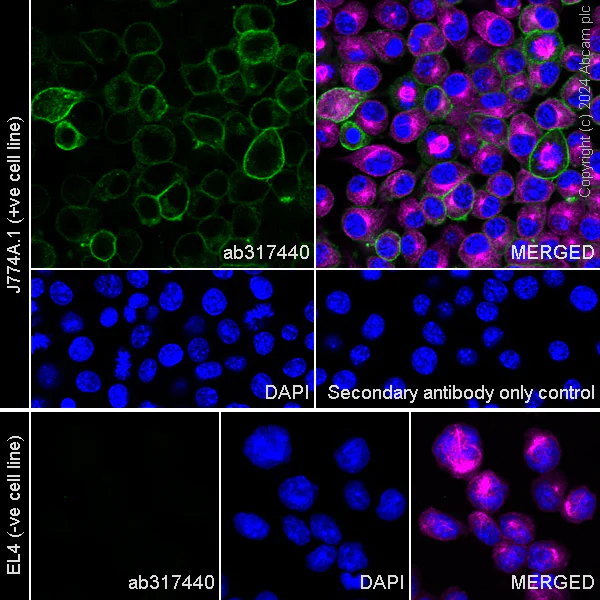
Immunocytochemistry/ Immunofluorescence - Anti-CD13 antibody [EPR27472-288] (AB317440)
Immunofluorescent analysis of 4% Paraformaldehyde-fixed, 0.1% TritonX-100 permeabilized J774A.1 (mouse reticulum cell sarcoma monocyte/macrophage) cells labelling CD13 with ab317440 at 1/50 (10.06 ug/ml) dilution, followed by ab150081 Goat Anti-Rabbit IgG H&L (Alexa Fluor® 488) preadsorbed antibody at 1/1000 2 ug/ml dilution (Green).
Confocal image showing membranous staining in J774A.1 cell line (shown in green). The counterstain was observed in magenta. Nuclear DNA was labeled with DAPI (shown in blue).
Negative control : EL4 (PMID : 8103749).
Image was taken with a confocal microscope (Leica-Microsystems, TCS SP8).
ab195889 Anti-alpha Tubulin mouse monoclonal antibody - Microtubule Marker (Alexa Fluor® 594) was used to counterstain tubulin at 1/200 2.5 ug/ml dilution (Magenta). The Nuclear counterstain was DAPI (Blue).
Secondary antibody only control : Secondary antibody is ab150081 Goat Anti-Rabbit IgG H&L (Alexa Fluor® 488) preadsorbed at 1/1000 2 ug/ml dilution.
- Flow Cyt
Supplier Data
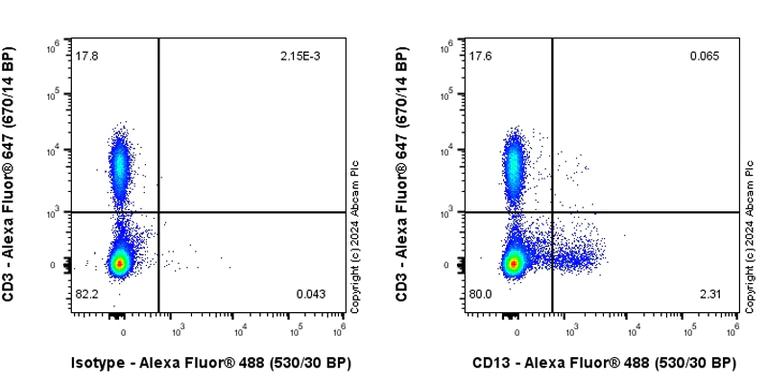
Flow Cytometry - Anti-CD13 antibody [EPR27472-288] (AB317440)
Flow cytometric analysis of Mouse spleen cell cells labelling CD13 with ab317440 at 1/500 dilution (0.1ug) / Right compared with a Rabbit monoclonal IgG (ab172730) / Left isotype control and an unlabelled control (cells without incubation with primary antibody and secondary antibody) (Blue).
Goat Anti-Rabbit IgG (Alexa Fluor® 488, ab150081) at 1/5000 dilution was used as the secondary antibody.
Cells were co-stained with anti-CD3 conjugated to Alexa Fluor®647.
Gated on viable cells.
- Flow Cyt
Supplier Data
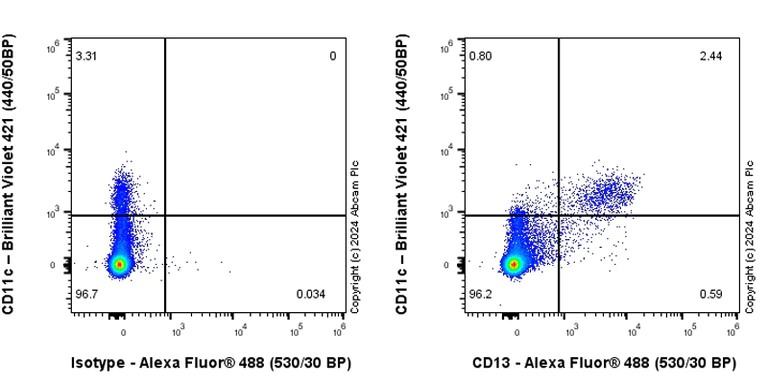
Flow Cytometry - Anti-CD13 antibody [EPR27472-288] (AB317440)
Flow cytometric analysis of Mouse spleen cell cells labelling CD13 with ab317440 at 1/500 dilution (0.1ug) / Right compared with a Rabbit monoclonal IgG (ab172730) / Left isotype control and an unlabelled control (cells without incubation with primary antibody and secondary antibody) (Blue).
Goat Anti-Rabbit IgG (Alexa Fluor® 488, ab150081) at 1/5000 dilution was used as the secondary antibody.
Cells were co-stained with anti-CD11c conjugated to Brilliant Violet 421.
Gated on viable cells.
- Flow Cyt
Supplier Data
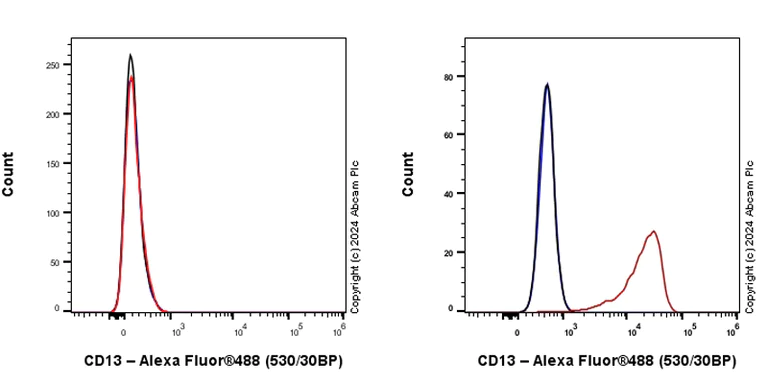
Flow Cytometry - Anti-CD13 antibody [EPR27472-288] (AB317440)
Flow cytometric analysis of J774A.1 (mouse reticulum cell sarcoma monocyte/macrophage) (Right) / EL4 (mouse lymphoma T lymphocyte) (Left) cells labelling CD13 with ab317440 at 1/500 dilution (0.1ug) (Red) compared with a Rabbit monoclonal IgG (ab172730) (Black) isotype control and an unlabelled control (cells without incubation with primary antibody and secondary antibody) (Blue).
Goat Anti-Rabbit IgG (Alexa Fluor® 488, ab150081) at 1/5000 dilution was used as the secondary antibody.
Gated on viable cells.
Negative control : EL4 (PMID : 8103749)
- IP
Supplier Data
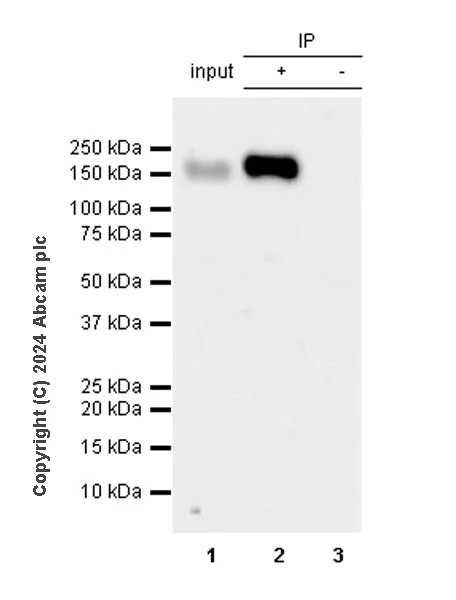
Immunoprecipitation - Anti-CD13 antibody [EPR27472-288] (AB317440)
CD13 was immunoprecipitated from 0.35 mg J774A.1 (mouse reticulum cell sarcoma monocyte/macrophage ) whole cell lysate with ab317440 at 1/30 dilution (2ug in 0.35mg lysates). Western blot was performed on the immunoprecipitate using ab317440 at 1/1000 dilution. VeriBlot for IP secondary antibody(HRP)(ab131366) was used at 1/5000 dilution.
Lane 1 : J774A.1 (mouse reticulum cell sarcoma monocyte/macrophage ) whole cell lysate
Lane 2 : ab317440 IP in J774A.1 (mouse reticulum cell sarcoma monocyte/macrophage ) whole cell lysate
Lane 3 : Rabbit monoclonal IgG (ab172730) instead of ab317440 in J774A.1 whole cell lysate
Blocking and dilution buffer and concentration : 5% NFDM/TBST.
All lanes:
Immunoprecipitation - Anti-CD13 antibody [EPR27472-288] (ab317440) at 1/30 dilution
All lanes:
J774A.1 (mouse reticulum cell sarcoma monocyte/macrophage ) whole cell lysate
Secondary
All lanes:
Immunoprecipitation - VeriBlot for IP Detection Reagent (HRP) (<a href='/products/reagents/veriblot-for-ip-detection-reagent-hrp-ab131366'>ab131366</a>) at 1/5000 dilution
false
Exposure time: 24s
- WB
Supplier Data
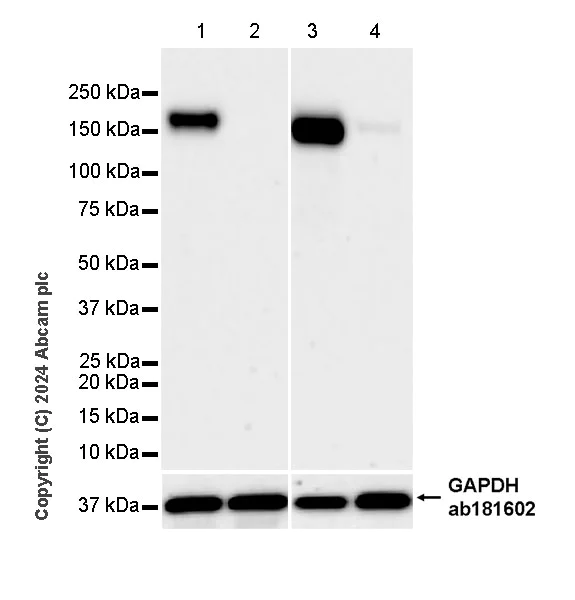
Western blot - Anti-CD13 antibody [EPR27472-288] (AB317440)
Blocking and diluting buffer and concentration : 5% NFDM/TBST.
Negative control : EL4 (PMID : 8103749).
Low expression : heart.
The molecular weight observed is consistent with what has been described in the literature (PMID : 37942010, 8103749).
In Western blot, Anti-GAPDH antibody [EPR16891] - Loading Control (ab181602) staining at 1/200000 dilution.
All lanes:
Western blot - Anti-CD13 antibody [EPR27472-288] (ab317440) at 1/1000 dilution
Lane 1:
J774A.1 (mouse reticulum cell sarcoma monocyte/macrophage ) whole cell lysate at 20 µg
Lane 2:
EL4 (mouse lymphoma T lymphocyte) whole cell lysate at 20 µg
Lane 3:
Mouse kidney tissue lysate at 20 µg
Lane 4:
Mouse heart tissue lysate at 20 µg
Secondary
All lanes:
Western blot - Goat Anti-Rabbit IgG H&L (HRP) (<a href='/products/secondary-antibodies/goat-rabbit-igg-h-l-hrp-ab97051'>ab97051</a>) at 1/100000 dilution
Observed band size: 150 kDa,36 kDa
false
Exposure time: 81s
関連する標識済み抗体及び組成の異なる製品 (4)
-
Anti-CD13 antibody [EPR27472-288] - BSA and Azide free
-
519 Alexa Fluor® 488
Alexa Fluor® 488 Anti-CD13 antibody [EPR27472-288]
-
617 Alexa Fluor® 594
Alexa Fluor® 594 Anti-CD13 antibody [EPR27472-288]
-
578 PE
PE Anti-CD13 antibody [EPR27472-288]
組合せ製品


Reactivity data
製品の詳細
Patented technology
Our RabMAb® technology is a patented hybridoma-based technology for making rabbit monoclonal antibodies. For details on our patents, please refer to RabMAb® patents.
What are the advantages of a recombinant monoclonal antibody?
This product is a recombinant monoclonal antibody, which offers several advantages including:
- - High batch-to-batch consistency and reproducibility
- - Improved sensitivity and specificity
- - Long-term security of supply
- - Animal-free batch production
For more information, read more on recombinant antibodies.
出荷温度及び保存条件
製品の状態
精製方法
バッファー組成
出荷温度
短期保存期間
短期保存温度
長期保存温度
分注に関する情報
保管に関する情報
補足情報
This supplementary information is collated from multiple sources and compiled automatically.
Biological function summary
CD13 regulates peptide-mediated signaling and controls the maturation and catabolism of bioactive peptides. The enzymatic function of CD13 influences processes such as cell proliferation motility and angiogenesis. It does not operate as part of a larger complex but its activity modulates several cellular and systemic functions. CD13's role in these biological processes highlights its importance in modulating local and systemic peptide pools which contributes to its diverse physiological effects.
Pathways
CD13 plays significant roles in the renin-angiotensin system and the regulation of inflammatory responses. In the renin-angiotensin system CD13 modulates the activity of angiotensin influencing blood pressure and fluid balance. Through its enzymatic activity CD13 interacts with proteins such as ACE another critical player in this pathway. In inflammation CD13 regulates the availability of chemotactic peptides affecting leukocyte migration and adhesion. The proteins it works with in inflammatory pathways include cytokines which CD13 indirectly modulates by altering chemokine activity.
製品プロトコール
- Visit the General protocols
- Visit the Troubleshooting
ターゲットの情報
文献 (2)
Recent publications for all applications. Explore the full list and refine your search
Oncology letters 30:456 PubMed40762017
2025
Applications
Unspecified application
Species
Unspecified reactive species
Oncology letters 28:468 PubMed39119236
2024
Applications
Unspecified application
Species
Unspecified reactive species
Abcam product promise
Please note: All products are 'FOR RESEARCH USE ONLY. NOT FOR USE IN DIAGNOSTIC OR THERAPEUTIC PROCEDURES'.
For licensing inquiries, please contact partnerships@abcam.com