Anti-Catalase 抗体 [EPR1928Y]
Anti-Catalase antibody [EPR1928Y]
- 20ul selling size
- RabMAb
- Recombinant
- KO Validated
- 詳細を見る
5
(1 Review)
|
(27 Publications)
Rabbit Recombinant Monoclonal Catalase antibody. Suitable for WB, IHC-P and reacts with Mouse, Rat, Human samples. Cited in 27 publications.
別名を表示する
Catalase, CAT
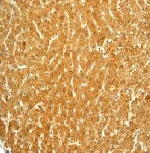
- IHC-P
Unknown
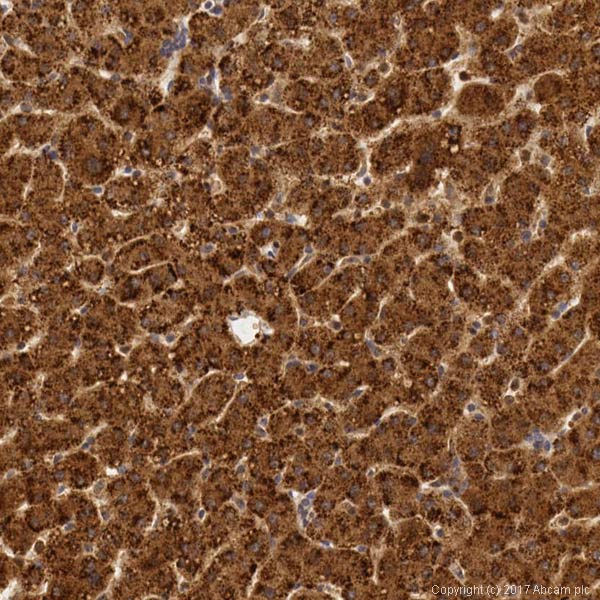
Immunohistochemistry (Formalin/PFA-fixed paraffin-embedded sections) - Anti-Catalase antibody [EPR1928Y] (AB76110)
ab76110 at 1/100-1/250 dilution staining Catalase in human liver by Immunohistochemistry, Paraffin-embedded tissue.
Perform heat mediated antigen retrieval before commencing with IHC staining protocol.
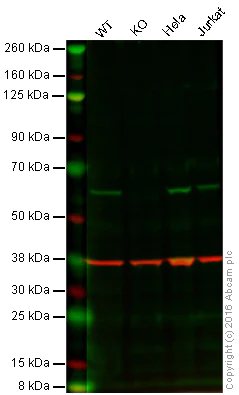
- WB
Lab
Western blot - Anti-Catalase antibody [EPR1928Y] (AB76110)
Lane 1 : Wild-type HAP1 cell lysate (20 μg)
Lane 2 : Catalase knockout HAP1 cell lysate (20 μg)
Lane 3 : HeLa cell lysate (20 μg)
Lane 4 : Jurkat cell lysate (20 μg)
Lanes 1 - 4 : Merged signal (red and green). Green - ab76110 observed at 60 kDa. Red - loading control, ab8245, observed at 37 kDa.
ab76110 was shown to specifically react with Catalase when Catalase knockout samples were used. Wild-type and Catalase knockout samples were subjected to SDS-PAGE. ab76110 and ab8245 (loading control to GAPDH) were diluted at 1/500 and 1/10000 respectively and incubated overnight at 4°C. Blots were developed with Goat anti-Rabbit IgG H&L (IRDye® 800CW) preadsorbed (ab216773) and Goat anti-Mouse IgG H&L (IRDye® 680RD) preadsorbed (ab216776) secondary antibodies at 1/10000 dilution for 1 hour at room temperature before imaging.
All lanes:
Western blot - Anti-Catalase antibody [EPR1928Y] (ab76110)
Predicted band size: 60 kDa
false
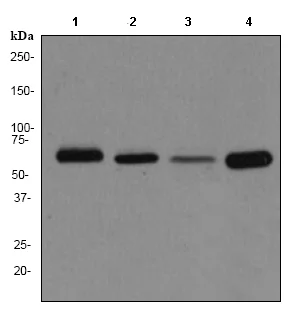
- WB
Unknown
Western blot - Anti-Catalase antibody [EPR1928Y] (AB76110)
All lanes:
Western blot - Anti-Catalase antibody [EPR1928Y] (ab76110) at 1/1000 dilution
Lane 1:
TF cell lysate at 10 µg
Lane 2:
HeLa cell lysate at 10 µg
Lane 3:
Jurkat cell lysate at 10 µg
Lane 4:
HepG2 cell lysate at 10 µg
Secondary
All lanes:
goat anti-rabbit HRP at 1/2000 dilution
Predicted band size: 60 kDa
Observed band size: 60 kDa
false
関連する標識済み抗体及び組成の異なる製品 (8)
-
Anti-Catalase antibody [EPR1928Y] - BSA and Azide free
-
660 APC
APC Anti-Catalase antibody [EPR1928Y]
-
519 Alexa Fluor® 488
Alexa Fluor® 488 Anti-Catalase antibody [EPR1928Y]
-
565 Alexa Fluor® 555
Alexa Fluor® 555 Anti-Catalase antibody [EPR1928Y]
-
617 Alexa Fluor® 594
Alexa Fluor® 594 Anti-Catalase antibody [EPR1928Y]
-
665 Alexa Fluor® 647
Alexa Fluor® 647 Anti-Catalase antibody [EPR1928Y]
-
775 Alexa Fluor® 750
Alexa Fluor® 750 Anti-Catalase antibody [EPR1928Y]
-
578 PE
PE Anti-Catalase antibody [EPR1928Y]
代替製品

Primary Antibodies
AB52477
Anti-Catalase antibody - Peroxisome Marker
BOND RX™ Validated|KO Validated|Lab Essentials
- 5
- 8
Primary Antibodies
AB209211
Anti-Catalase antibody [EPR20198] - Peroxisome Marker
KO Validated|RabMAb|Recombinant|Lab Essentials|20ul selling size

- 5
- 3
Primary Antibodies
AB76024
Anti-Catalase antibody [EP1929Y] - Peroxisome Marker
20ul selling size|KO Validated|RabMAb|Recombinant|Lab Essentials
- 5
- 1
Primary Antibodies
AB223793
Anti-Catalase antibody [EPR20198] - BSA and Azide free
RabMAb|Recombinant|KO Validated
- 0
- 0
Primary Antibodies
AB227116
Anti-Catalase antibody [EP1929Y] - BSA and Azide free
RabMAb|Recombinant|KO Validated
- 0
- 0
Primary Antibodies
AB110292
Anti-Catalase antibody [12C2DB9] - Peroxisome Marker
KO Validated|Lab Essentials
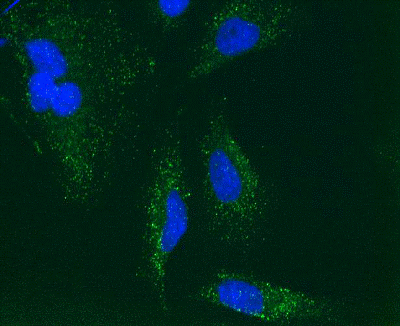
- 5
- 3
組合せ製品

Primary Antibodies
AB68155
Anti-SOD2/MnSOD antibody [EPR2560Y]
RabMAb|Recombinant|KO Validated|20ul selling size

- 5
- 2


Primary Antibodies
AB51254
Anti-Superoxide Dismutase 1 antibody [EP1727Y]
RabMAb|Recombinant|KO Validated|20ul selling size
- 5
- 4
Reactivity data
製品の詳細
Patented technology
Our RabMAb® technology is a patented hybridoma-based technology for making rabbit monoclonal antibodies. For details on our patents, please refer to RabMAb® patents.
What are the advantages of a recombinant monoclonal antibody?
This product is a recombinant monoclonal antibody, which offers several advantages including:
- - High batch-to-batch consistency and reproducibility
- - Improved sensitivity and specificity
- - Long-term security of supply
- - Animal-free batch production
For more information, read more on recombinant antibodies.
出荷温度及び保存条件
製品の状態
精製方法
バッファー組成
出荷温度
短期保存温度
長期保存温度
分注に関する情報
保管に関する情報
補足情報
This supplementary information is collated from multiple sources and compiled automatically.
Biological function summary
Catalase contributes to antioxidant defense by breaking down hydrogen peroxide preventing cellular damage. In peroxisomes it works alongside other peroxisomal enzymes to maintain cell health and metabolic regulation. Catalase does not form a complex but interacts closely with other enzymes like superoxide dismutase which dismutates superoxide radicals into less harmful substances. Increased Catalase activity levels can be measured using Catalase activity kits and activity assays allowing us to learn about peroxisome function.
Pathways
Hydrogen peroxide removal by Catalase is vital in the reactive oxygen species (ROS) metabolic process and plays a part in the cellular response to oxidative stress. Catalase interacts with the glutathione peroxidase pathway safeguarding cells from oxidative stress-related damage. Superoxide dismutase works synergistically with Catalase transforming superoxide anions into hydrogen peroxide before its decomposition by Catalase. These activities highlight the essential role Catalase plays in protecting cells from oxidative stress damage.
製品プロトコール
- Visit the General protocols
- Visit the Troubleshooting
ターゲットの情報
文献 (27)
Recent publications for all applications. Explore the full list and refine your search
Frontiers in cardiovascular medicine 12:1506388 PubMed40486827
2025
Applications
Unspecified application
Species
Unspecified reactive species
The Journal of physiology 601:4699-4721 PubMed37815420
2023
Applications
Unspecified application
Species
Unspecified reactive species
Nutrients 15: PubMed37764716
2023
Applications
Unspecified application
Species
Unspecified reactive species
Cell biology and toxicology 39:3061-3075 PubMed37368165
2023
Applications
Unspecified application
Species
Unspecified reactive species
Acta pharmacologica Sinica 44:2037-2047 PubMed37193756
2023
Applications
Unspecified application
Species
Unspecified reactive species
Journal of advanced research 46:87-100 PubMed37003700
2023
Applications
Unspecified application
Species
Unspecified reactive species
Cancer research 82:3486-3498 PubMed35916672
2022
Applications
Unspecified application
Species
Unspecified reactive species
International journal of molecular sciences 23: PubMed35628465
2022
Applications
Unspecified application
Species
Unspecified reactive species
Frontiers in pharmacology 12:747325 PubMed35115920
2022
Applications
Unspecified application
Species
Unspecified reactive species
Cell death & disease 12:940 PubMed34645791
2021
Applications
Unspecified application
Species
Unspecified reactive species
Abcam product promise
Please note: All products are 'FOR RESEARCH USE ONLY. NOT FOR USE IN DIAGNOSTIC OR THERAPEUTIC PROCEDURES'.
For licensing inquiries, please contact partnerships@abcam.com