Anti-Caspase-9 抗体 [E23]
Anti-Caspase-9 antibody [E23]
- 20ul selling size
- RabMAb®
- Recombinant
- KO Validated
- 詳細を見る
4
(5 Reviews)
|
(310 Publications)
Rabbit Recombinant Monoclonal Caspase-9 antibody. Suitable for IHC-P, IP, WB, ICC/IF, Flow Cyt (Intra) and reacts with Human samples. Cited in 310 publications.
別名を表示する
MCH6, CASP9, Caspase-9, CASP-9, Apoptotic protease Mch-6, Apoptotic protease-activating factor 3, ICE-like apoptotic protease 6, APAF-3, ICE-LAP6
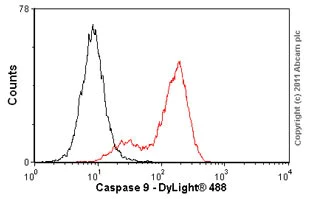
- Flow Cyt (Intra)
Unknown
Flow Cytometry (Intracellular) - Anti-Caspase-9 antibody [E23] (AB32539)
Overlay histogram showing K562 cells stained with unpurified ab32539 (red line). The cells were fixed with methanol (5 min) and then permeabilized with 0.1% PBS-Tween for 20 min. The cells were then incubated in 1x PBS / 10% normal goat serum / 0.3M glycine to block non-specific protein-protein interactions followed by the antibody (unpurified ab32539, 1/100 dilution) for 30 min at 22°C. The secondary antibody used was anti-rabbit DyLight® 488 (ab96899) at 1/500 dilution for 30 min at 22°C. Isotype control antibody (black line) was rabbit monoclonal IgG (1μg/1x106 cells) used under the same conditions. Acquisition of >5,000 events was performed. This antibody gave a positive signal in K562 cells fixed with 4% paraformaldehyde (10 min)/permeabilized with 0.1% PBS-Tween used under the same conditions.
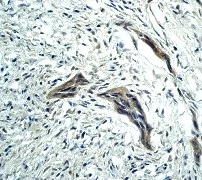
- IHC-P
Unknown
Immunohistochemistry (Formalin/PFA-fixed paraffin-embedded sections) - Anti-Caspase-9 antibody [E23] (AB32539)
Immunohistochemistry (Formalin/PFA-fixed paraffin-embedded sections) analysis of human cervical carcinoma tissue labelling Caspase 9 with unpurified ab32539 at a dilution of 1/50.
Perform heat mediated antigen retrieval before commencing with IHC staining protocol.
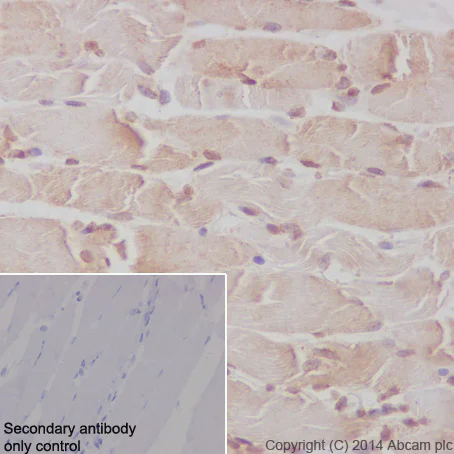
- IHC-P
Unknown
Immunohistochemistry (Formalin/PFA-fixed paraffin-embedded sections) - Anti-Caspase-9 antibody [E23] (AB32539)
Immunohistochemistry (Formalin/PFA-fixed paraffin-embedded sections) analysis of human skeletal muscle tissue labelling Caspase-9 with purified ab32539 at 1/250. Heat mediated antigen retrieval was performed using Tris/EDTA buffer pH 9. ab97051, a HRP-conjugated goat anti-rabbit IgG (H+L) was used as the secondary antibody (1/500). Negative control using PBS instead of primary antibody. Counterstained with hematoxylin.
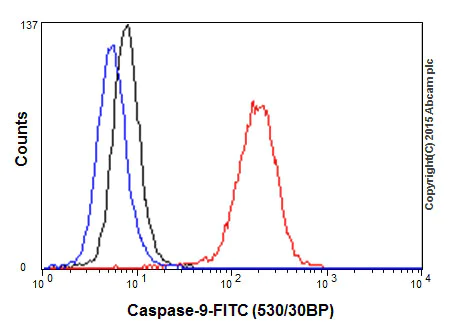
- Flow Cyt (Intra)
Unknown
Flow Cytometry (Intracellular) - Anti-Caspase-9 antibody [E23] (AB32539)
Intracellular Flow Cytometry analysis of K562 cells labelling Caspase-9 with purified ab32539 at 1/250 (red). Cells were fixed with 100% methanol. A FITC-conjugated goat anti-rabbit IgG (1/500) was used as the secondary antibody. Black - Isotype control, rabbit monoclonal IgG. Blue - Unlabelled control, cells without incubation with primary and secondary antibodies.
- ICC/IF
Unknown
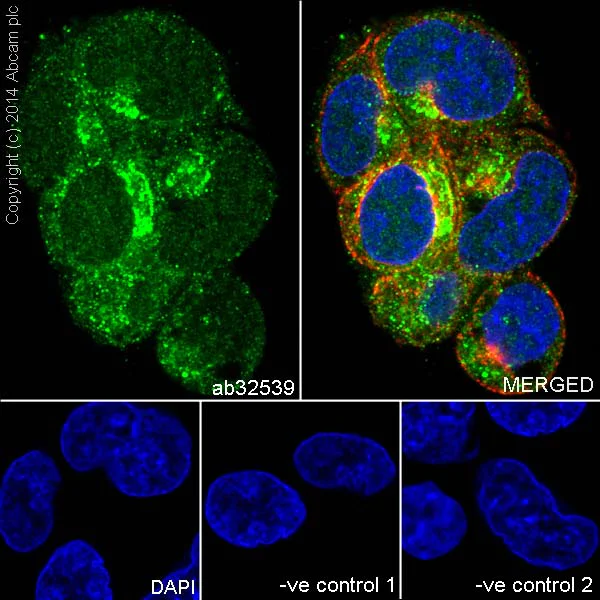
Immunocytochemistry/ Immunofluorescence - Anti-Caspase-9 antibody [E23] (AB32539)
Immunocytochemistry/Immunofluorescence analysis of HepG2 cells labelling Caspase-9 with purified ab32539 at 1/500. Cells were fixed with 4% paraformaldehyde and permeabilized with 0.1% Triton X-100. ab150077, an Alexa Fluor® 488-conjugated goat anti-rabbit IgG (1/1000) was used as the secondary antibody. DAPI (blue) was used as the nuclear counterstain. ab7291, a mouse anti-tubulin (1/1000) and ab150120, an Alexa Fluor® 594-conjugated goat anti-mouse IgG (1/1000) were also used.
Control 1 : primary antibody (1/500) and secondary antibody, ab150120, an Alexa Fluor® 594-conjugated goat anti-mouse IgG (1/1000).
Control 2 : ab7291 (1/1000) and secondary antibody, ab150077, an Alexa Fluor® 488-conjugated goat anti-rabbit IgG (1/1000).
- IP
Unknown
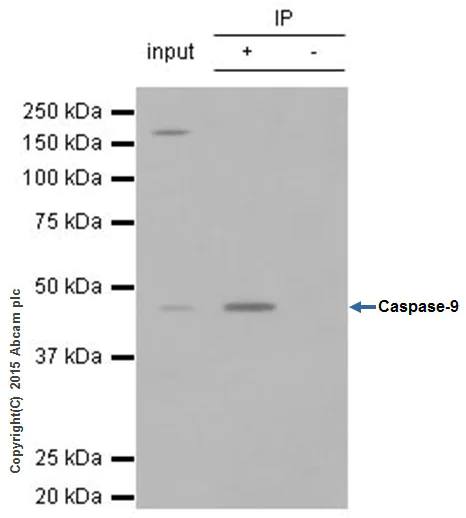
Immunoprecipitation - Anti-Caspase-9 antibody [E23] (AB32539)
ab32539 (purified) at 1/80 immunoprecipitating Caspase-9 in HeLa whole cell lysate.
Lane 1 (input) : HeLa whole cell lysate (10μg)
Lane 2 (+) : ab32539 + HeLa whole cell lysate.
Lane 3 (-) : Rabbit monoclonal IgG (ab172730) instead of ab32539 in HeLa whole cell lysate.
For western blotting, a HRP-conjugated anti-rabbit IgG, specific to the non-reduced form of IgG was used as the secondary antibody (1/1500).
Blocking buffer and concentration : 5% NFDM/TBST.
Diluting buffer and concentration : 5% NFDM /TBST.
All lanes:
Immunoprecipitation - Anti-Caspase-9 antibody [E23] (ab32539)
Predicted band size: 46 kDa
Observed band size: 46 kDa
false
- WB
Lab
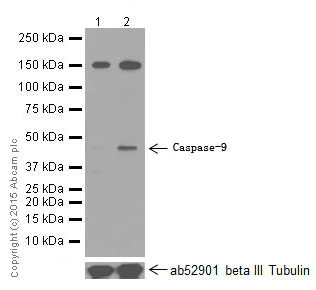
Western blot - Anti-Caspase-9 antibody [E23] (AB32539)
Blocking and dilution buffer : 5% NFDM/TBST.
All lanes:
Western blot - Anti-Caspase-9 antibody [E23] (ab32539) at 1/1000 dilution
Lane 1:
HeLa whole cell lysate - treated with Camptothecin at 10 µg
Lane 2:
HeLa whole cell lysate - untreated at 10 µg
Secondary
All lanes:
Western blot - Goat Anti-Rabbit IgG H&L (HRP) (<a href='/products/secondary-antibodies/goat-rabbit-igg-h-l-hrp-ab97051'>ab97051</a>) at 1/1000 dilution
Predicted band size: 46 kDa
Observed band size: 35 kDa,46 kDa
false
- WB
Lab
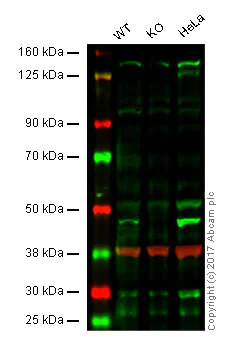
Western blot - Anti-Caspase-9 antibody [E23] (AB32539)
Lanes :
Lane 1 : Wild-type HAP1 whole cell lysate (40 μg)
Lane 2 : CASP9 knockout HAP1 whole cell lysate (40 μg)
Lane 3 : HeLa whole cell lysate (40 μg)
Lanes 1 - 4 : Merged signal (red and green). Green - ab32539 observed at 45 kDa. Red - loading control, ab8245, observed at 37 kDa.
ab32539 was shown to specifically recognize Caspase-9 in wild type HAP1 cells along with additional cross-reactive bands. No band was observed when Caspase-9 knockout samples were examined. Wild-type and Caspase-9 knockout samples were subjected to SDS-PAGE. ab32539 and ab8245 (Mouse anti GAPDH loading control) were incubated overnight at 4°C at 1/500 dilution and 1/10,000 dilution respectively. Blots were developed with Goat anti-Rabbit IgG H&L (IRDye® 800CW) preabsorbed ab216773 and Goat anti-Mouse IgG H&L (IRDye® 680RD) preabsorbed ab216776 secondary antibodies at 1/10,000 dilution for 1 hour at room temperature before imaging.
All lanes:
Western blot - Anti-Caspase-9 antibody [E23] (ab32539)
Predicted band size: 46 kDa
false
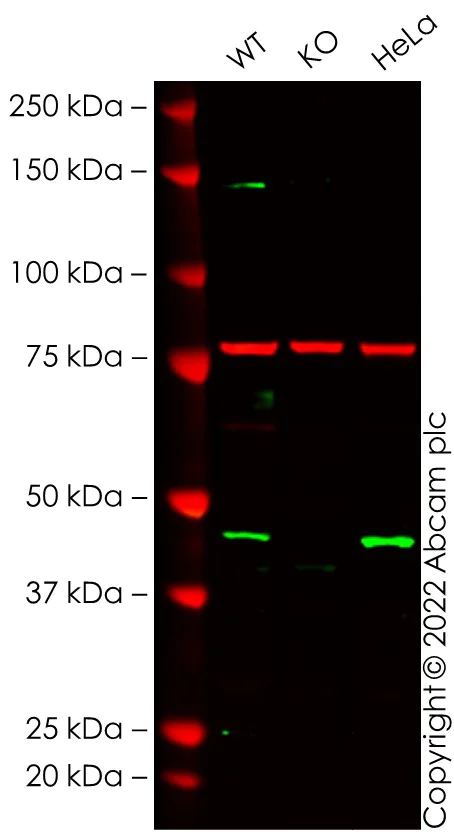
- WB
Lab
Western blot - Anti-Caspase-9 antibody [E23] (AB32539)
False colour image of Western blot : Anti-Caspase-9 antibody [E23] staining at 1/1000 dilution, shown in green; Mouse anti-CANX [CANX/1543] (ab238078) loading control staining at 1/20000 dilution, shown in red. In Western blot, ab32539 was shown to bind specifically to Caspase-9. A band was observed at 45 kDa in wild-type THP-1 cell lysates with no signal observed at this size in CASP9 knockout cell line ab276122 (knockout cell lysate ab284219). To generate this image, wild-type and CASP9 knockout THP-1 cell lysates were analysed. First, samples were run on an SDS-PAGE gel then transferred onto a nitrocellulose membrane. Membranes were blocked in 3 % milk in TBS-0.1 % Tween® 20 (TBS-T) before incubation with primary antibodies overnight at 4 °C. Blots were washed four times in TBS-T, incubated with secondary antibodies for 1 h at room temperature, washed again four times then imaged. Secondary antibodies used were Goat anti-Rabbit IgG H&L (IRDye® 800CW) preabsorbed (ab216773) and Goat anti-Mouse IgG H&L (IRDye® 680RD) preabsorbed (ab216776) at 1/20000 dilution.
All lanes:
Western blot - Anti-Caspase-9 antibody [E23] (ab32539) at 1/1000 dilution
Lane 1:
Wild-type THP-1 cell lysate at 20 µg
Lane 2:
CASP9 knockout THP-1 cell lysate at 20 µg
Lane 3:
HeLa cell lysate at 20 µg
Predicted band size: 46 kDa
Observed band size: 45 kDa
false
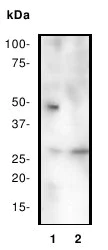
- WB
Unknown
Western blot - Anti-Caspase-9 antibody [E23] (AB32539)
All lanes:
Western blot - Anti-Caspase-9 antibody [E23] (ab32539) at 1/20000 dilution
Lane 1:
Jurkat cell lysate - untreated
Lane 2:
Jurkat cell lysate - treated with Camptothecin
Predicted band size: 46 kDa
Observed band size: 28 kDa,48 kDa
false
関連する標識済み抗体及び組成の異なる製品 (8)
-
Anti-Caspase-9 antibody [E23] - BSA and Azide free
-
660 APC
APC Anti-Caspase-9 antibody [E23]
-
519 Alexa Fluor® 488
Alexa Fluor® 488 Anti-Caspase-9 antibody [E23]
-
565 Alexa Fluor® 555
Alexa Fluor® 555 Anti-Caspase-9 antibody [E23]
-
603 Alexa Fluor® 568
Alexa Fluor® 568 Anti-Caspase-9 antibody [E23]
-
665 Alexa Fluor® 647
Alexa Fluor® 647 Anti-Caspase-9 antibody [E23]
-
HRP Anti-Caspase-9 antibody [E23]
-
578 PE
PE Anti-Caspase-9 antibody [E23]
代替製品
Primary Antibodies
AB184786
Anti-Caspase-9 antibody [EPR18868]
20ul selling size|RabMAb|Recombinant

- 5
- 1
Primary Antibodies
AB202068
Anti-Caspase-9 antibody [EPR18107]
20ul selling size|RabMAb®|Recombinant|KO Validated
- 5
- 4
Primary Antibodies
AB185719
Anti-Caspase-9 antibody [EPR18108]
20ul selling size|RabMAb|Recombinant|KO Validated
- 0
- 0
Primary Antibodies
AB240287
Anti-Caspase-9 antibody [EPR18868] - BSA and Azide free
RabMAb|Recombinant

- 0
- 0
Primary Antibodies
AB222231
Anti-Caspase-9 antibody [EPR18107] - BSA and Azide free
RabMAb|Recombinant|KO Validated
- 0
- 0
Primary Antibodies
AB32068
20ul selling size|RabMAb®|Recombinant|KO Validated
- 0
- 0
組合せ製品

Primary Antibodies
AB32503
BOND RX™ Validated|20ul selling size|RabMAb®|Recombinant|KO Validated
- 4
- 12
Primary Antibodies
AB32351
20ul selling size|RabMAb®|Recombinant|KO Validated

- 4
- 15
Primary Antibodies
AB182858
Anti-Bcl-2 antibody [EPR17509]
BOND RX™ Validated|RabMAb|Recombinant|KO Validated|20ul selling size

- 5
- 13
Primary Antibodies
AB108333
Anti-Pro Caspase-8 antibody [EPR162]
20ul selling size|RabMAb|Recombinant|KO Validated
- 4
- 1
Reactivity data
製品の詳細
Species reactivity
Mouse, Rat: We have preliminary internal testing data to indicate this antibody may not react with these species.
Please contact us for more information.
Patented technology
Our RabMAb® technology is a patented hybridoma-based technology for making rabbit monoclonal antibodies. For details on our patents, please refer to RabMAb® patents.
What are the advantages of a recombinant monoclonal antibody?
This product is a recombinant monoclonal antibody, which offers several advantages including:
- - High batch-to-batch consistency and reproducibility
- - Improved sensitivity and specificity
- - Long-term security of supply
- - Animal-free batch production
For more information, read more on recombinant antibodies.
出荷温度及び保存条件
製品の状態
精製方法
バッファー組成
出荷温度
短期保存期間
短期保存温度
長期保存温度
分注に関する情報
保管に関する情報
製品プロトコール
- Visit the General protocols
- Visit the Troubleshooting
ターゲットの情報
文献 (310)
Recent publications for all applications. Explore the full list and refine your search
ACS omega 10:34528-34538 PubMed40821538
2025
Applications
Unspecified application
Species
Unspecified reactive species
Frontiers in oncology 15:1585945 PubMed40708936
2025
Applications
Unspecified application
Species
Unspecified reactive species
Clinical epigenetics 17:129 PubMed40696470
2025
Applications
Unspecified application
Species
Unspecified reactive species
Antioxidants (Basel, Switzerland) 14: PubMed40563376
2025
Applications
Unspecified application
Species
Unspecified reactive species
Journal of environmental pathology, toxicology and oncology : official organ of the International Society for Environmental Toxicology and Cancer 44:31-39 PubMed40493899
2025
Applications
Unspecified application
Species
Unspecified reactive species
International journal of molecular sciences 26: PubMed40429928
2025
Applications
Unspecified application
Species
Unspecified reactive species
Acta oncologica (Stockholm, Sweden) 64:715-728 PubMed40426308
2025
Applications
Unspecified application
Species
Unspecified reactive species
Biomedicines 13: PubMed40426921
2025
Applications
Unspecified application
Species
Unspecified reactive species
Chinese medicine 20:71 PubMed40420092
2025
Applications
Unspecified application
Species
Unspecified reactive species
Current issues in molecular biology 47: PubMed39852151
2025
Applications
Unspecified application
Species
Unspecified reactive species
Abcam product promise
Please note: All products are 'FOR RESEARCH USE ONLY. NOT FOR USE IN DIAGNOSTIC OR THERAPEUTIC PROCEDURES'.
For licensing inquiries, please contact partnerships@abcam.com