JavaScript is disabled in your browser. Please enable JavaScript to view this website.
AB223258

Anti-ATR (phospho T1989) 抗体 [EPR21991]

Anti-ATR (phospho T1989) antibody [EPR21991]

5

(1 Review)

|

(14 Publications)

Rabbit Recombinant Monoclonal ATR phospho T1989 antibody. Suitable for Dot, WB and reacts with Synthetic peptide, Human samples. Cited in 14 publications.

別名を表示する

FRP1, ATR, Serine/threonine-protein kinase ATR, Ataxia telangiectasia and Rad3-related protein, FRAP-related protein 1
3 Images
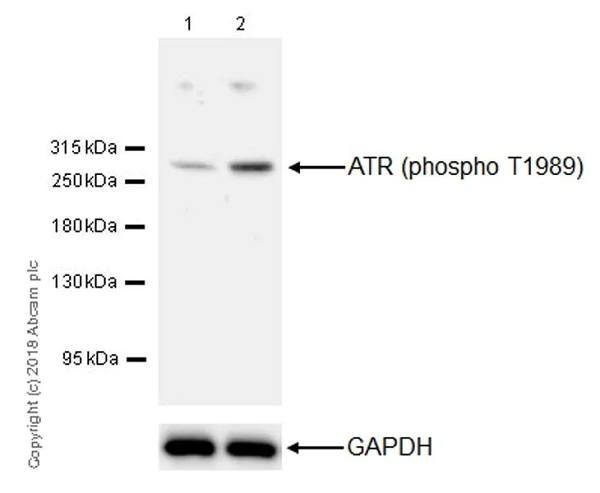
Western blot - Anti-ATR (phospho T1989) antibody [EPR21991] (AB223258)
  • WB

Supplier Data

Western blot - Anti-ATR (phospho T1989) antibody [EPR21991] (AB223258)

Blocking/Dilution buffer : 2% BSA/TBST ATR Thr1989 phosphorylation is increased after DNA damage (PMID : 21777809). This data was developed using the same antibody clone in a different buffer formulation containing PBS, BSA, glycerol, and sodium azide (ab223258).

All lanes:

Western blot - Anti-ATR (phospho T1989) antibody [EPR21991] (ab223258) at 1/1000 dilution

Lane 1:

Untreated HEK-293 (human embryonic kidney epithelial cell) whole cell lysate at 20 µg

Lane 2:

HEK-293 treated with 2mM hydroxyurea for 16 hours, whole cell lysate at 20 µg

Secondary

All lanes:

Western blot - Goat Anti-Rabbit IgG H&L (HRP) (<a href='/products/secondary-antibodies/goat-rabbit-igg-h-l-hrp-ab97051'>ab97051</a>) at 1/100000 dilution

false
Western blot - Anti-ATR (phospho T1989) antibody [EPR21991] (AB223258)
  • WB

Supplier Data

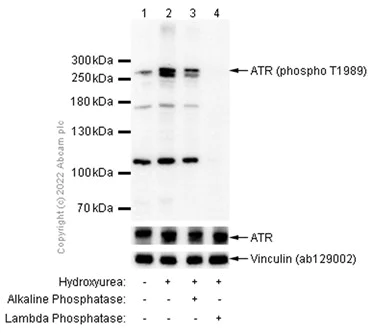
Western blot - Anti-ATR (phospho T1989) antibody [EPR21991] (AB223258)

Blocking and dilution buffer : 5% NFDM/TBST. We are unsure of the nature of the 110kDa band.

Lanes 1 - 4:

Western blot - Anti-ATR (phospho T1989) antibody [EPR21991] (ab223258) at 1/1000 dilution

Lanes 1 - 4:

Western blot - Anti-ATR (phospho T1989) antibody [EPR21991] - BSA and Azide free (<a href='/products/primary-antibodies/atr-phospho-t1989-antibody-epr21991-bsa-and-azide-free-ab237563'>ab237563</a>) at 1/1000 dilution

Lane 1:

Untreated HeLa (Human cervix adenocarcinoma epithelial cell) whole cell lysate at 15 µg

Lane 2:

HeLa treated with 4mM hydroxyurea for 20 hours whole cell lysate at 15 µg

Lane 3:

HeLa treated with 4mM hydroxyurea for 20 hours whole cell lysate, then the membrane treated with Alkaline Phosphatase for 1 hour at 15 µg

Lane 4:

HeLa treated with 4mM hydroxyurea for 20 hours whole cell lysate, then the membrane treated with Lambda Phosphatase for 1 hour at 15 µg

Secondary

All lanes:

Western blot - Goat Anti-Rabbit IgG H&L (HRP) (<a href='/products/secondary-antibodies/goat-rabbit-igg-h-l-hrp-ab97051'>ab97051</a>) at 1/20000 dilution

Observed band size: 270 kDa

false

Exposure time: 100s
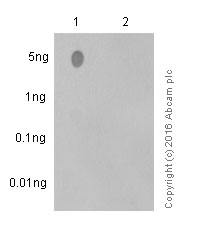
Dot Blot - Anti-ATR (phospho T1989) antibody [EPR21991] (AB223258)
  • Dot

Supplier Data

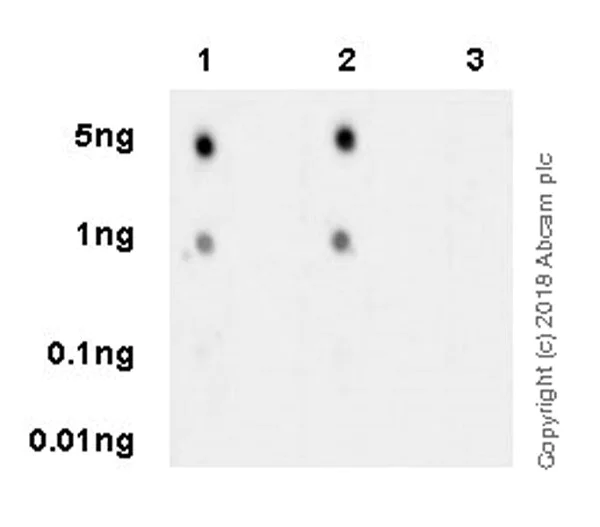
Dot Blot - Anti-ATR (phospho T1989) antibody [EPR21991] (AB223258)

Dot blot analysis of ATR (phospho T1989) labeled with ab223258 at 1/1000 dilution.

Lane 1 : ATR (phospho T1989) peptide (aa1983-1992).
Lane 2 : ATR (phospho T1989) peptide (aa1986-1995).
Lane 3 : ATR non-phospho peptide.

Goat Anti-Rabbit IgG H&L (HRP) (ab97051) at 1/100000 dilution was used as secondary antibody.

Blocking/Dilution buffer : 5% NFDM/TBST.

Exposure time : 10 seconds.

関連する標識済み抗体及び組成の異なる製品 (1)

  • Carrier free

    Anti-ATR (phospho T1989) antibody [EPR21991] - BSA and Azide free

Key facts

宿主種

Rabbit

クローン性

Monoclonal

クローン番号

EPR21991

アイソタイプ

IgG

キャリアフリー

No

交差種

Human

アプリケーション

WB, Dot

applications

免疫原

The exact immunogen used to generate this antibody is proprietary information.

Reactivity data

{ "title": "Reactivity Data", "filters": { "stats": ["", "Species", "Dilution Info", "Notes"], "tabs": { "all-applications": {"fullname" : "All Applications", "shortname": "All Applications"}, "Dot" : {"fullname" : "Dot Blot", "shortname":"Dot"}, "WB" : {"fullname" : "Western blot", "shortname":"WB"} }, "product-promise": { "all": "all", "testedAndGuaranteed": "tested", "guaranteed": "expected", "predicted": "predicted", "notRecommended": "not-recommended" } }, "values": { "Human": { "Dot-species-checked": "guaranteed", "Dot-species-dilution-info": "", "Dot-species-notes": "", "WB-species-checked": "testedAndGuaranteed", "WB-species-dilution-info": "1/1000", "WB-species-notes": "<p></p>" }, "Synthetic peptide": { "Dot-species-checked": "testedAndGuaranteed", "Dot-species-dilution-info": "1/1000", "Dot-species-notes": "<p></p>", "WB-species-checked": "notRecommended", "WB-species-dilution-info": "", "WB-species-notes": "" } } }

製品の詳細

Patented technology
Our RabMAb® technology is a patented hybridoma-based technology for making rabbit monoclonal antibodies. For details on our patents, please refer to RabMAb® patents.

What are the advantages of a recombinant monoclonal antibody?
This product is a recombinant monoclonal antibody, which offers several advantages including:

  • - High batch-to-batch consistency and reproducibility
  • - Improved sensitivity and specificity
  • - Long-term security of supply
  • - Animal-free batch production

For more information, read more on recombinant antibodies.

出荷温度及び保存条件

製品の状態
Liquid
精製方法
Affinity purification Protein A
バッファー組成
pH: 7.2 - 7.4 Preservative: 0.01% Sodium azide Constituents: PBS, 40% Glycerol (glycerin, glycerine), 0.05% BSA
出荷温度
Conditional Ambient
短期保存期間
1-2 weeks
短期保存温度
+4°C
長期保存温度
-20°C
分注に関する情報
Upon delivery aliquot
保管に関する情報
Avoid freeze / thaw cycle

補足情報

This supplementary information is collated from multiple sources and compiled automatically.

ATR also known as Ataxia Telangiectasia and Rad3-related protein is a serine/threonine kinase with a molecular weight of approximately 301 kDa. This protein localizes mainly in the nucleus where it functions as an important component in the cellular response to DNA damage and replication stress. ATR detects DNA strand breaks and ssDNA coated with RPA and becomes activated to phosphorylate several downstream targets initiating the DNA damage response. High expression of ATR occurs in proliferative tissues emphasizing its role in cell cycle regulation.
Biological function summary

ATR plays an essential role in maintaining genomic stability. It is part of a larger protein complex that includes ATRIP (ATR-interacting protein) which helps in localizing ATR to sites of DNA damage. Once activated ATR phosphorylates various substrates including CHK1 a critical checkpoint kinase involved in cell cycle arrest during DNA repair processes. The ability of ATR to coordinate with these proteins helps cells manage DNA damage effectively and prevent genomic instability.

Pathways

ATR functions centrally in the DNA damage response and repair mechanisms particularly the ATR-Chk1 pathway. This pathway interacts closely with the ATM (Ataxia Telangiectasia Mutated) pathway which also responds to DNA damage but usually to double-strand breaks. ATR primarily acts in response to replication stress and its activation leads to the arrest of the cell cycle allowing DNA repair to occur. This cooperation between ATR and ATM highlights their complementary roles in safeguarding genomic integrity under stress.

ATR mutations and dysregulation have strong associations with cancer and Seckel syndrome. In the context of cancer ATR often works in concert with ATM to manage DNA repair and cancer cells frequently overexpress ATR to cope with high levels of replication stress. This makes ATR a potential target for cancer therapy where its inhibition could sensitize tumor cells to chemotherapy. In Seckel syndrome ATR mutations result in developmental anomalies showcasing the important role ATR plays in cellular replication and repair processes.

製品プロトコール

For this product, it's our understanding that no specific protocols are required. You can visit:

ターゲットの情報

Serine/threonine protein kinase which activates checkpoint signaling upon genotoxic stresses such as ionizing radiation (IR), ultraviolet light (UV), or DNA replication stalling, thereby acting as a DNA damage sensor (PubMed : 10597277, PubMed : 10608806, PubMed : 10859164, PubMed : 11721054, PubMed : 12791985, PubMed : 12814551, PubMed : 14657349, PubMed : 14729973, PubMed : 14742437, PubMed : 15210935, PubMed : 15496423, PubMed : 16260606, PubMed : 21144835, PubMed : 21777809, PubMed : 23273981, PubMed : 25083873, PubMed : 27723717, PubMed : 27723720, PubMed : 30139873, PubMed : 33848395, PubMed : 37788673, PubMed : 37832547, PubMed : 9427750, PubMed : 9636169). Recognizes the substrate consensus sequence [ST]-Q (PubMed : 10597277, PubMed : 10608806, PubMed : 10859164, PubMed : 11721054, PubMed : 12791985, PubMed : 12814551, PubMed : 14657349, PubMed : 14729973, PubMed : 14742437, PubMed : 15210935, PubMed : 15496423, PubMed : 16260606, PubMed : 21144835, PubMed : 23273981, PubMed : 27723717, PubMed : 27723720, PubMed : 33848395, PubMed : 9427750, PubMed : 9636169). Phosphorylates BRCA1, CHEK1, MCM2, RAD17, RBBP8, RPA2, SMC1 and p53/TP53, which collectively inhibit DNA replication and mitosis and promote DNA repair, recombination and apoptosis (PubMed : 11114888, PubMed : 11418864, PubMed : 11865061, PubMed : 21777809, PubMed : 23273981, PubMed : 25083873, PubMed : 9925639). Phosphorylates 'Ser-139' of histone variant H2AX at sites of DNA damage, thereby regulating DNA damage response mechanism (PubMed : 11673449). Required for FANCD2 ubiquitination (PubMed : 15314022). Critical for maintenance of fragile site stability and efficient regulation of centrosome duplication (PubMed : 12526805). Acts as a regulator of the S-G2 transition by restricting the activity of CDK1 during S-phase to prevent premature entry into G2 (PubMed : 30139873). Acts as a regulator of the nuclear envelope integrity in response to DNA damage and stress (PubMed : 25083873, PubMed : 37788673, PubMed : 37832547). Acts as a mechanical stress sensor at the nuclear envelope : relocalizes to the nuclear envelope in response to mechanical stress and mediates a checkpoint via phosphorylation of CHEK1 (PubMed : 25083873). Also promotes nuclear envelope rupture in response to DNA damage by mediating phosphorylation of LMNA at 'Ser-282', leading to lamin disassembly (PubMed : 37832547). Involved in the inflammatory response to genome instability and double-stranded DNA breaks : acts by localizing to micronuclei arising from genome instability and catalyzing phosphorylation of LMNA at 'Ser-395', priming LMNA for subsequent phosphorylation by CDK1 and micronuclei envelope rupture (PubMed : 37788673). The rupture of micronuclear envelope triggers the cGAS-STING pathway thereby activating the type I interferon response and innate immunity (PubMed : 37788673). Positively regulates the restart of stalled replication forks following activation by the KHDC3L-OOEP scaffold complex (By similarity).
See full target information ATR pT1989

文献 (14)

Recent publications for all applications. Explore the full list and refine your search

Cancer cell international 25:100 PubMed40098146

2025

Broussoflavonol B induces S-phase arrest and apoptosis in pancreatic cancer cells by modulating the cell cycle checkpoint through inhibition of the AURKA/PLK1 pathway.

Applications

Unspecified application

Species

Unspecified reactive species

HyokChol Choe,Zhen Wang,Jianhua Huang,Yutong Yang,Zhihao Zhao,HyonSu Jo,HyonU Pak,Tanveer Ali,Kaiyue Ding,Junnan Ma,Lingzhi Li,Dong Shang,Lin Zhang

Nature communications 15:10435 PubMed39616195

2024

Multi-protomics analysis identified host cellular pathways perturbed by tick-borne encephalitis virus infection.

Applications

Unspecified application

Species

Unspecified reactive species

Liyan Sui,Wenfang Wang,Xuerui Guo,Yinghua Zhao,Tian Tian,Jinlong Zhang,Heming Wang,Yueshan Xu,Hongmiao Chi,Hanxi Xie,Wenbo Xu,Nan Liu,Li Zhao,Guangqi Song,Zedong Wang,Kaiyu Zhang,Lihe Che,Yicheng Zhao,Guoqing Wang,Quan Liu

Nucleic acids research 52:12351-12377 PubMed39315696

2024

p53-dependent crosstalk between DNA replication integrity and redox metabolism mediated through a NRF2-PARP1 axis.

Applications

Unspecified application

Species

Unspecified reactive species

Gamal Ahmed Elfar,Obed Aning,Tsz Wai Ngai,Pearlyn Yeo,Joel Wai Kit Chan,Shang Hong Sim,Leonard Goh,Ju Yuan,Cheryl Zi Jin Phua,Joanna Zhen Zhen Yeo,Shi Ya Mak,Brian Kim Poh Goh,Pierce Kah-Hoe Chow,Wai Leong Tam,Ying Swan Ho,Chit Fang Cheok

Molecular cancer therapeutics 23:911-923 PubMed38466804

2024

The Novel ATR Inhibitor M1774 Induces Replication Protein Overexpression and Broad Synergy with DNA-targeted Anticancer Drugs.

Applications

Unspecified application

Species

Unspecified reactive species

Ukhyun Jo,Yasuhiro Arakawa,Astrid Zimmermann,Daiki Taniyama,Makito Mizunuma,Lisa M Jenkins,Tapan Maity,Suresh Kumar,Frank T Zenke,Naoko Takebe,Yves Pommier

Hereditas 160:29 PubMed37349788

2023

Enhancer-driven transcription of MCM8 by E2F4 promotes ATR pathway activation and glioma stem cell characteristics.

Applications

Unspecified application

Species

Unspecified reactive species

Yu-Meng Sun,Yi-Meng Zhang,Hai-Liang Shi,Song Yang,Yin-Long Zhao,Hong-Jiang Liu,Chen Li,Hong-Lei Liu,Ji-Peng Yang,Jian Song,Guo-Zhu Sun,Jian-Kai Yang

Scientific reports 13:8304 PubMed37221295

2023

Sting and p53 DNA repair pathways are compromised in Alzheimer's disease.

Applications

Unspecified application

Species

Unspecified reactive species

Thomas J Nelson,Yunhui Xu

Nature communications 14:1925 PubMed37024461

2023

Replication-associated formation and repair of human topoisomerase IIIα cleavage complexes.

Applications

Unspecified application

Species

Unspecified reactive species

Liton Kumar Saha,Sourav Saha,Xi Yang,Shar-Yin Naomi Huang,Yilun Sun,Ukhyun Jo,Yves Pommier

Nature 614:767-773 PubMed36755096

2023

Telomere-to-mitochondria signalling by ZBP1 mediates replicative crisis.

Applications

Unspecified application

Species

Unspecified reactive species

Joe Nassour,Lucia Gutierrez Aguiar,Adriana Correia,Tobias T Schmidt,Laura Mainz,Sara Przetocka,Candy Haggblom,Nimesha Tadepalle,April Williams,Maxim N Shokhirev,Semih C Akincilar,Vinay Tergaonkar,Gerald S Shadel,Jan Karlseder

Turkish neurosurgery 33:46-52 PubMed35713250

2022

CBX8 Promotes Cell Proliferation and Metastasis and Leads to Radiotherapy Tolerance of Glioma Cells.

Applications

Unspecified application

Species

Unspecified reactive species

Qiang Liu,Xianguo Li,Wenhong Gao

iScience 25:104591 PubMed35789855

2022

A small-molecule Skp1 inhibitor elicits cell death by p53-dependent mechanism.

Applications

Unspecified application

Species

Unspecified reactive species

Muzammal Hussain,Yongzhi Lu,Muqddas Tariq,Hao Jiang,Yahai Shu,Shuang Luo,Qiang Zhu,Jiancun Zhang,Jinsong Liu
View all publications

Abcam product promise

当社は、高品質な試薬を通じてお客様の研究を力強くサポートすることをお約束いたします。ご使用いただく各段階で、常にお客様をサポートできる体制を整えております。万が一、製品が期待通りに機能しない場合は、「Abcam Product Promise」による当社保証制度に基づき、安心してご利用いただけます。
保証に関する詳細については利用規約をご確認ください。

Please note: All products are 'FOR RESEARCH USE ONLY. NOT FOR USE IN DIAGNOSTIC OR THERAPEUTIC PROCEDURES'.

For licensing inquiries, please contact partnerships@abcam.com