Anti-ATM 抗体 [EPR20100] - BSA and Azide free
Anti-ATM antibody [EPR20100] - BSA and Azide free
- RabMAb
- Recombinant
- KO Validated
- 詳細を見る
Be the first to review this product! Submit a review
|
(1 Publication)
Rabbit Recombinant Monoclonal ATM antibody. Carrier free. Suitable for IP, ChIP, WB and reacts with Human, Mouse, Rat samples. Cited in 1 publication.
別名を表示する
Serine-protein kinase ATM, Ataxia telangiectasia mutated, A-T mutated, ATM
- IP
Supplier Data
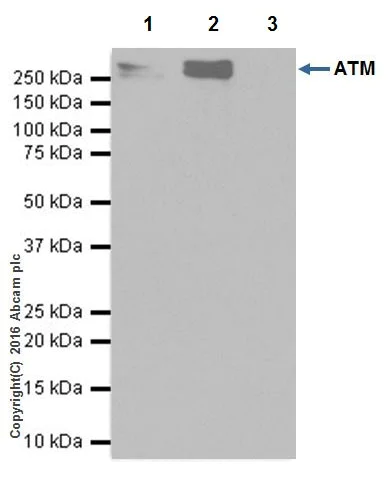
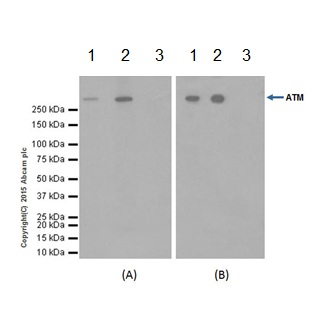
Immunoprecipitation - Anti-ATM antibody [EPR20100] - BSA and Azide free (AB223533)
ATM was immunoprecipitated from 0.35 mg of HEK-293 (Human epithelial cell line from embryonic kidney) whole cell lysate with ab201022 at 1/40 dilution. Western blot was performed from the immunoprecipitate using ab201022 at 1/1000 dilution. VeriBlot for IP Detection Reagent (HRP) (ab131366), was used for detection at 1/10000 dilution.
Lane 1 : HEK-293 whole cell lysate, 10 μg (Input).
Lane 2 : ab201022 IP in HEK-293 whole cell lysate.
Lane 3 : Rabbit monoclonal IgG (ab172730) instead of ab201022 in HEK-293 whole cell lysate.
Blocking and dilution buffer and concentration : 5% NFDM/TBST.
Exposure time : 3 minutes.
ATM cleavage has been documented previously and the fragment pattern is consistent with what has been described in the literature PMID : 16849690
This data was developed using the same antibody clone in a different buffer formulation containing PBS, BSA, glycerol, and sodium azide (ab201022).
All lanes:
Immunoprecipitation - Anti-ATM antibody [EPR20100] - ChIP Grade (<a href='/products/primary-antibodies/atm-antibody-epr20100-chip-grade-ab201022'>ab201022</a>)
Predicted band size: 351 kDa
Observed band size: 350 kDa
false
- ChIP
Supplier Data
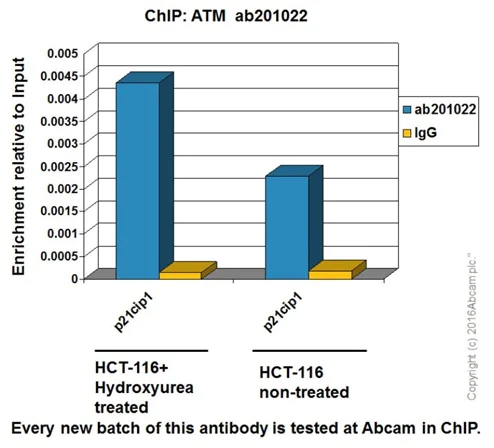
ChIP - Anti-ATM antibody [EPR20100] - BSA and Azide free (AB223533)
Chromatin was prepared from HCT 116 (Human colorectal carcinoma cell line) cells treated with 1mM Hydroxyurea for 16h and non-treated according to the Abcam X-ChIP protocol. Cells were fixed with formaldehyde for 10 minutes. The ChIP was performed with 25µg of chromatin, 2µg of ab201022 (blue), and 20µl of Anti rabbit IgG sepharose beads. 2μg of rabbit normal IgG was added to the beads control (yellow). The immunoprecipitated DNA was quantified by real time PCR (Sybr green approach).
This data was developed using the same antibody clone in a different buffer formulation containing PBS, BSA, glycerol, and sodium azide (ab201022).
- WB
Lab
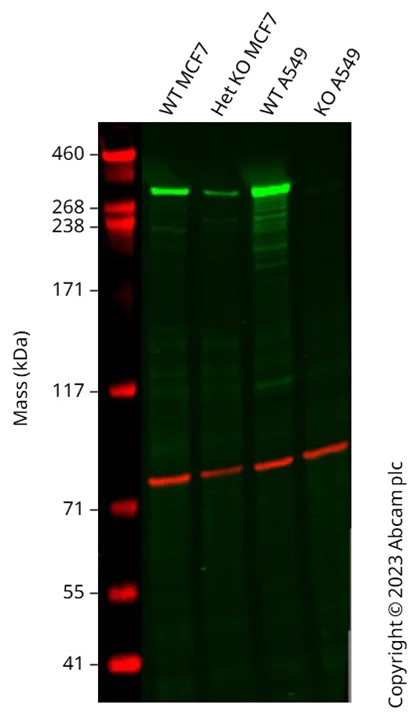
Western blot - Anti-ATM antibody [EPR20100] - BSA and Azide free (AB223533)
This data was developed using the same antibody clone in a different buffer formulation containing PBS, BSA, glycerol, and sodium azide (ab201022). Anti-ATM antibody [EPR20100] (ab201022) staining at 1/1000 dilution, shown in green; Mouse anti-CANX [CANX/1543] (ab238078) loading control staining at 1/20000 dilution, shown in red. In Western blot, ab201022 was shown to bind specifically to ATM. A band was observed at 350 kDa in wild-type MCF7 cell lysates with a reduction in signal observed at this size in ATM heterozygous knockout cell line ab282630. To generate this image, wild-type and ATM heterozygous knockout MCF7 cell lysates were analysed. First, samples were run on an SDS-PAGE gel then transferred onto a nitrocellulose membrane. Membranes were blocked in 3 % milk in TBS-0.1 % Tween$®$ 20 (TBS-T) before incubation with primary antibodies overnight at 4 °C. Blots were washed four times in TBS-T, incubated with secondary antibodies for 1 h at room temperature, washed again four times then imaged. Secondary antibodies used were Goat anti-Rabbit IgG H&L 800CW and Goat anti-Mouse IgG H&L 680RD at 1/20000 dilution
All lanes:
Western blot - Anti-ATM antibody [EPR20100] - ChIP Grade (<a href='/products/primary-antibodies/atm-antibody-epr20100-chip-grade-ab201022'>ab201022</a>) at 1/1000 dilution
Lane 1:
Wild-type MCF7 cell lysate at 20 µg
Lane 2:
ATM knockout MCF7 cell lysate at 20 µg
Lane 3:
Wild-type A549 cell lysate at 20 µg
Lane 4:
ATM knockout A549 ab283811 cell lysate at 20 µg
Predicted band size: 351 kDa
Observed band size: 350 kDa
false
- WB
Unknown
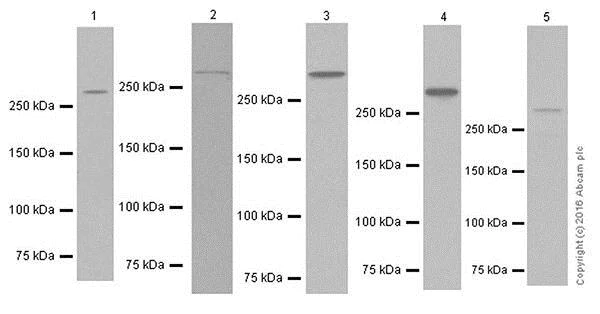
Western blot - Anti-ATM antibody [EPR20100] - BSA and Azide free (AB223533)
This data was developed using the same antibody clone in a different buffer formulation containing PBS, BSA, glycerol, and sodium azide (ab201022).
Blocking/Dilution buffer : 5% NFDM/TBST.
Exposure time : Lane 1 and 2 : 3 minutes; Lane 3 : 30 seconds; Lane 4 : 5 seconds; Lane 5 : 1 second
All lanes:
Western blot - Anti-ATM antibody [EPR20100] - BSA and Azide free (ab223533) at 1/1000 dilution
Lane 1:
Human testis lysate at 10 µg
Lane 2:
PC-12 (Rat adrenal gland pheochromocytoma cell line) whole cell lysate at 10 µg
Lane 3:
RAW 264.7 (Mouse macrophage cell line transformed with Abelson murine leukemia virus) whole cell lysate at 10 µg
Lane 4:
293 (Human epithelial cell line from embryonic kidney) whole cell lysate at 10 µg
Lane 5:
SH-SY5Y (Human neuroblastoma cell line from bone marrow) whole cell lysate at 10 µg
Secondary
All lanes:
Western blot - Goat Anti-Rabbit IgG H&L (HRP) (<a href='/products/secondary-antibodies/goat-rabbit-igg-h-l-hrp-ab97051'>ab97051</a>) at 1/20000 dilution
Predicted band size: 351 kDa
Observed band size: 351 kDa
false
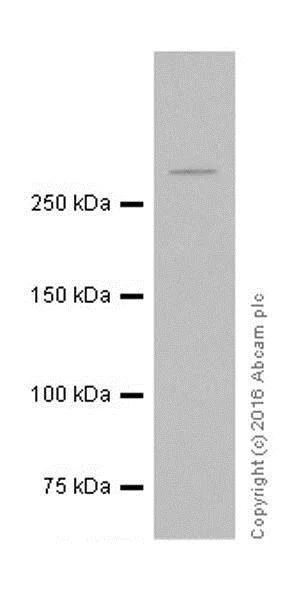
- WB
Unknown
Western blot - Anti-ATM antibody [EPR20100] - BSA and Azide free (AB223533)
This data was developed using the same antibody clone in a different buffer formulation containing PBS, BSA, glycerol, and sodium azide (ab201022).
Blocking/Dilution buffer : 5% NFDM/TBST.
All lanes:
Western blot - Anti-ATM antibody [EPR20100] - BSA and Azide free (ab223533) at 1/5000 dilution
All lanes:
HeLa (Human epithelial cell line from cervix adenocarcinoma) whole cell lysate at 10 µg
Secondary
All lanes:
Western blot - Goat Anti-Rabbit IgG H&L (HRP) (<a href='/products/secondary-antibodies/goat-rabbit-igg-h-l-hrp-ab97051'>ab97051</a>) at 1/20000 dilution
Predicted band size: 351 kDa
Observed band size: 351 kDa
false
Exposure time: 10s
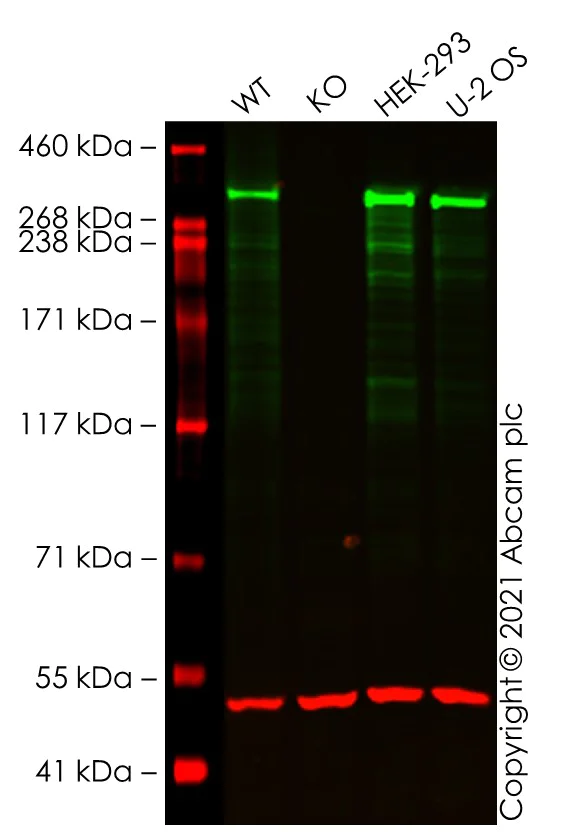
- WB
Lab
Western blot - Anti-ATM antibody [EPR20100] - BSA and Azide free (AB223533)
False colour image of Western blot : Anti-ATM antibody [EPR20100] - ChIP Grade staining at 1/1000 dilution, shown in green; Mouse anti-Alpha Tubulin [DM1A] (ab7291) loading control staining at 1/20000 dilution, shown in red. In Western blot, ab201022 was shown to bind specifically to ATM. A band was observed at 350 kDa in wild-type A549 cell lysates with no signal observed at this size in ATM knockout cell line ab276095 (knockout cell lysate ab283834). To generate this image, wild-type and ATM knockout A549 cell lysates were analysed. First, samples were run on an SDS-PAGE gel then transferred onto a nitrocellulose membrane. Membranes were blocked in 5 % milk in TBS-0.1 % Tween® 20 (TBS-T) before incubation with primary antibodies overnight at 4 °C. Blots were washed four times in TBS-T, incubated with secondary antibodies for 1 h at room temperature, washed again four times then imaged. Secondary antibodies used were Goat anti-Rabbit IgG H&L (IRDye® 800CW) preabsorbed (ab216773) and Goat anti-Mouse IgG H&L (IRDye® 680RD) preabsorbed (ab216776) at 1/20000 dilution.
All lanes:
Western blot - Anti-ATM antibody [EPR20100] - ChIP Grade (<a href='/products/primary-antibodies/atm-antibody-epr20100-chip-grade-ab201022'>ab201022</a>) at 1/1000 dilution
Lane 1:
Wild-type A549 cell lysate at 20 µg
Lane 2:
ATM knockout A549 cell lysate at 20 µg
Lane 2:
Western blot - Human ATM knockout A549 cell line (<a href='/products/cell-lines/human-atm-knockout-a549-cell-line-ab276095'>ab276095</a>)
Lane 3:
HEK-293 cell lysate at 20 µg
Lane 4:
U-2 OS cell lysate at 20 µg
Predicted band size: 351 kDa
Observed band size: 350 kDa
false
関連する標識済み抗体及び組成の異なる製品 (1)
-
Anti-ATM antibody [EPR20100] - ChIP Grade
代替製品

Primary Antibodies
AB199726
RabMAb|Recombinant|KO Validated|20ul selling size
- 2
- 1
Primary Antibodies
AB81292
Anti-ATM (phospho S1981) antibody [EP1890Y]
RabMAb|Recombinant|20ul selling size

- 5
- 18
Primary Antibodies
AB32420
RabMAb|Recombinant|KO Validated|20ul selling size

- 5
- 8
Primary Antibodies
AB208775
Anti-ATM (phospho S1981) antibody [EP1890Y] - BSA and Azide free
RabMAb|Recombinant

- 0
- 0

Primary Antibodies
AB216617
Anti-ATM antibody [Y170] - BSA and Azide free
RabMAb|Recombinant|KO Validated
- 0
- 0
組合せ製品
Primary Antibodies
AB81292
Anti-ATM (phospho S1981) antibody [EP1890Y]
RabMAb|Recombinant|20ul selling size
- 5
- 18
Primary Antibodies
AB81299
Anti-gamma H2A.X (phospho S139) antibody [EP854(2)Y]
BOND RX™ Validated|20ul selling size|RabMAb|Recombinant

- 4
- 18
Primary Antibodies
AB109520
RabMAb|Recombinant|KO Validated|Lab Essentials|20ul selling size

- 5
- 17
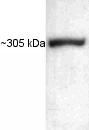
Reactivity data
製品の詳細
ab223533 is the carrier-free version of ab201022.
Patented technology
Our RabMAb® technology is a patented hybridoma-based technology for making rabbit monoclonal antibodies. For details on our patents, please refer to RabMAb® patents.
Conjugation ready
Our carrier-free antibodies are typically supplied in a PBS-only formulation, purified and free of BSA, sodium azide and glycerol. This conjugation-ready format is designed for use with fluorochromes, metal isotopes, oligonucleotides, and enzymes, which makes them ideal for antibody labelling, functional and cell-based assays, flow-based assays (e.g. mass cytometry) and Multiplex Imaging applications.
Use our conjugation kits for antibody conjugates that are ready-to-use in as little as 20 minutes with 1 minute hands-on-time and 100% antibody recovery: available for fluorescent dyes, HRP, biotin and gold.
Compatibility
This product is compatible with the Maxpar® Antibody Labeling Kit from Fluidigm, without the need for antibody preparation. Maxpar® is a trademark of Fluidigm Canada Inc.
出荷温度及び保存条件
製品の状態
精製方法
バッファー組成
出荷温度
短期保存温度
長期保存温度
保管に関する情報
補足情報
This supplementary information is collated from multiple sources and compiled automatically.
Biological function summary
ATM acts as a coordinator in cellular response to DNA damage highly interacting with multiple components of the DNA repair machinery. It forms a complex with proteins like NBS1 and MRN complex facilitating repair by recruiting and activating other proteins involved in homologous recombination and non-homologous end joining pathways. ATM also modulates p53 activity a primary response factor in cellular stress management linking ATM to control of cell cycle arrest and apoptosis. This positions ATM as an integral part of maintaining cellular integrity in face of genomic insult.
Pathways
ATM integrates neatly within the DNA damage response and cell cycle control pathways. ATM's operative relationship with the MRN complex and its role in the PI3K-related protein kinase family helps initiate appropriate repair processes upon DNA damage detection. Additionally ATM regulates the activity of proteins such as Chk2 which further propagates signals to p53 influencing decisions between cell cycle arrest and apoptosis. These interactions link ATM closely to essential processes like DNA repair and cell survival highlighting its role in genomic maintenance.
製品プロトコール
- Visit the General protocols
- Visit the Troubleshooting
ターゲットの情報
文献 (1)
Recent publications for all applications. Explore the full list and refine your search
Journal of translational medicine 19:463 PubMed34772407
2021
Applications
Unspecified application
Species
Unspecified reactive species
Abcam product promise
Please note: All products are 'FOR RESEARCH USE ONLY. NOT FOR USE IN DIAGNOSTIC OR THERAPEUTIC PROCEDURES'.
For licensing inquiries, please contact partnerships@abcam.com