Anti-ATF2 抗体 [EPR22938-114] - BSA and Azide free (Capture)
Anti-ATF2 antibody [EPR22938-114] - BSA and Azide free (Capture)
- RabMAb
- Recombinant
- 詳細を見る
Be the first to review this product! Submit a review
|
(0 Publication)
Rabbit Recombinant Monoclonal ATF2 antibody. Carrier free. Suitable for sELISA and reacts with Human samples.
別名を表示する
CREB2, CREBP1, ATF2, Cyclic AMP-dependent transcription factor ATF-2, cAMP-dependent transcription factor ATF-2, Activating transcription factor 2, Cyclic AMP-responsive element-binding protein 2, HB16, cAMP response element-binding protein CRE-BP1, CREB-2, cAMP-responsive element-binding protein 2
- sELISA
Supplier Data
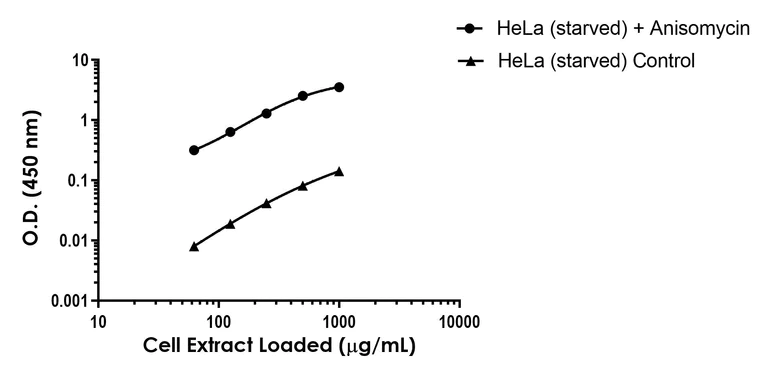
Sandwich ELISA - Anti-ATF2 antibody [EPR22938-114] - BSA and Azide free (Capture) (AB308569)
Sandwich ELISA of ab308568 with the capture antibody dilution at 2 µg/mL and detector antibody dilution at 0.5 µg/mL. HeLa (starved) + Anisomycin : Hela starved overnight, then treated with 250 ng/ml anisomycin for 30 minutes, whole cell lysate. Serial dilutions of lysates were analyzed. HeLa (starved) Control : Hela starved overnight, whole cell lysate. Serial dilutions of lysates were analyzed.
関連する標識済み抗体及び組成の異なる製品 (2)
-
Anti-ATF2 antibody [EPR22938-114]
-
Anti-ATF2 antibody [EPR22938-114] - BSA and Azide free
組合せ製品
Primary Antibodies
AB32537
BOND RX™ Validated|KO Validated|RabMAb|Recombinant|Lab Essentials|20ul selling size
- 5
- 4
Primary Antibodies
AB32019
Anti-ATF2 (phospho T71) antibody [E268]
Advanced Validation|RabMAb|Recombinant|Trial Size
- 0
- 0
Primary Antibodies
AB16667
BOND RX™ Validated|KO Validated|RabMAb|Advanced Validation|Recombinant|20ul selling size

- 5
- 133
Reactivity data
製品の詳細
Sandwich ELISA
The recommended antibody orientation is based on internal optimization for ELISA-based assays. Antibody orientation is assay dependent and needs to be optimized for each assay type. Please note that the range provided for this antibody is only an estimation based on the performance of the product using the recommended antibody pair. Performance of the antibody pair will depend on the specific characteristics of your assay. We guarantee the product works in sandwich ELISA, but we do not guarantee the sensitivity or dynamic range of the antibody in your assay.
Patented technology
Our RabMAb® technology is a patented hybridoma-based technology for making rabbit monoclonal antibodies. For details on our patents, please refer to RabMAb® patents.
What are the advantages of a recombinant monoclonal antibody?
This product is a recombinant monoclonal antibody, which offers several advantages including:
- - High batch-to-batch consistency and reproducibility
- - Improved sensitivity and specificity
- - Long-term security of supply
- - Animal-free batch production
For more information, read more on recombinant antibodies.
Conjugation ready
Our carrier-free antibodies are typically supplied in a PBS-only formulation, purified and free of BSA, sodium azide and glycerol. This conjugation-ready format is designed for use with fluorochromes, metal isotopes, oligonucleotides, and enzymes, which makes them ideal for antibody labelling, functional and cell-based assays, flow-based assays (e.g. mass cytometry) and Multiplex Imaging applications.
Use our conjugation kits for antibody conjugates that are ready-to-use in as little as 20 minutes with 1 minute hands-on-time and 100% antibody recovery: available for fluorescent dyes, HRP, biotin and gold.
出荷温度及び保存条件
製品の状態
バッファー組成
出荷温度
短期保存温度
長期保存温度
補足情報
This supplementary information is collated from multiple sources and compiled automatically.
Biological function summary
ATF2 takes part in the regulation of gene expression in response to various stimuli. It often forms a complex with other proteins such as c-Jun when binding to the DNA. This complex then influences the transcription of genes that respond to cellular stress and DNA damage. By phosphorylating specific serine residues cellular kinases activate ATF2 which then translocates to the nucleus where it exerts its function.
Pathways
ATF2 integrates into the MAPK and JNK signaling cascades which are important for transmitting stress signals from the cell surface to the nucleus. Through these pathways ATF2 interacts with proteins such as JNK and p38 MAPK modulating the transcription of downstream genes that control cell proliferation apoptosis and differentiation. Its role in these pathways positions ATF2 as a critical node where various signaling inputs merge to influence cellular outcomes.
製品プロトコール
- Visit the General protocols
- Visit the Troubleshooting
ターゲットの情報
Abcam product promise
Please note: All products are 'FOR RESEARCH USE ONLY. NOT FOR USE IN DIAGNOSTIC OR THERAPEUTIC PROCEDURES'.
For licensing inquiries, please contact partnerships@abcam.com