JavaScript is disabled in your browser. Please enable JavaScript to view this website.
AB221557

Anti-ARNTL2 抗体

Anti-ARNTL2 antibody

Be the first to review this product! Submit a review

|

(3 Publications)

Rabbit Polyclonal ARNTL2 antibody. Suitable for WB, ICC/IF and reacts with Human samples. Cited in 3 publications. Immunogen corresponding to Recombinant Fragment Protein within Human BMAL2 aa 450-550.

別名を表示する

ARNTL2, BHLHE6, CLIF, MOP9, PASD9, BMAL2, Basic helix-loop-helix ARNT-like protein 2, Aryl hydrocarbon receptor nuclear translocator-like protein 2, Basic-helix-loop-helix-PAS protein MOP9, Brain and muscle ARNT-like 2, CYCLE-like factor, Class E basic helix-loop-helix protein 6, Member of PAS protein 9, PAS domain-containing protein 9, bHLHe6
1 Images
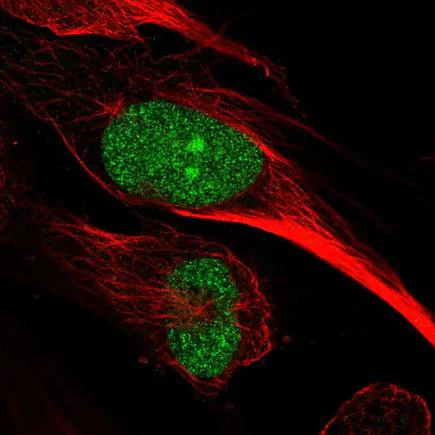
Immunocytochemistry/ Immunofluorescence - Anti-ARNTL2 antibody (AB221557)
  • ICC/IF

Supplier Data

Immunocytochemistry/ Immunofluorescence - Anti-ARNTL2 antibody (AB221557)

Immunofluorescent analysis of PFA-fixed, Triton X-100 permeabilized U-251 MG cells labeling ARNTL2 with ab221557 at 4 μg/mL (green).

Key facts

宿主種

Rabbit

クローン性

Polyclonal

アイソタイプ

IgG

キャリアフリー

No

交差種

Human

アプリケーション

WB, ICC/IF

applications

免疫原

Recombinant Fragment Protein within Human BMAL2 aa 450-550. The exact immunogen used to generate this antibody is proprietary information.

Q8WYA1

Reactivity data

{ "title": "Reactivity Data", "filters": { "stats": ["", "Species", "Dilution Info", "Notes"], "tabs": { "all-applications": {"fullname" : "All Applications", "shortname": "All Applications"}, "WB" : {"fullname" : "Western blot", "shortname":"WB"}, "ICCIF" : {"fullname" : "Immunocytochemistry/ Immunofluorescence", "shortname":"ICC/IF"} }, "product-promise": { "all": "all", "testedAndGuaranteed": "tested", "guaranteed": "expected", "predicted": "predicted", "notRecommended": "not-recommended" } }, "values": { "Human": { "WB-species-checked": "testedAndGuaranteed", "WB-species-dilution-info": "0.04-0.4 µg/mL", "WB-species-notes": "<p></p>", "ICCIF-species-checked": "testedAndGuaranteed", "ICCIF-species-dilution-info": "0.25-2 µg/mL", "ICCIF-species-notes": "<p>Fixation/Permeabilization: PFA/Triton X-100.</p>" } } }

出荷温度及び保存条件

製品の状態
Liquid
精製方法
Affinity purification Immunogen
バッファー組成
pH: 7.2 Preservative: 0.02% Sodium azide Constituents: PBS, 40% Glycerol (glycerin, glycerine)
出荷温度
Blue Ice
短期保存期間
1-2 weeks
短期保存温度
+4°C
長期保存温度
-20°C
分注に関する情報
Upon delivery aliquot
保管に関する情報
Avoid freeze / thaw cycle

補足情報

This supplementary information is collated from multiple sources and compiled automatically.

ARNTL2 also known as Brain and Muscle ARNT-Like 2 is a transcription factor with a mass of approximately 75 kDa. It is primarily expressed in various tissues such as liver lung and skeletal muscle. ARNTL2 forms heterodimers with proteins like CLOCK playing an important role in regulating circadian rhythms at the molecular level. The protein facilitates transcription through its basic helix-loop-helix (bHLH) and Per-Arnt-Sim (PAS) domains.
Biological function summary

ARNTL2 functions as a part of a transcriptional regulatory complex that controls the expression of clock-related genes. This complex is pivotal in maintaining homeostasis in biological rhythms. By interacting with other core clock proteins ARNTL2 influences processes like metabolism cell cycle and hormone production. The regulation of these processes helps maintain the body's natural cycles and responds to environmental cues.

Pathways

ARNTL2 is a integral player in the circadian rhythm pathway. This pathway involves interactions with proteins such as CLOCK NPAS2 and PER which synchronize biological functions with day-night cycles. Additionally ARNTL2 links to the gene regulatory network that participates in the metabolism pathway coordinating metabolic responses based on circadian cues and synchronizing body's energy utilization patterns.

ARNTL2 links to conditions like cancer and metabolic syndromes. Its dysregulation can disrupt circadian rhythms thereby affecting cell cycle and metabolic balance. Interactions with proteins like CLOCK and PER2 potentially contribute to these disorders as aberrations in these interactions might lead to tumorigenesis or metabolic imbalances. Understanding ARNTL2's role in these pathways provides insights into therapeutic approaches in related diseases.

製品プロトコール

For this product, it's our understanding that no specific protocols are required. You can visit:

ターゲットの情報

Transcriptional activator which forms a core component of the circadian clock. The circadian clock, an internal time-keeping system, regulates various physiological processes through the generation of approximately 24 hour circadian rhythms in gene expression, which are translated into rhythms in metabolism and behavior. It is derived from the Latin roots 'circa' (about) and 'diem' (day) and acts as an important regulator of a wide array of physiological functions including metabolism, sleep, body temperature, blood pressure, endocrine, immune, cardiovascular, and renal function. Consists of two major components : the central clock, residing in the suprachiasmatic nucleus (SCN) of the brain, and the peripheral clocks that are present in nearly every tissue and organ system. Both the central and peripheral clocks can be reset by environmental cues, also known as Zeitgebers (German for 'timegivers'). The predominant Zeitgeber for the central clock is light, which is sensed by retina and signals directly to the SCN. The central clock entrains the peripheral clocks through neuronal and hormonal signals, body temperature and feeding-related cues, aligning all clocks with the external light/dark cycle. Circadian rhythms allow an organism to achieve temporal homeostasis with its environment at the molecular level by regulating gene expression to create a peak of protein expression once every 24 hours to control when a particular physiological process is most active with respect to the solar day. Transcription and translation of core clock components (CLOCK, NPAS2, BMAL1, BMAL2, PER1, PER2, PER3, CRY1 and CRY2) plays a critical role in rhythm generation, whereas delays imposed by post-translational modifications (PTMs) are important for determining the period (tau) of the rhythms (tau refers to the period of a rhythm and is the length, in time, of one complete cycle). A diurnal rhythm is synchronized with the day/night cycle, while the ultradian and infradian rhythms have a period shorter and longer than 24 hours, respectively. Disruptions in the circadian rhythms contribute to the pathology of cardiovascular diseases, cancer, metabolic syndromes and aging. A transcription/translation feedback loop (TTFL) forms the core of the molecular circadian clock mechanism. Transcription factors, CLOCK or NPAS2 and BMAL1 or BMAL2, form the positive limb of the feedback loop, act in the form of a heterodimer and activate the transcription of core clock genes and clock-controlled genes (involved in key metabolic processes), harboring E-box elements (5'-CACGTG-3') within their promoters. The core clock genes : PER1/2/3 and CRY1/2 which are transcriptional repressors form the negative limb of the feedback loop and interact with the CLOCK|NPAS2-BMAL1|BMAL2 heterodimer inhibiting its activity and thereby negatively regulating their own expression. This heterodimer also activates nuclear receptors NR1D1/2 and RORA/B/G, which form a second feedback loop and which activate and repress BMAL1 transcription, respectively. The CLOCK-BMAL2 heterodimer activates the transcription of SERPINE1/PAI1 and BHLHE40/DEC1.
See full target information BMAL2

文献 (3)

Recent publications for all applications. Explore the full list and refine your search

Translational oncology 26:101562 PubMed36228410

2022

ARNTL2 is an indicator of poor prognosis, promotes epithelial-to-mesenchymal transition and inhibits ferroptosis in lung adenocarcinoma.

Applications

Unspecified application

Species

Unspecified reactive species

Huan Zhang,Guangyao Shan,Xing Jin,Xiangyang Yu,GuoShu Bi,Mingxiang Feng,Hao Wang,Miao Lin,Cheng Zhan,Qun Wang,Ming Li

Cancer cell international 21:341 PubMed34217271

2021

Upregulation of ARNTL2 is associated with poor survival and immune infiltration in clear cell renal cell carcinoma.

Applications

Unspecified application

Species

Unspecified reactive species

Song Wang,Xueyou Ma,Yufan Ying,Jiazhu Sun,Zitong Yang,Jiangfeng Li,Ke Jin,Xiao Wang,Bo Xie,Xiangyi Zheng,Ben Liu,Liping Xie

Clinical cancer research : an official journal of 24:4887-4899 PubMed29793947

2018

Comprehensive Profiling of DNA Repair Defects in Breast Cancer Identifies a Novel Class of Endocrine Therapy Resistance Drivers.

Applications

Unspecified application

Species

Unspecified reactive species

Meenakshi Anurag,Nindo Punturi,Jeremy Hoog,Matthew N Bainbridge,Matthew J Ellis,Svasti Haricharan
View all publications

Abcam product promise

当社は、高品質な試薬を通じてお客様の研究を力強くサポートすることをお約束いたします。ご使用いただく各段階で、常にお客様をサポートできる体制を整えております。万が一、製品が期待通りに機能しない場合は、「Abcam Product Promise」による当社保証制度に基づき、安心してご利用いただけます。
保証に関する詳細については利用規約をご確認ください。

Please note: All products are 'FOR RESEARCH USE ONLY. NOT FOR USE IN DIAGNOSTIC OR THERAPEUTIC PROCEDURES'.

For licensing inquiries, please contact partnerships@abcam.com