JavaScript is disabled in your browser. Please enable JavaScript to view this website.
AB151578

Anti-APT-2 抗体

Anti-APT-2 antibody

Be the first to review this product! Submit a review

|

(6 Publications)

Rabbit Polyclonal APT-2 antibody. Suitable for WB and reacts with Human samples. Cited in 6 publications.

別名を表示する

APT2, LYPLA2, Acyl-protein thioesterase 2, APT-2, Lysophospholipase II, Palmitoyl-protein hydrolase, LPL-II, LysoPLA II
2 Images
Western blot - Anti-APT-2 antibody (AB151578)
  • WB

Unknown

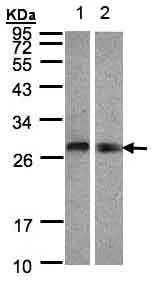
Western blot - Anti-APT-2 antibody (AB151578)

All lanes:

Western blot - Anti-APT-2 antibody (ab151578) at 1/1000 dilution

Lane 1:

HepG2 cell lysate at 30 µg

Lane 2:

Raji cell lysate at 30 µg

Predicted band size: 24 kDa

false
Western blot - Anti-APT-2 antibody (AB151578)
  • WB

CiteAb

Western blot - Anti-APT-2 antibody (AB151578)

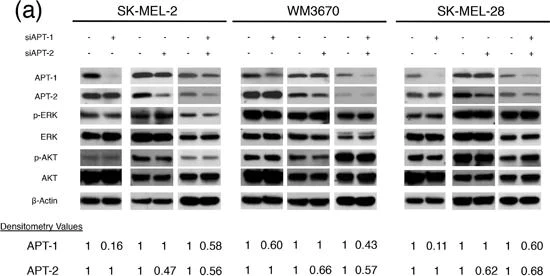
APT-2 western blot using anti-APT-2 antibody ab151578. Publication image and figure legend from Vujic, I., Sanlorenzo, M., et al., 2016, Oncotarget, PubMed 26771141.

ab151578 was used in this publication in western blot. This may not be the same as the application(s) guaranteed by Abcam. For a full list of applications guaranteed by Abcam for ab151578 please see the product overview.

siRNA knock down of APT-1 and APT-2 in NRAS and BRAF mutant melanoma(a) and (b) melanoma cells with indicated mutations were transfected with APT-1 or APT-2 targeting siRNA pools (siAPT1, siAPT2) or their combination and compared to cells transfected with a non-targeting siRNA pool (concentration 100nM, incubation 72hrs). a. Immunoblots after APT-1, APT-2 or dual knock down. Densitometry values for APT-1 and APT-2 show the percentage of protein expression following siRNA treatment. No relevant changes in NRAS downstream effectors are seen following APT-1, APT-2 or dual knock down. b. Bar graphs depicting viable cells after APT-1, APT-2 or dual knock down. Analyses revealed no significant differences in cell viability in NRAS and BRAF mutant melanoma cells (incubation 72hrs, n > 3, error bars represent SD)

false

Key facts

宿主種

Rabbit

クローン性

Polyclonal

アイソタイプ

IgG

キャリアフリー

No

交差種

Human

アプリケーション

WB

applications

免疫原

The exact immunogen used to generate this antibody is proprietary information.

Reactivity data

{ "title": "Reactivity Data", "filters": { "stats": ["", "Species", "Dilution Info", "Notes"], "tabs": { "all-applications": {"fullname" : "All Applications", "shortname": "All Applications"}, "WB" : {"fullname" : "Western blot", "shortname":"WB"} }, "product-promise": { "all": "all", "testedAndGuaranteed": "tested", "guaranteed": "expected", "predicted": "predicted", "notRecommended": "not-recommended" } }, "values": { "Human": { "WB-species-checked": "testedAndGuaranteed", "WB-species-dilution-info": "1/500 - 1/3000", "WB-species-notes": "<p></p>" }, "Mouse": { "WB-species-checked": "predicted", "WB-species-dilution-info": "", "WB-species-notes": "" }, "Rat": { "WB-species-checked": "predicted", "WB-species-dilution-info": "", "WB-species-notes": "" }, "Cow": { "WB-species-checked": "predicted", "WB-species-dilution-info": "", "WB-species-notes": "" } } }

出荷温度及び保存条件

製品の状態
Liquid
精製方法
Affinity purification Immunogen
バッファー組成
pH: 7 Preservative: 0.01% Thimerosal (merthiolate) Constituents: 10% Glycerol (glycerin, glycerine), 1.21% Tris, 0.75% Glycine
出荷温度
Blue Ice
短期保存温度
+4°C
長期保存温度
-20°C
分注に関する情報
Upon delivery aliquot
保管に関する情報
Avoid freeze / thaw cycle

補足情報

This supplementary information is collated from multiple sources and compiled automatically.

APT-2 also known as lysophospholipase A2 (lypla2) is an enzyme involved in lipid metabolism. APT-2 has a molecular mass of approximately 25 kDa and is expressed in various tissues including the brain heart and muscle. As an important member of the lipid acyl hydrolase family it removes fatty acids from lysophospholipids. Researchers often use the names anti-APT and anti-ApT in antibody studies targeting this enzyme. APT-2 identification in these tissues highlights its importance in lipid processing and suggests its broader functional implications.
Biological function summary

APT-2 plays a critical role in maintaining phospholipid homeostasis contributing to membrane fluidity and signal transduction. It is involved in hydrolyzing lysophospholipids into lysoglycerophospholipids and free fatty acids. Not part of a complex APT-2 acts as an individual enzyme handling specific substrates in this context. Its activity regulates levels of lipid signaling molecules influencing cellular responses to environmental cues. APT-2 also contributes to energy storage via metabolism of lipid substrates linking its enzymatic activity to broader metabolic pathways.

Pathways

APT-2 holds significance in both metabolic and signaling pathways specifically the glycerophospholipid metabolism and lysophospholipid signaling pathways. It catalyzes reactions key to these pathways and intersects with proteins like phospholipase A2 and PLA2G6. Glycerophospholipid metabolism sees APT-2 breaking down molecules to sustain membrane integrity and cellular communication processes. In lysophospholipid signaling its activity regulates bioactive lipid levels which impact a variety of cellular signaling events showing a well-integrated role in cellular physiology.

The dysfunction of APT-2 links to neurodegenerative diseases and cardiovascular disorders. Altered APT-2 activity is associated with Alzheimer's disease due to disrupted lipid homeostasis and membrane composition. The enzyme's interaction with proteins like phospholipase A2 highlights its involvement in these neurodegenerative processes. Furthermore cardiovascular health implications arise from its role in lysophospholipid metabolism and associated inflammatory responses. Aberrations in APT-2 function can modulate pathways that exacerbate atherosclerosis further connecting its activity to disease states.

製品プロトコール

For this product, it's our understanding that no specific protocols are required. You can visit:

ターゲットの情報

Acts as an acyl-protein thioesterase hydrolyzing fatty acids from S-acylated cysteine residues in proteins such as trimeric G alpha proteins, GSDMD, GAP43, ZDHHC6 or HRAS (PubMed : 21152083, PubMed : 28826475). Deacylates GAP43 (PubMed : 21152083). Mediates depalmitoylation of ZDHHC6 (PubMed : 28826475). Has lysophospholipase activity (PubMed : 25301951). Hydrolyzes prostaglandin glycerol esters (PG-Gs) in the following order prostaglandin D2-glycerol ester (PGD2-G) > prostaglandin E2 glycerol ester (PGE2-G) > prostaglandin F2-alpha-glycerol ester (PGF2-alpha-G) (PubMed : 25301951). Hydrolyzes 1-arachidonoylglycerol but not 2-arachidonoylglycerol or arachidonoylethanolamide (PubMed : 25301951).
See full target information LYPLA2

文献 (6)

Recent publications for all applications. Explore the full list and refine your search

Nature communications 16:867 PubMed39833225

2025

Palmitoylation-dependent regulation of GPX4 suppresses ferroptosis.

Applications

Unspecified application

Species

Unspecified reactive species

Bin Huang,Hui Wang,Shuo Liu,Meng Hao,Dan Luo,Yi Zhou,Ying Huang,Yong Nian,Lei Zhang,Bo Chu,Chengqian Yin

Cell death & disease 15:60 PubMed38233383

2024

Dietary long-chain fatty acids promote colitis by regulating palmitoylation of STAT3 through CD36-mediated endocytosis.

Applications

Unspecified application

Species

Unspecified reactive species

Yuping Wei,Jinting Li,Jiao Li,Chuan Liu,Xingzhou Guo,Zhengru Liu,Luyun Zhang,Shenglan Bao,Xiaohan Wu,Wenhao Su,Xiaoli Wang,Jixiang Zhang,Weiguo Dong

Reproductive sciences (Thousand Oaks, Calif.) 31:128-138 PubMed37603234

2023

Estrogen Regulates Scribble Localization in Endometrial Epithelial Cells Through Acyl Protein Thioesterase (APT)-Mediated S-Palmitoylation in Adenomyosis.

Applications

Unspecified application

Species

Unspecified reactive species

Zhixing Jin,Juan Wang,Youguo Chen

Journal of cell science 136: PubMed37039765

2023

Activity-dependent post-translational regulation of palmitoylating and depalmitoylating enzymes in the hippocampus.

Applications

Unspecified application

Species

Unspecified reactive species

Danya Abazari,Angela R Wild,Tian Qiu,Bryan C Dickinson,Shernaz X Bamji

Nature communications 10:877 PubMed30787281

2019

Targeting MC1R depalmitoylation to prevent melanomagenesis in redheads.

Applications

Unspecified application

Species

Unspecified reactive species

Shuyang Chen,Changpeng Han,Xiao Miao,Xin Li,Chengqian Yin,Junrong Zou,Min Liu,Shanshan Li,Lukasz Stawski,Bo Zhu,Qiong Shi,Zhi-Xiang Xu,Chunying Li,Colin R Goding,Jun Zhou,Rutao Cui

Oncotarget 7:7297-306 PubMed26771141

2016

Acyl protein thioesterase 1 and 2 (APT-1, APT-2) inhibitors palmostatin B, ML348 and ML349 have different effects on NRAS mutant melanoma cells.

Applications

WB

Species

Unspecified reactive species

Igor Vujic,Martina Sanlorenzo,Rosaura Esteve-Puig,Marin Vujic,Andrew Kwong,Aaron Tsumura,Ryan Murphy,Adrian Moy,Christian Posch,Babak Monshi,Klemens Rappersberger,Susana Ortiz-Urda
View all publications

Abcam product promise

当社は、高品質な試薬を通じてお客様の研究を力強くサポートすることをお約束いたします。ご使用いただく各段階で、常にお客様をサポートできる体制を整えております。万が一、製品が期待通りに機能しない場合は、「Abcam Product Promise」による当社保証制度に基づき、安心してご利用いただけます。
保証に関する詳細については利用規約をご確認ください。

Please note: All products are 'FOR RESEARCH USE ONLY. NOT FOR USE IN DIAGNOSTIC OR THERAPEUTIC PROCEDURES'.

For licensing inquiries, please contact partnerships@abcam.com