JavaScript is disabled in your browser. Please enable JavaScript to view this website.
AB239308

APC/Cy7® Anti-HLA-DR 抗体 [L243]

APC/Cy7® Anti-HLA-DR antibody [L243]

Be the first to review this product! Submit a review

|

(1 Publication)

Anti-HLA-DR antibody [L243] conjugated to APC/Cy7® - suitable for flow cytometry, and reacts with human samples. Clone [L243] is a mouse monoclonal antibody and one of the most commonly used clones for flow cytometry.

Design your panel with our interactive flow cytometry panel builder. Click here.

別名を表示する

HLA-DRA1, HLA-DRA, MHC class II antigen DRA
1 Images
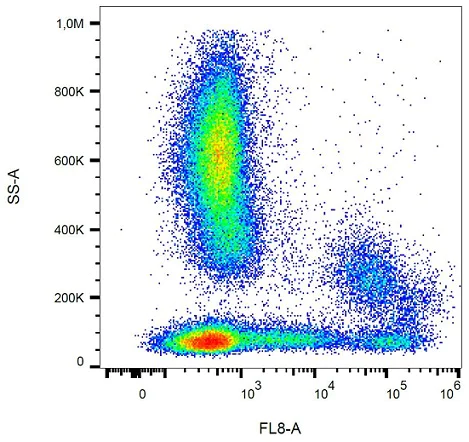
Flow Cytometry - APC/Cy7® Anti-HLA-DR antibody [L243] (AB239308)
  • Flow Cyt

Supplier Data

Flow Cytometry - APC/Cy7® Anti-HLA-DR antibody [L243] (AB239308)

Flow cytometric analysis of human peripheral blood labeling HLA-DR using ab239308. Surface staining. Gated on leukocytes.

関連する標識済み抗体及び組成の異なる製品 (1)

  • 660 APC

    APC Anti-HLA-DRA antibody [L243]

Key facts

宿主種

Mouse

クローン性

Monoclonal

クローン番号

L243

アイソタイプ

IgG2a

標識

APC/Cy7®

励起波長/蛍光波長

Ex: 650nm, Em: 785nm

キャリアフリー

No

交差種

Human

アプリケーション

Flow Cyt

applications

免疫原

Cell preparation containing HLA-DRA protein. The exact immunogen used to generate this antibody is proprietary information.

P01903

特異性

ab239308 recognizes specifically HLA-DR molecules, both peptide-loaded and empty.

Reactivity data

{ "title": "Reactivity Data", "filters": { "stats": ["", "Species", "Dilution Info", "Notes"], "tabs": { "all-applications": {"fullname" : "All Applications", "shortname": "All Applications"}, "FlowCyt" : {"fullname" : "Flow Cytometry", "shortname":"Flow Cyt"} }, "product-promise": { "all": "all", "testedAndGuaranteed": "tested", "guaranteed": "expected", "predicted": "predicted", "notRecommended": "not-recommended" } }, "values": { "Human": { "FlowCyt-species-checked": "testedAndGuaranteed", "FlowCyt-species-dilution-info": "4 µL for 10^6 Cells", "FlowCyt-species-notes": "<p>(or 100 μl of whole blood).</p>" }, "Dog": { "FlowCyt-species-checked": "predicted", "FlowCyt-species-dilution-info": "", "FlowCyt-species-notes": "" }, "Primates": { "FlowCyt-species-checked": "predicted", "FlowCyt-species-dilution-info": "", "FlowCyt-species-notes": "" } } }

製品の詳細

This product or portions thereof is manufactured under license from Carnegie Mellon University under U.S. Patent Number 5, 268, 486 and related patents. Cy® and CyDye® are trademarks of Cytiva.

出荷温度及び保存条件

製品の状態
Liquid
精製方法
Size-exclusion chromatography
精製に関する特記事項
Purified antibody is conjugated with tandem dye Allophycocyanin/Cy7 ® under optimum conditions. The conjugate is purified by size-exclusion chromatography and adjusted for direct use. No reconstitution is necessary.
バッファー組成
pH: 7.4 Preservative: 0.0975% Sodium azide Constituents: PBS
出荷温度
Blue Ice
短期保存温度
+4°C
長期保存温度
+4°C
保管に関する情報
Store in the dark

製品プロトコール

For this product, it's our understanding that no specific protocols are required. You can visit:

ターゲットの情報

An alpha chain of antigen-presenting major histocompatibility complex class II (MHCII) molecule. In complex with the beta chain HLA-DRB, displays antigenic peptides on professional antigen presenting cells (APCs) for recognition by alpha-beta T cell receptor (TCR) on HLA-DR-restricted CD4-positive T cells. This guides antigen-specific T-helper effector functions, both antibody-mediated immune response and macrophage activation, to ultimately eliminate the infectious agents and transformed cells (PubMed : 15265931, PubMed : 15322540, PubMed : 17334368, PubMed : 22327072, PubMed : 24190431, PubMed : 27591323, PubMed : 29884618, PubMed : 31495665, PubMed : 8145819, PubMed : 9075930). Typically presents extracellular peptide antigens of 10 to 30 amino acids that arise from proteolysis of endocytosed antigens in lysosomes (PubMed : 8145819). In the tumor microenvironment, presents antigenic peptides that are primarily generated in tumor-resident APCs likely via phagocytosis of apoptotic tumor cells or macropinocytosis of secreted tumor proteins (PubMed : 31495665). Presents peptides derived from intracellular proteins that are trapped in autolysosomes after macroautophagy, a mechanism especially relevant for T cell selection in the thymus and central immune tolerance (PubMed : 17182262, PubMed : 23783831). The selection of the immunodominant epitopes follows two processing modes : 'bind first, cut/trim later' for pathogen-derived antigenic peptides and 'cut first, bind later' for autoantigens/self-peptides (PubMed : 25413013). The anchor residue at position 1 of the peptide N-terminus, usually a large hydrophobic residue, is essential for high affinity interaction with MHCII molecules (PubMed : 8145819).
See full target information HLA-DRA

文献 (1)

Recent publications for all applications. Explore the full list and refine your search

Journal of nanobiotechnology 22:803 PubMed39734237

2024

Targeting AURKA with multifunctional nanoparticles in CRPC therapy.

Applications

Unspecified application

Species

Unspecified reactive species

Bin Deng,Binghu Ke,Qixing Tian,Yukui Gao,Qiliang Zhai,Wenqiang Zhang
View all publications

Abcam product promise

当社は、高品質な試薬を通じてお客様の研究を力強くサポートすることをお約束いたします。ご使用いただく各段階で、常にお客様をサポートできる体制を整えております。万が一、製品が期待通りに機能しない場合は、「Abcam Product Promise」による当社保証制度に基づき、安心してご利用いただけます。
保証に関する詳細については利用規約をご確認ください。

Please note: All products are 'FOR RESEARCH USE ONLY. NOT FOR USE IN DIAGNOSTIC OR THERAPEUTIC PROCEDURES'.

For licensing inquiries, please contact partnerships@abcam.com