JavaScript is disabled in your browser. Please enable JavaScript to view this website.
AB270635

APC Anti-CXCR4/CD184 抗体 [12G5]

APC Anti-CXCR4/CD184 antibody [12G5]

Be the first to review this product! Submit a review

|

(0 Publication)

Anti-CXCR4/CD184 antibody [12G5] conjugated to APC - suitable for flow cytometry, and reacts with human samples. Clone [12G5] is a mouse monoclonal antibody and one of the most commonly used clones for flow cytometry.

Design your panel with our interactive flow cytometry panel builder. Click here.

別名を表示する

CD184, C-X-C chemokine receptor type 4, CXC-R4, CXCR-4, FB22, Fusin, HM89, LCR1, Leukocyte-derived seven transmembrane domain receptor, Lipopolysaccharide-associated protein 3, NPYRL, Stromal cell-derived factor 1 receptor, LESTR, LAP-3, LPS-associated protein 3, SDF-1 receptor, CXCR4
2 Images
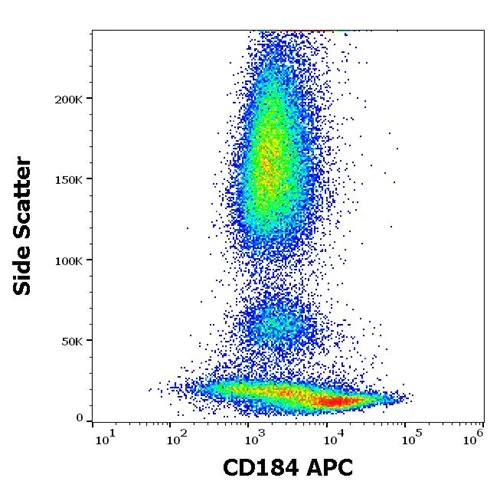
Flow Cytometry - APC Anti-CXCR4/CD184 antibody [12G5] (AB270635)
  • Flow Cyt

Supplier Data

Flow Cytometry - APC Anti-CXCR4/CD184 antibody [12G5] (AB270635)

Flow cytometric analysis of human peripheral whole blood cells labeling CD184 using ab270635, with the concentration of 10 μl reagent /100 μl of peripheral whole blood.
Flow Cytometry - APC Anti-CXCR4/CD184 antibody [12G5] (AB270635)
  • Flow Cyt

Supplier Data

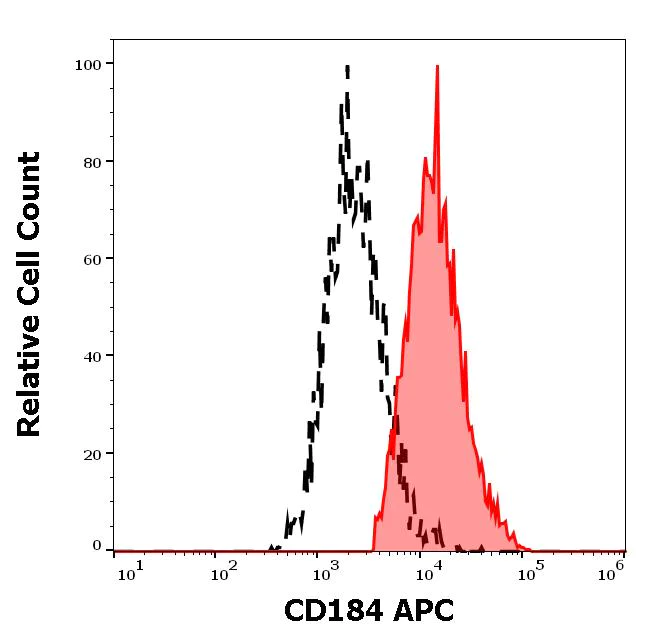
Flow Cytometry - APC Anti-CXCR4/CD184 antibody [12G5] (AB270635)

Flow cytometric analysis of lymphocytes (red) and monocytes (black) cells labeling CD184 using ab270635. Concentration of 10 μl reagent/100μl peripheral whole blood.

関連する標識済み抗体及び組成の異なる製品 (3)

Key facts

宿主種

Mouse

クローン性

Monoclonal

クローン番号

12G5

アイソタイプ

IgG2a

軽鎖のタイプ

kappa

標識

APC

励起波長/蛍光波長

Ex: 650nm, Em: 660nm

キャリアフリー

No

交差種

Human, Primates

アプリケーション

Flow Cyt

applications

免疫原

Cell preparation containing CXCR4/CD184 protein. The exact immunogen used to generate this antibody is proprietary information.

P61073

Reactivity data

{ "title": "Reactivity Data", "filters": { "stats": ["", "Species", "Dilution Info", "Notes"], "tabs": { "all-applications": {"fullname" : "All Applications", "shortname": "All Applications"}, "FlowCyt" : {"fullname" : "Flow Cytometry", "shortname":"Flow Cyt"} }, "product-promise": { "all": "all", "testedAndGuaranteed": "tested", "guaranteed": "expected", "predicted": "predicted", "notRecommended": "not-recommended" } }, "values": { "Human": { "FlowCyt-species-checked": "testedAndGuaranteed", "FlowCyt-species-dilution-info": "10 µL for 10^6 Cells", "FlowCyt-species-notes": "<p></p>" }, "Primates": { "FlowCyt-species-checked": "guaranteed", "FlowCyt-species-dilution-info": "10 µL for 10^6 Cells", "FlowCyt-species-notes": "<p></p>" } } }

出荷温度及び保存条件

製品の状態
Liquid
精製方法
Size-exclusion chromatography
バッファー組成
pH: 7.4 Preservative: 0.1% Sodium azide Constituents: PBS
出荷温度
Blue Ice
短期保存温度
+4°C
長期保存温度
+4°C
保管に関する情報
Store in the dark

補足情報

This supplementary information is collated from multiple sources and compiled automatically.

CXCR4 also known as C-X-C chemokine receptor type 4 is a G protein-coupled receptor that is involved in signal transduction. It has a molecular weight of approximately 41 kDa. CXCR4 is ubiquitously expressed across various tissues including immune cells like T and B lymphocytes as well as in bone marrow brain and heart. It binds specifically with the ligand CXCL12 also known as stromal cell-derived factor 1 (SDF-1) facilitating responses such as cell migration and proliferation.
Biological function summary

CXCR4 plays an important role in the immune system hematopoiesis and angiogenesis. It does not function alone and is often part of a larger protein complex where it recruits and activates other G proteins. The receptor mediates chemotactic responses directing cells to sites of inflammation or injury. Its interaction with CXCL12 is critical for maintaining immune surveillance aiding in the movement and positioning of immune cells.

Pathways

CXCR4 integrates into significant cellular signaling pathways such as the PI3K/AKT pathway and the MAPK pathway. It collaborates closely with signaling proteins like AKT1 and MAPK1 impacting cell survival and growth. These pathways are essential for various cellular functions including cell cycle progression and apoptosis regulation. The cross-talk between CXCR4 and these pathways underlines its influence on cell fate decisions.

CXCR4 is implicated in cancer metastasis and HIV entry into cells. Overexpression of CXCR4 is observed in several cancers contributing to tumor growth and metastasis. The interaction between CXCR4 and CXCL12 facilitates the infiltration and spread of cancer cells. Additionally in HIV CXCR4 serves as a coreceptor along with CD4 allowing the virus to enter and infect host cells. Both cancer and HIV illustrate CXCR4's central role in disease progression and pathogenesis.

製品プロトコール

For this product, it's our understanding that no specific protocols are required. You can visit:

ターゲットの情報

Receptor for the C-X-C chemokine CXCL12/SDF-1 that transduces a signal by increasing intracellular calcium ion levels and enhancing MAPK1/MAPK3 activation (PubMed : 10074102, PubMed : 10452968, PubMed : 10644702, PubMed : 10825158, PubMed : 18799424, PubMed : 20048153, PubMed : 20505072, PubMed : 24912431, PubMed : 28978524, PubMed : 8752280, PubMed : 8752281). Ligand binding causes a conformation change that triggers signaling via guanine nucleotide-binding proteins (G proteins) and modulates the activity of downstream effectors, such as adenylate cyclase (PubMed : 16725153, PubMed : 17197449, PubMed : 18799424, PubMed : 39093700). CXCR4 is coupled to G(i) G alpha proteins and mediates inhibition of adenylate cyclase (PubMed : 17197449, PubMed : 39093700). Involved in the AKT signaling cascade (PubMed : 24912431). Plays a role in regulation of cell migration, e.g. during wound healing (PubMed : 28978524). Also acts as a receptor for extracellular ubiquitin; leading to enhanced intracellular calcium ions and reduced cellular cAMP levels (PubMed : 20228059). Binds bacterial lipopolysaccharide (LPS) et mediates LPS-induced inflammatory response, including TNF secretion by monocytes (PubMed : 11276205). Involved in hematopoiesis and in cardiac ventricular septum formation (By similarity). Also plays an essential role in vascularization of the gastrointestinal tract, probably by regulating vascular branching and/or remodeling processes in endothelial cells (By similarity). Involved in cerebellar development; in the CNS, could mediate hippocampal-neuron surviva (By similarity).. (Microbial infection) Acts as a coreceptor (CD4 being the primary receptor) for human immunodeficiency virus-1/HIV-1 X4 isolates and as a primary receptor for some HIV-2 isolates. Promotes Env-mediated fusion of the virus (PubMed : 10074122, PubMed : 10756055, PubMed : 8849450, PubMed : 8929542, PubMed : 9427609).
See full target information CXCR4/CD184

Abcam product promise

当社は、高品質な試薬を通じてお客様の研究を力強くサポートすることをお約束いたします。ご使用いただく各段階で、常にお客様をサポートできる体制を整えております。万が一、製品が期待通りに機能しない場合は、「Abcam Product Promise」による当社保証制度に基づき、安心してご利用いただけます。
保証に関する詳細については利用規約をご確認ください。

Please note: All products are 'FOR RESEARCH USE ONLY. NOT FOR USE IN DIAGNOSTIC OR THERAPEUTIC PROCEDURES'.

For licensing inquiries, please contact partnerships@abcam.com