JavaScript is disabled in your browser. Please enable JavaScript to view this website.
AB198583

Alexa Fluor® 647 Anti-Cytochrome C 抗体 [37BA11]

Alexa Fluor® 647 Anti-Cytochrome C antibody [37BA11]

Be the first to review this product! Submit a review

|

(2 Publications)

Anti-Cytochrome C antibody [37BA11] conjugated to Alexa Fluor® 647 - suitable for ICC/IF, and reacts with human samples. Clone [37BA11] is a mouse monoclonal antibody cited in 2 publications.

別名を表示する

CYC, CYCS, Cytochrome c
1 Images
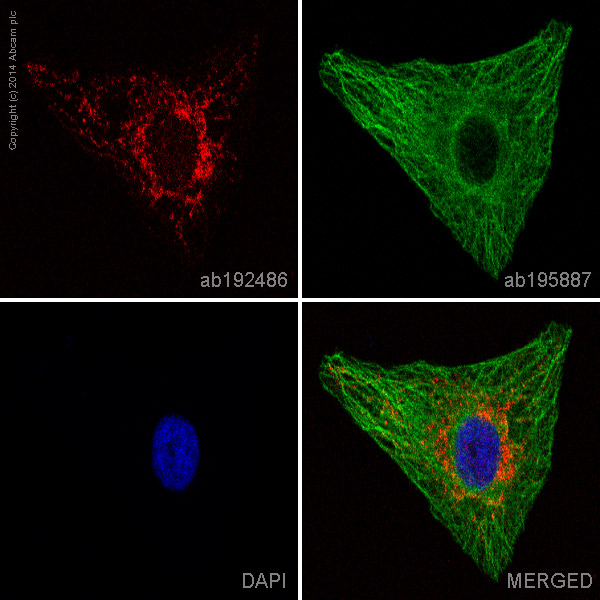
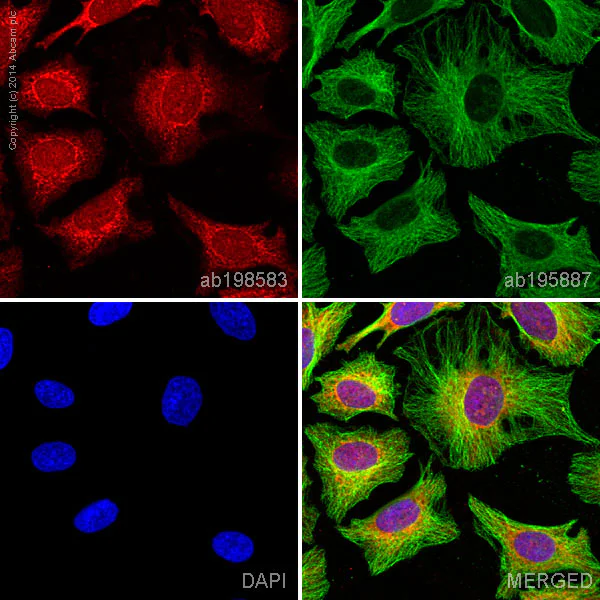
Immunocytochemistry/ Immunofluorescence - Alexa Fluor® 647 Anti-Cytochrome C antibody [37BA11] (AB198583)
  • ICC/IF

Lab

Immunocytochemistry/ Immunofluorescence - Alexa Fluor® 647 Anti-Cytochrome C antibody [37BA11] (AB198583)

ab198583 staining Cytochrome C in HeLa cells. The cells were fixed with 100% methanol (5 min), permeabilized with 0.1% Triton X-100 for 5 minutes and then blocked with 1% BSA/10% normal goat serum/0.3M glycine in 0.1% PBS-Tween for 1h. The cells were then incubated overnight at +4°C with ab198583 at 1/100 dilution (shown in red) and ab195887, Mouse monoclonal to alpha Tubulin (Alexa Fluor® 488), at 1/250 dilution (shown in green). Nuclear DNA was labelled with DAPI (shown in blue).

Image was taken with a confocal microscope (Leica-Microsystems, TCS SP8).

関連する標識済み抗体及び組成の異なる製品 (3)

  • Unconjugated

    Anti-Cytochrome C antibody [37BA11]

  • 519 Alexa Fluor® 488

    Alexa Fluor® 488 Anti-Cytochrome C antibody [37BA11]

  • HRP

    HRP Anti-Cytochrome C antibody [37BA11]

Key facts

宿主種

Mouse

クローン性

Monoclonal

クローン番号

37BA11

アイソタイプ

IgG2a

軽鎖のタイプ

kappa

標識

Alexa Fluor® 647

励起波長/蛍光波長

Ex: 650nm, Em: 665nm

キャリアフリー

No

交差種

Human

アプリケーション

ICC/IF

applications

免疫原

The exact immunogen used to generate this antibody is proprietary information.

Reactivity data

{ "title": "Reactivity Data", "filters": { "stats": ["", "Species", "Dilution Info", "Notes"], "tabs": { "all-applications": {"fullname" : "All Applications", "shortname": "All Applications"}, "ICCIF" : {"fullname" : "Immunocytochemistry/ Immunofluorescence", "shortname":"ICC/IF"} }, "product-promise": { "all": "all", "testedAndGuaranteed": "tested", "guaranteed": "expected", "predicted": "predicted", "notRecommended": "not-recommended" } }, "values": { "Human": { "ICCIF-species-checked": "testedAndGuaranteed", "ICCIF-species-dilution-info": "1/100", "ICCIF-species-notes": "<p>This product gave a positive signal in HeLa cells fixed with 100% methanol (5 min)</p>" }, "Mouse": { "ICCIF-species-checked": "predicted", "ICCIF-species-dilution-info": "", "ICCIF-species-notes": "" }, "Rat": { "ICCIF-species-checked": "predicted", "ICCIF-species-dilution-info": "", "ICCIF-species-notes": "" }, "Caenorhabditis elegans": { "ICCIF-species-checked": "predicted", "ICCIF-species-dilution-info": "", "ICCIF-species-notes": "" }, "Cow": { "ICCIF-species-checked": "predicted", "ICCIF-species-dilution-info": "", "ICCIF-species-notes": "" } } }

製品の詳細

Alexa Fluor® is a registered trademark of Molecular Probes, Inc, a Thermo Fisher Scientific Company. The Alexa Fluor® dye included in this product is provided under an intellectual property license from Life Technologies Corporation. As this product contains the Alexa Fluor® dye, the purchase of this product conveys to the buyer the non-transferable right to use the purchased product and components of the product only in research conducted by the buyer (whether the buyer is an academic or for-profit entity). As this product contains the Alexa Fluor® dye the sale of this product is expressly conditioned on the buyer not using the product or its components, or any materials made using the product or its components, in any activity to generate revenue, which may include, but is not limited to use of the product or its components: in manufacturing; (ii) to provide a service, information, or data in return for payment (iii) for therapeutic, diagnostic or prophylactic purposes; or (iv) for resale, regardless of whether they are sold for use in research. For information on purchasing a license to this product for purposes other than research, contact Life Technologies Corporation, 5781 Van Allen Way, Carlsbad, CA 92008 USA or outlicensing@thermofisher.com.

出荷温度及び保存条件

製品の状態
Liquid
精製方法
Affinity purification
精製に関する特記事項
ab110325 was produced in vitro using hybridomas grown in serum-free medium, and then purified by biochemical fractionation.
バッファー組成
pH: 7.4 Preservative: 0.02% Sodium azide Constituents: PBS, 30% Glycerol (glycerin, glycerine), 1% BSA
出荷温度
Blue Ice
短期保存期間
1-2 weeks
短期保存温度
+4°C
長期保存温度
-20°C
分注に関する情報
Upon delivery aliquot
保管に関する情報
Avoid freeze / thaw cycle|Store in the dark

補足情報

This supplementary information is collated from multiple sources and compiled automatically.

Cytochrome C also referred to as "cytochrome c" or "Cyt C" is a small protein with a molecular weight of approximately 12 kDa. It is a component of the electron transport chain playing an essential mechanical role in cellular respiration. Cytochrome C is expressed in the mitochondria of eukaryotic cells where it functions as a heme protein. The mass of this protein allows efficient electron transfer between Complex III (cytochrome bc1 complex) and Complex IV (cytochrome c oxidase) contributing to ATP synthesis.
Biological function summary

Cytochrome c contributes to the process of oxidative phosphorylation within mitochondria. It is not only an important electron carrier but it also plays a significant role in apoptosis. In the event of cellular stress cytochrome c releases into the cytosol and forms part of the apoptosome complex. This apoptosome activation leads to the caspase cascade driving programmed cell death. Therefore cytochrome C serves as both a mediator of energy production and a regulator of apoptosis.

Pathways

Cytochrome c is integral to the mitochondrial electron transport chain and apoptotic pathways. It interacts with proteins in these pathways such as cytochrome c oxidase in oxidative phosphorylation and Apaf-1 during apoptosis. The electron transport chain's function is dependent on the efficient transfer of electrons facilitated by cytochrome c ensuring ATP production in cellular respiration.

Cytochrome c links to conditions like cancer and neurodegenerative diseases. In cancer its role in the apoptotic pathway often emerges as cancer cells can develop mechanisms to evade apoptosis impacting cytochrome c release. For neurodegenerative diseases disruptions in mitochondrial function and cytochrome c's release can facilitate cell death implicating its role in conditions like Parkinson's disease. The interaction of cytochrome c with proteins such as p53 in response to cellular stress further highlights its involvement in disease pathogenesis.

製品プロトコール

For this product, it's our understanding that no specific protocols are required. You can visit:

ターゲットの情報

Electron carrier protein. The oxidized form of the cytochrome c heme group can accept an electron from the heme group of the cytochrome c1 subunit of cytochrome reductase. Cytochrome c then transfers this electron to the cytochrome oxidase complex, the final protein carrier in the mitochondrial electron-transport chain.. Plays a role in apoptosis. Suppression of the anti-apoptotic members or activation of the pro-apoptotic members of the Bcl-2 family leads to altered mitochondrial membrane permeability resulting in release of cytochrome c into the cytosol. Binding of cytochrome c to Apaf-1 triggers the activation of caspase-9, which then accelerates apoptosis by activating other caspases.
See full target information CYCS

文献 (2)

Recent publications for all applications. Explore the full list and refine your search

Cell death and differentiation 23:2031-2041 PubMed27588704

2016

The oncolytic compound LTX-401 targets the Golgi apparatus.

Applications

Unspecified application

Species

Unspecified reactive species

Heng Zhou,Allan Sauvat,Lígia C Gomes-da-Silva,Sylvère Durand,Sabrina Forveille,Kristina Iribarren,Takahiro Yamazaki,Sylvie Souquere,Lucillia Bezu,Kevin Müller,Marion Leduc,Peng Liu,Liwei Zhao,Aurélien Marabelle,Laurence Zitvogel,Øystein Rekdal,Oliver Kepp,Guido Kroemer

Oncotarget 6:26599-614 PubMed26378049

2015

The oncolytic peptide LTX-315 kills cancer cells through Bax/Bak-regulated mitochondrial membrane permeabilization.

Applications

Unspecified application

Species

Unspecified reactive species

Heng Zhou,Sabrina Forveille,Allan Sauvat,Valentina Sica,Valentina Izzo,Sylvère Durand,Kevin Müller,Peng Liu,Laurence Zitvogel,Øystein Rekdal,Oliver Kepp,Guido Kroemer
View all publications

Abcam product promise

当社は、高品質な試薬を通じてお客様の研究を力強くサポートすることをお約束いたします。ご使用いただく各段階で、常にお客様をサポートできる体制を整えております。万が一、製品が期待通りに機能しない場合は、「Abcam Product Promise」による当社保証制度に基づき、安心してご利用いただけます。
保証に関する詳細については利用規約をご確認ください。

Please note: All products are 'FOR RESEARCH USE ONLY. NOT FOR USE IN DIAGNOSTIC OR THERAPEUTIC PROCEDURES'.

For licensing inquiries, please contact partnerships@abcam.com