Alexa Fluor® 647 Anti-ACE2 抗体 [EPR24705-45]
Alexa Fluor® 647 Anti-ACE2 antibody [EPR24705-45]
- RabMAb
- Recombinant
- 詳細を見る
4
(1 Review)
|
(1 Publication)
Rabbit Recombinant Monoclonal ACE2 antibody - conjugated to Alexa Fluor® 647. Suitable for IHC-P, Flow Cyt, ICC/IF and reacts with Human samples. Cited in 1 publication.
別名を表示する
UNQ868/PRO1885, ACE2, Angiotensin-converting enzyme 2, Angiotensin-converting enzyme homolog, Angiotensin-converting enzyme-related carboxypeptidase, Metalloprotease MPROT15, ACEH, ACE-related carboxypeptidase
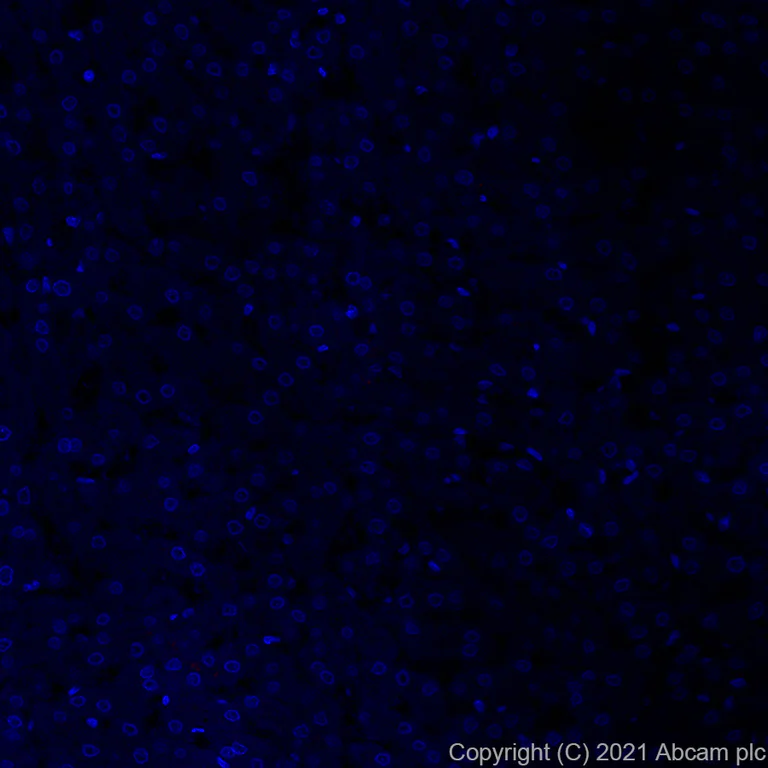
- IHC-P
Lab
Immunohistochemistry (Formalin/PFA-fixed paraffin-embedded sections) - Alexa Fluor® 647 Anti-ACE2 antibody [EPR24705-45] (AB283658)
Immunohistochemical analysis of paraffin-embedded human liver tissue labeling ACE2 with ab283658 at 1/100 dilution (5.0 μg/ml) followed by a ready to use.
Negative control : no staining in human liver. The section was then incubated overnight at +4°C in TBS containing 0.025% (v/v) Triton X-100 and 1% (w/v) BSA with ab283658 at 1/100 dilution (shown in red). Nuclear DNA was labeled with DAPI (shown in blue). The section was then mounted using Fluoromount®. Non-specific protein-protein interactions were then blocked in TBS containing 0.025% (v/v) Triton X-100, 0.3M (w/v) glycine and 1% (w/v) BSA for 1h at room temperature. Image was taken with a confocal microscope (Leica-Microsystems, TCS SP8). Counterstained with DAPI.
Heat mediated antigen retrieval using ab93684 (Tris/EDTA buffer, pH 9.0)
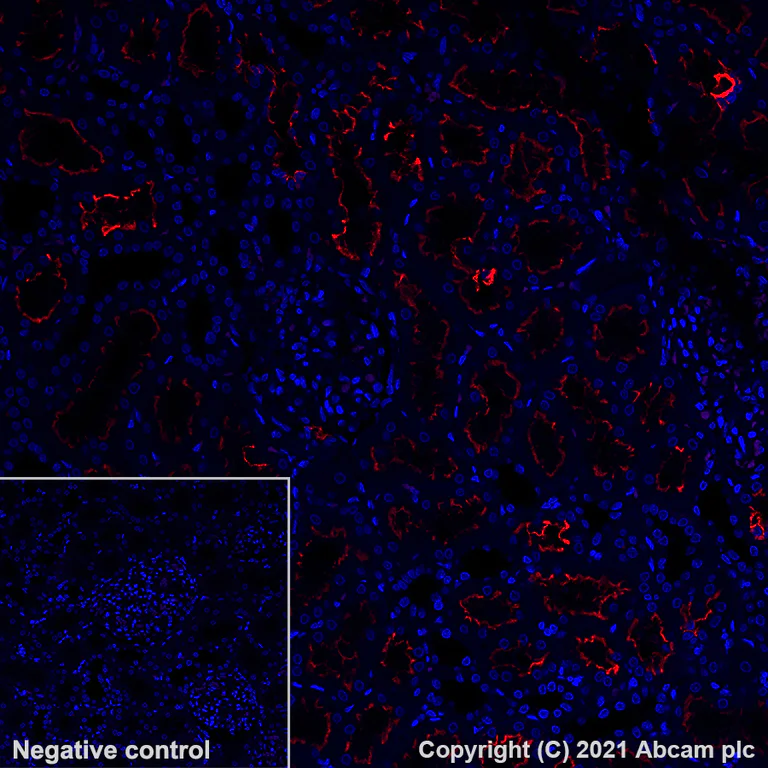
- IHC-P
Lab
Immunohistochemistry (Formalin/PFA-fixed paraffin-embedded sections) - Alexa Fluor® 647 Anti-ACE2 antibody [EPR24705-45] (AB283658)
Immunohistochemical analysis of paraffin-embedded human kidney tissue labelling ACE2 with ab283658 at 1/100 dilution (5.0 μg/ml) followed by a ready to use.
Apical membranous staining in human kidney. The section was then incubated overnight at +4°C in TBS containing 0.025% (v/v) Triton X-100 and 1% (w/v) BSA with ab283658 at 1/100 dilution (shown in red). Nuclear DNA was labeled with DAPI (shown in blue). The section was then mounted using Fluoromount®. Non-specific protein-protein interactions were then blocked in TBS containing 0.025% (v/v) Triton X-100, 0.3M (w/v) glycine and 1% (w/v) BSA for 1h at room temperature. Image was taken with a confocal microscope (Leica-Microsystems, TCS SP8). Counterstained with DAPI.
Heat mediated antigen retrieval using ab93684 (Tris/EDTA buffer, pH 9.0)
関連する標識済み抗体及び組成の異なる製品 (2)
-
Anti-ACE2 antibody [EPR24705-45]
-
Anti-ACE2 antibody [EPR24705-45] - BSA and Azide free
組合せ製品

Primary Antibodies
AB183734
RabMAb|Recombinant|Lab Essentials|20ul selling size
- 5
- 24
Primary Antibodies
AB303591
Alexa Fluor® 647 Anti-TMPRSS2 antibody [EPR24407-87]
RabMAb|Recombinant
- 0
- 0

Primary Antibodies
AB207305
Anti-SQSTM1 / p62 antibody [EPR18351] - Autophagosome Marker
20ul selling size|KO Validated|RabMAb|Recombinant|Lab Essentials|Trial Size

- 5
- 3
Reactivity data
製品の詳細
Patented technology
Our RabMAb® technology is a patented hybridoma-based technology for making rabbit monoclonal antibodies. For details on our patents, please refer to RabMAb® patents.
What are the advantages of a recombinant monoclonal antibody?
This product is a recombinant monoclonal antibody, which offers several advantages including:
- - High batch-to-batch consistency and reproducibility
- - Improved sensitivity and specificity
- - Long-term security of supply
- - Animal-free batch production
For more information, read more on recombinant antibodies.
Alexa Fluor® is a registered trademark of Molecular Probes, Inc, a Thermo Fisher Scientific Company. The Alexa Fluor® dye included in this product is provided under an intellectual property license from Life Technologies Corporation. As this product contains the Alexa Fluor® dye, the purchase of this product conveys to the buyer the non-transferable right to use the purchased product and components of the product only in research conducted by the buyer (whether the buyer is an academic or for-profit entity). As this product contains the Alexa Fluor® dye the sale of this product is expressly conditioned on the buyer not using the product or its components, or any materials made using the product or its components, in any activity to generate revenue, which may include, but is not limited to use of the product or its components: in manufacturing; (ii) to provide a service, information, or data in return for payment (iii) for therapeutic, diagnostic or prophylactic purposes; or (iv) for resale, regardless of whether they are sold for use in research. For information on purchasing a license to this product for purposes other than research, contact Life Technologies Corporation, 5781 Van Allen Way, Carlsbad, CA 92008 USA or outlicensing@thermofisher.com.
出荷温度及び保存条件
製品の状態
精製方法
バッファー組成
出荷温度
短期保存期間
短期保存温度
長期保存温度
分注に関する情報
保管に関する情報
補足情報
This supplementary information is collated from multiple sources and compiled automatically.
Biological function summary
The ACE2 protein plays an important role in the regulation of cardiovascular and renal functions. It is a single-pass type I membrane protein and its activity reduces inflammation and oxidative stress in cells. ACE2 does not function as part of a larger protein complex but its enzymatic conversion has a substantial impact on reducing the effects of angiotensin II in the body leading to vasodilation and decreased blood pressure.
Pathways
ACE2 involvement is significant in the renin-angiotensin system and the kallikrein-kinin system. These pathways are essential for maintaining cardiovascular homeostasis. In the renin-angiotensin system ACE2 works in opposition to angiotensin-converting enzyme (ACE) balancing the effects through the production of angiotensin-(1-7) from angiotensin II. Additionally ACE2 interacts indirectly with proteins like angiotensin receptor type 1 (AT1) and angiotensin receptor type 2 (AT2) ensuring proper signaling and physiological responses.
製品プロトコール
- Visit the General protocols
- Visit the Troubleshooting
ターゲットの情報
文献 (1)
Recent publications for all applications. Explore the full list and refine your search
Journal of virology 99:e0220224 PubMed40152594
2025
Applications
Unspecified application
Species
Unspecified reactive species
Abcam product promise
Please note: All products are 'FOR RESEARCH USE ONLY. NOT FOR USE IN DIAGNOSTIC OR THERAPEUTIC PROCEDURES'.
For licensing inquiries, please contact partnerships@abcam.com