Alexa Fluor® 488 Anti-Myogenin 抗体 [F5D]
Alexa Fluor® 488 Anti-Myogenin antibody [F5D]
Be the first to review this product! Submit a review
|
(0 Publication)
Anti-Myogenin antibody [F5D] conjugated to Alexa Fluor® 488 - suitable for ICC/IF, and reacts with mouse, human samples. Clone [F5D] is a mouse monoclonal antibody cited in 6 publications.
別名を表示する
Myogenin, Myog
- ICC/IF
Lab
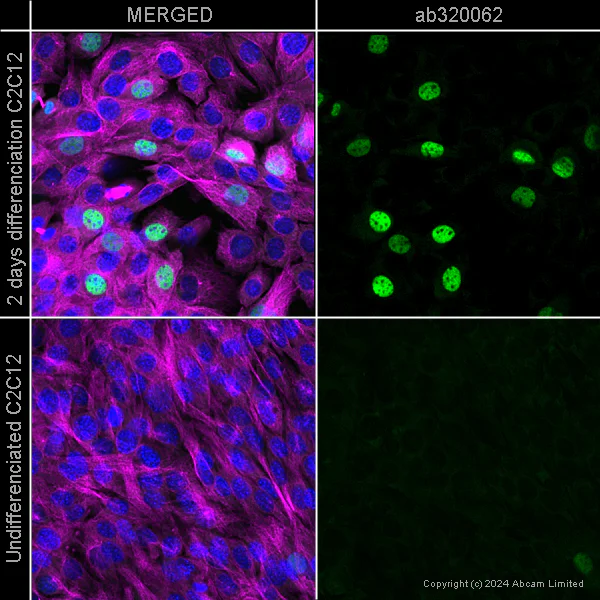
Immunocytochemistry/ Immunofluorescence - Alexa Fluor® 488 Anti-Myogenin antibody [F5D] (AB320062)
ab320062 staining myogenin in 48h differenciated-C2C12 cells (2% Horse Serum + 1uM Insulin for 48hr), with negative expression in undifferenciated C2C12 cells. The cells were fixed with 4% formaldehyde (10 min), permeabilised with 0.1% Triton x-100 for 5 minutes and then blocked with 1% BSA/10% normal goat serum/0.3M glycine in 0.1% PBS-Tween for 1h. The cells were then incubated overnight at +4°C with ab320062 at 0.5 ug/ml (shown in green). ab195884, rat monoclonal to Tubulin (Alexa Fluor® 647) (shown in magenta) was used at 2 ug/ml for structural counterstaining.
Image was acquired with a high-content analyser (Operetta CLS, Perkin Elmer) and a maximum intensity projection of confocal sections is shown.
This product also work with 100% methanol (5 min) fixation under the same testing conditions.
関連する標識済み抗体及び組成の異なる製品 (3)
-
Anti-Myogenin antibody [F5D]
-
Anti-Myogenin antibody [F5D] - BSA and Azide free
-
665 Alexa Fluor® 647
Alexa Fluor® 647 Anti-Myogenin antibody [F5D]
組合せ製品
Primary Antibodies
AB185033
Alexa Fluor® 488 Anti-Desmin antibody [Y66] - Cytoskeleton Marker
RabMAb|Recombinant

- 0
- 0

Primary Antibodies
AB313240
Alexa Fluor® 555 Anti-MyoD1 antibody [EPR6653-131]
RabMAb|Recombinant
- 0
- 0
Primary Antibodies
AB309082
Alexa Fluor® 647 Anti-CD10 antibody [EPR22867-118]
BOND RX™ Validated|RabMAb|Recombinant

- 0
- 0
Reactivity data
製品の詳細
Want a custom formulation?
This antibody clone is manufactured by Abcam. If you require a custom buffer formulation or conjugation for your experiments, please contact orders@abcam.com
Alexa Fluor® is a registered trademark of Molecular Probes, Inc, a Thermo Fisher Scientific Company. The Alexa Fluor® dye included in this product is provided under an intellectual property license from Life Technologies Corporation. As this product contains the Alexa Fluor® dye, the purchase of this product conveys to the buyer the non-transferable right to use the purchased product and components of the product only in research conducted by the buyer (whether the buyer is an academic or for-profit entity). As this product contains the Alexa Fluor® dye the sale of this product is expressly conditioned on the buyer not using the product or its components, or any materials made using the product or its components, in any activity to generate revenue, which may include, but is not limited to use of the product or its components: in manufacturing; (ii) to provide a service, information, or data in return for payment (iii) for therapeutic, diagnostic or prophylactic purposes; or (iv) for resale, regardless of whether they are sold for use in research. For information on purchasing a license to this product for purposes other than research, contact Life Technologies Corporation, 5781 Van Allen Way, Carlsbad, CA 92008 USA or outlicensing@thermofisher.com.
出荷温度及び保存条件
製品の状態
精製方法
バッファー組成
出荷温度
短期保存期間
短期保存温度
長期保存温度
分注に関する情報
保管に関する情報
補足情報
This supplementary information is collated from multiple sources and compiled automatically.
Biological function summary
Myogenin functions in controlling the transcription of muscle-specific genes that are essential during myogenesis. This transcription factor forms heterodimers with E-proteins becoming part of DNA-binding complexes that activate the transcription of muscle-specific genes. Myogenin's presence is critical during muscle cell fusion and maturation signifying its importance in proper muscle tissue formation and maintenance. Myogenin staining is often used as a technique to study muscle differentiation in various experimental settings.
Pathways
Myogenin is integrated into the myogenic regulatory network where it activates genes involved in muscle fiber maturation. It participates in the MyoD regulatory pathway working alongside other myogenic regulatory factors like MyoD Myf5 and MRF4. These proteins create a coordinated network ensuring efficient muscle cell differentiation and growth. The cross-talk between myogenin and these factors highlights its role in the intricate web of gene regulation necessary for muscle development.
製品プロトコール
- Visit the General protocols
- Visit the Troubleshooting
ターゲットの情報
Abcam product promise
Please note: All products are 'FOR RESEARCH USE ONLY. NOT FOR USE IN DIAGNOSTIC OR THERAPEUTIC PROCEDURES'.
For licensing inquiries, please contact partnerships@abcam.com