Alexa Fluor® 488 Anti-ENO1 抗体 [EPR19758]
Alexa Fluor® 488 Anti-ENO1 antibody [EPR19758]
- RabMAb
- Recombinant
- 詳細を見る
Be the first to review this product! Submit a review
|
(0 Publication)
Rabbit Recombinant Monoclonal ENO1 antibody - conjugated to Alexa Fluor® 488. Suitable for Flow Cyt (Intra), IHC-P, ICC/IF and reacts with Human, Mouse, Rat samples.
別名を表示する
ENO1L1, MBPB1, MPB1, ENO1, Alpha-enolase, 2-phospho-D-glycerate hydro-lyase, C-myc promoter-binding protein, Enolase 1, MBP-1, MPB-1, Non-neural enolase, Phosphopyruvate hydratase, Plasminogen-binding protein, NNE
- IHC-P
Lab
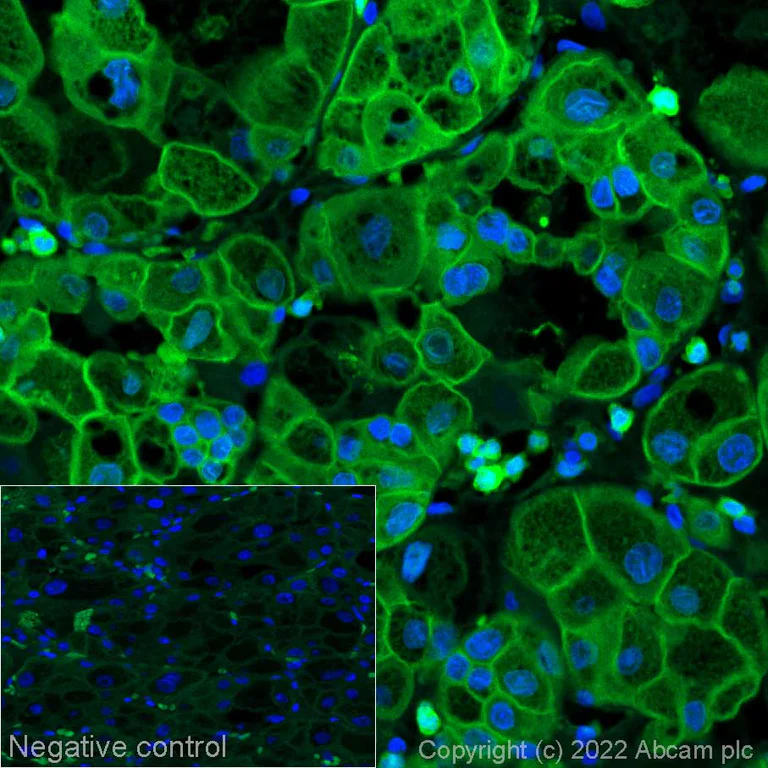
Immunohistochemistry (Formalin/PFA-fixed paraffin-embedded sections) - Alexa Fluor® 488 Anti-ENO1 antibody [EPR19758] (AB303582)
Immunofluorescence staining of ENO1 in a section of formalin-fixed paraffin-embedded human clear cell carcinoma*.
Performed on a Leica BOND. The section was pre-treated using heat mediated antigen retrieval with EDTA (pH9.0) using retrieval settings of 110°C for 40 minutes. The section was then incubated at room temperature for 1 hour with ab303582 at 1/50 dilution (shown in green). Nuclear DNA was labelled with DAPI (shown in blue). The section was then mounted using Dako Fluorescence Mounting Medium®.
Image was taken with a confocal microscope (Leica-Microsystems, TCS SP8).
For other IHC staining systems (automated and non-automated), customers should optimize variable parameters such as antigen retrieval conditions, antibody concentrations and incubation times.
*Tissue obtained from the Human Research Tissue Bank, supported by the NIHR Cambridge Biomedical Research Centre.
- Flow Cyt (Intra)
Supplier Data
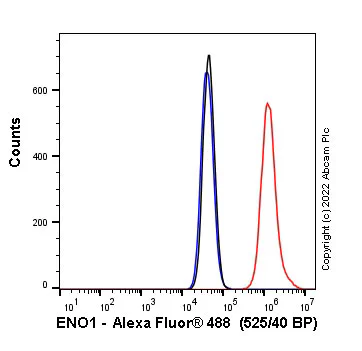
Flow Cytometry (Intracellular) - Alexa Fluor® 488 Anti-ENO1 antibody [EPR19758] (AB303582)
Flow cytometry overlay histogram showing HeLa cells stained with ab303582 (red line). The cells were fixed with 80 % methanol (5 min) and then permeabilized with 0.1% PBS-Triton X-100 for 15 min. The cells were incubated in 1x PBS containing 10 % normal goat serum to block non-specific protein-protein interaction followed by the antibody (ab303582) (1x 10⁶ in 100μl at 0.2μg/ml (1/2500)) for 30 min at 22°C.
Isotype control antibody (black line) was Rabbit IgG (monoclonal) Alexa Fluor 488 ® (ab199091) used at the same concentration and conditions as the primary antibody. Unlabeled sample (blue line) was also used as a control.
Acquisition of >5000 events were collected using a 50 mW Blue laser (488 nm) and 525/40 bandpass filter.
This antibody gave a positive signal in HeLa cells fixed with 4% formaldehyde (10 min) / permeabilized with 0.1% PBS-Triton X-100 for 15 min used under the same conditions.
- ICC/IF
Supplier Data
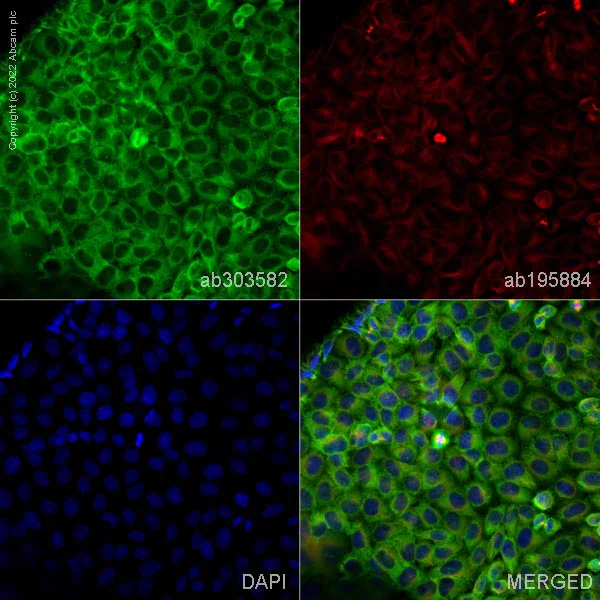
Immunocytochemistry/ Immunofluorescence - Alexa Fluor® 488 Anti-ENO1 antibody [EPR19758] (AB303582)
ab303582 staining ENO-1 in HeLa (human cervix adenocarcinoma epithelial cell line) cells. The cells were fixed with 4% formaldehyde (10 min), permeabilized with 0.1% Triton x-100 for 5 minutes and then blocked with 1% BSA/10% normal goat serum/0.3 M glycine in 0.1% PBS-Tween for 1h. The cells were then incubated overnight at +4°C with ab303582 at 0.04 µg/ml (shown in green) and ab195884 (Alexa Fluor® 647 Anti-Tubulin antibody [YOL1/34]) at 2 µg/ml (shown in red). Nuclear DNA was labeled with DAPI (shown in blue). Image was acquired with a high-content analyzer (Operetta CLS, Perkin Elmer) and a maximum intensity projection of confocal sections is shown.
関連する標識済み抗体及び組成の異なる製品 (10)
-
Anti-ENO1 antibody [EPR19758]
-
Anti-ENO1 antibody [EPR19758] - BSA and Azide free
-
660 APC
APC Anti-ENO1 antibody [EPR19758]
-
565 Alexa Fluor® 555
Alexa Fluor® 555 Anti-ENO1 antibody [EPR19758]
-
603 Alexa Fluor® 568
Alexa Fluor® 568 Anti-ENO1 antibody [EPR19758]
-
617 Alexa Fluor® 594
Alexa Fluor® 594 Anti-ENO1 antibody [EPR19758]
-
665 Alexa Fluor® 647
Alexa Fluor® 647 Anti-ENO1 antibody [EPR19758]
-
775 Alexa Fluor® 750
Alexa Fluor® 750 Anti-ENO1 antibody [EPR19758]
-
HRP Anti-ENO1 antibody [EPR19758]
-
578 PE
PE Anti-ENO1 antibody [EPR19758]
組合せ製品
Primary Antibodies
AB195020
Alexa Fluor® 647 Anti-Glucose Transporter GLUT1 antibody [EPR3915]
RabMAb|Recombinant|KO Validated|Trial Size
- 4
- 5
Primary Antibodies
AB199829
Alexa Fluor® 647 Anti-ENO1 + ENO2 + ENO3 antibody [EPR3377] - Neuronal Marker
RabMAb|Recombinant
- 5
- 1
Primary Antibodies
AB216385
Alexa Fluor® 594 Anti-ATP5A antibody [EPR13030(B)] - Mitochondrial Marker
RabMAb|Recombinant
- 4
- 1
Primary Antibodies
AB237314
Alexa Fluor® 647 Anti-Hexokinase II antibody [EPR20839]
RabMAb|Recombinant

- 0
- 0
Reactivity data
製品の詳細
Patented technology
Our RabMAb® technology is a patented hybridoma-based technology for making rabbit monoclonal antibodies. For details on our patents, please refer to RabMAb® patents.
What are the advantages of a recombinant monoclonal antibody?
This product is a recombinant monoclonal antibody, which offers several advantages including:
- - High batch-to-batch consistency and reproducibility
- - Improved sensitivity and specificity
- - Long-term security of supply
- - Animal-free batch production
For more information, read more on recombinant antibodies.
Alexa Fluor® is a registered trademark of Molecular Probes, Inc, a Thermo Fisher Scientific Company. The Alexa Fluor® dye included in this product is provided under an intellectual property license from Life Technologies Corporation. As this product contains the Alexa Fluor® dye, the purchase of this product conveys to the buyer the non-transferable right to use the purchased product and components of the product only in research conducted by the buyer (whether the buyer is an academic or for-profit entity). As this product contains the Alexa Fluor® dye the sale of this product is expressly conditioned on the buyer not using the product or its components, or any materials made using the product or its components, in any activity to generate revenue, which may include, but is not limited to use of the product or its components: in manufacturing; (ii) to provide a service, information, or data in return for payment (iii) for therapeutic, diagnostic or prophylactic purposes; or (iv) for resale, regardless of whether they are sold for use in research. For information on purchasing a license to this product for purposes other than research, contact Life Technologies Corporation, 5781 Van Allen Way, Carlsbad, CA 92008 USA or outlicensing@thermofisher.com.
出荷温度及び保存条件
製品の状態
精製方法
バッファー組成
出荷温度
短期保存期間
短期保存温度
長期保存温度
分注に関する情報
保管に関する情報
補足情報
This supplementary information is collated from multiple sources and compiled automatically.
Biological function summary
The ENO1 protein serves multiple functions beyond its glycolytic activity. It also acts as a plasminogen receptor on the cell surface aiding in the modulation of pericellular and extracellular matrix degradation processes. Through this role ENO1 influences cell migration and tissue remodeling. This protein can form part of larger protein complexes contributing to its versatility in various cellular functions.
Pathways
ENO1 plays a critical role in glycolysis a central metabolic pathway that converts glucose into pyruvate generating ATP as a result. In this pathway ENO1 closely interacts with other enzymes like phosphoglycerate kinase and pyruvate kinase. Additionally as a plasminogen receptor ENO1 links to the plasminogen activation pathway affecting fibrinolysis and cellular response to tissue injury.
製品プロトコール
- Visit the General protocols
- Visit the Troubleshooting
ターゲットの情報
Abcam product promise
Please note: All products are 'FOR RESEARCH USE ONLY. NOT FOR USE IN DIAGNOSTIC OR THERAPEUTIC PROCEDURES'.
For licensing inquiries, please contact partnerships@abcam.com