Alexa Fluor® 488 Anti-EGFR 抗体 [EP38Y]
Alexa Fluor® 488 Anti-EGFR antibody [EP38Y]
- RabMAb
- Recombinant
- 詳細を見る
Be the first to review this product! Submit a review
|
(3 Publications)
Rabbit Recombinant Monoclonal EGFR antibody - conjugated to Alexa Fluor® 488. Suitable for ICC/IF, Flow Cyt (Intra), IHC-P and reacts with Human, Mouse, Rat samples. Cited in 3 publications.
別名を表示する
ERBB, ERBB1, HER1, EGFR, Epidermal growth factor receptor, Proto-oncogene c-ErbB-1, Receptor tyrosine-protein kinase erbB-1
- Flow Cyt (Intra)
Unknown
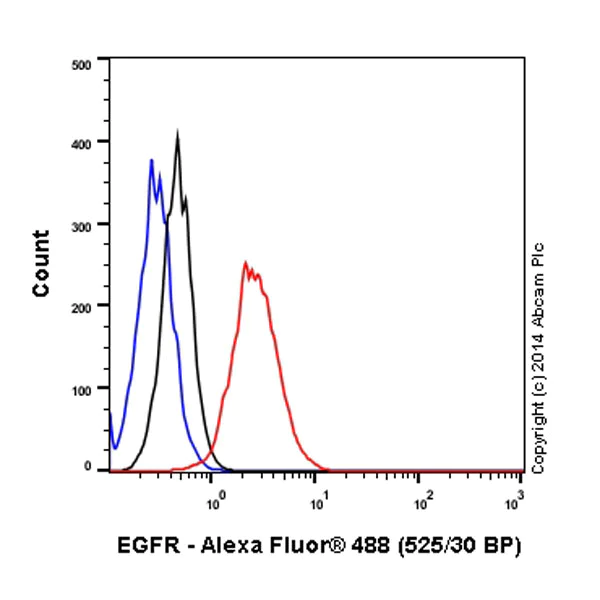
Flow Cytometry (Intracellular) - Alexa Fluor® 488 Anti-EGFR antibody [EP38Y] (AB193244)
Overlay histogram showing HeLa cells stained with ab193244 (red line). The cells were fixed with 80% methanol (5 min) and then permeabilized with 0.1% PBS-Tween for 20 min. The cells were then incubated in 1x PBS / 10% normal goat serum / 0.3M glycine to block non-specific protein-protein interactions followed by the antibody (ab193244, 1/50 dilution) for 30 min at 22°C. Isotype control antibody (black line) was rabbit IgG (monoclonal) Alexa Fluor® 488 used at the same concentration and conditions as the primary antibody. Unlabelled sample (blue line) was also used as a control.
Acquisition of >5,000 events were collected using a 20mW Argon ion laser (488nm) and 525/30 bandpass filter.
This antibody gave a positive signal in HeLa fixed with 4% formaldehyde (10 min)/permeabilized with 0.1% PBS-Tween for 20 min used under the same conditions.
- ICC/IF
Lab
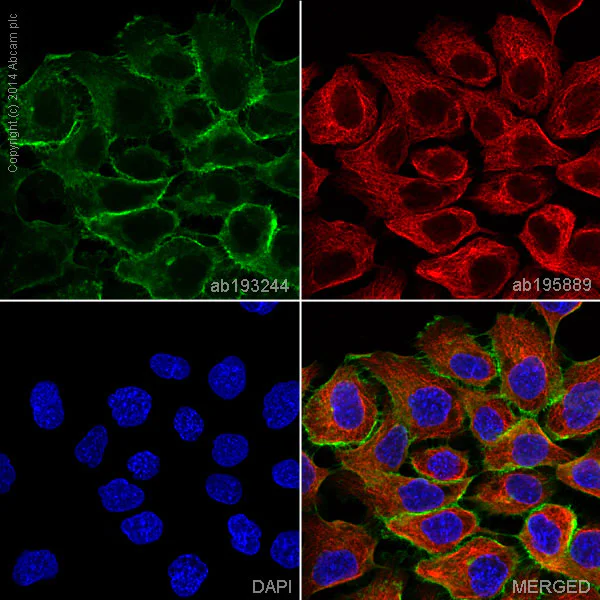
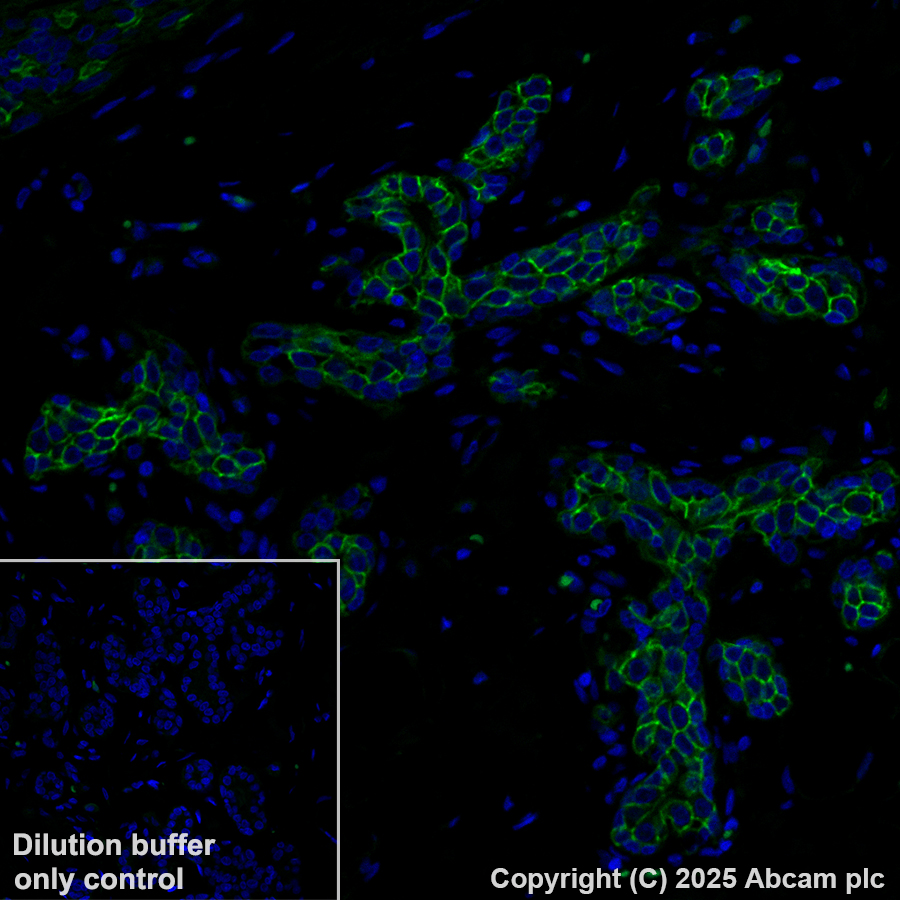
Immunocytochemistry/ Immunofluorescence - Alexa Fluor® 488 Anti-EGFR antibody [EP38Y] (AB193244)
ab193244 staining EGFR in A431 cells. The cells were fixed with 100% methanol (5 min), permeabilised in 0.1% Triton X-100 for 5 minutes and then blocked in 1% BSA/10% normal goat serum/0.3M glycine in 0.1% PBS-Tween for 1h. The cells were then incubated with ab193244 at 1/100 dilution (shown in green) and ab195889, Mouse monoclonal [DM1A] to alpha Tubulin (Alexa Fluor® 594, shown in red) at 1/167 dilution overnight at +4°C. Nuclear DNA was labelled in blue with DAPI.
Image was taken with a confocal microscope (Leica-Microsystems, TCS SP8).
関連する標識済み抗体及び組成の異なる製品 (10)
-
Anti-EGFR antibody [EP38Y]
-
Anti-EGFR antibody [EP38Y] - BSA and Azide free
-
Anti-EGFR antibody [EP38Y] - Low endotoxin, Azide free
-
565 Alexa Fluor® 555
Alexa Fluor® 555 Anti-EGFR antibody [EP38Y]
-
617 Alexa Fluor® 594
Alexa Fluor® 594 Anti-EGFR antibody [EP38Y]
-
665 Alexa Fluor® 647
Alexa Fluor® 647 Anti-EGFR antibody [EP38Y]
-
775 Alexa Fluor® 750
Alexa Fluor® 750 Anti-EGFR antibody [EP38Y]
-
Biotin Anti-EGFR antibody [EP38Y]
-
HRP Anti-EGFR antibody [EP38Y]
-
578 PE
PE Anti-EGFR antibody [EP38Y]
代替製品
Primary Antibodies
AB32578
Anti-EGFR (phospho Y1173) antibody [E124]
RabMAb|Recombinant|Lab Essentials|20ul selling size
- 0
- 0
Primary Antibodies
AB40815
Anti-EGFR (phospho Y1068) antibody [EP774Y]
RabMAb|Recombinant|Lab Essentials|20ul selling size

- 4
- 14
Primary Antibodies
AB76153
RabMAb|Recombinant|Lab Essentials|20ul selling size|KO Validated
- 0
- 0
Primary Antibodies
AB32430
Anti-EGFR (phospho Y1068) antibody [Y38]
RabMAb|Recombinant|Lab Essentials|20ul selling size

- 0
- 0
Primary Antibodies
AB32077
BOND RX™ Validated|KO Validated|RabMAb|Recombinant|Lab Essentials|20ul selling size

- 5
- 4
Primary Antibodies
AB32562
BOND RX™ Validated|RabMAb|Recombinant|Lab Essentials|20ul selling size

- 0
- 0
Primary Antibodies
AB227737
Anti-EGFR (deleted E746 + L747 + R748 + E749 + A750) antibody [SP111]
RabMAb|Recombinant|Lab Essentials|20ul selling size

- 0
- 0
組合せ製品
Primary Antibodies
AB194719
Alexa Fluor® 647 Anti-Vimentin antibody [EPR3776] - Cytoskeleton Marker
RabMAb|Recombinant|KO Validated

- 5
- 1
Primary Antibodies
AB225509
Alexa Fluor® 488 Anti-ErbB2 / HER2 antibody [EPR19547-12]
RabMAb|Recombinant

- 5
- 1
Reactivity data
製品の詳細
Patented technology
Our RabMAb® technology is a patented hybridoma-based technology for making rabbit monoclonal antibodies. For details on our patents, please refer to RabMAb® patents.
Alexa Fluor® is a registered trademark of Molecular Probes, Inc, a Thermo Fisher Scientific Company. The Alexa Fluor® dye included in this product is provided under an intellectual property license from Life Technologies Corporation. As this product contains the Alexa Fluor® dye, the purchase of this product conveys to the buyer the non-transferable right to use the purchased product and components of the product only in research conducted by the buyer (whether the buyer is an academic or for-profit entity). As this product contains the Alexa Fluor® dye the sale of this product is expressly conditioned on the buyer not using the product or its components, or any materials made using the product or its components, in any activity to generate revenue, which may include, but is not limited to use of the product or its components: in manufacturing; (ii) to provide a service, information, or data in return for payment (iii) for therapeutic, diagnostic or prophylactic purposes; or (iv) for resale, regardless of whether they are sold for use in research. For information on purchasing a license to this product for purposes other than research, contact Life Technologies Corporation, 5781 Van Allen Way, Carlsbad, CA 92008 USA or outlicensing@thermofisher.com.
出荷温度及び保存条件
製品の状態
精製度
バッファー組成
出荷温度
短期保存期間
短期保存温度
長期保存温度
分注に関する情報
保管に関する情報
補足情報
This supplementary information is collated from multiple sources and compiled automatically.
Biological function summary
The EGFR protein plays an important role in cellular communication and signaling processes. EGFR pairs with other receptor family members to form active dimers or even higher-order complexes which in turn initiate intracellular signaling cascades. Through these complexes EGFR influences many processes including cell differentiation and repair. This function of EGFR makes it an integral part of mammalian biology affecting how cells respond to their environment by mediating changes in gene expression.
Pathways
EGFR is a central player in the MAPK and PI3K/Akt signaling pathways. Alongside other protein partners like KRAS and PI3 kinase it contributes to transmitting signals from the cell surface to the nucleus affecting gene transcription and cell behavior. These pathways are important for normal cell growth and division and aberrations in these pathways can lead to excessive or insufficient cell proliferation.
製品プロトコール
- Visit the General protocols
- Visit the Troubleshooting
ターゲットの情報
文献 (3)
Recent publications for all applications. Explore the full list and refine your search
The journal of histochemistry and cytochemistry : official journal of the Histochemistry Society 73:223-236 PubMed40552463
2025
Applications
Unspecified application
Species
Unspecified reactive species
Nanomaterials (Basel, Switzerland) 14: PubMed39453005
2024
Applications
Unspecified application
Species
Unspecified reactive species
European journal of nuclear medicine and molecular imaging 46:948-956 PubMed30069577
2018
Applications
Unspecified application
Species
Unspecified reactive species
Abcam product promise
Please note: All products are 'FOR RESEARCH USE ONLY. NOT FOR USE IN DIAGNOSTIC OR THERAPEUTIC PROCEDURES'.
For licensing inquiries, please contact partnerships@abcam.com