JavaScript is disabled in your browser. Please enable JavaScript to view this website.
AB185033

Alexa Fluor® 488 Anti-Desmin 抗体 [Y66] - Cytoskeleton Marker

Alexa Fluor® 488 Anti-Desmin antibody [Y66] - Cytoskeleton Marker

Be the first to review this product! Submit a review

|

(24 Publications)

Rabbit Recombinant Monoclonal Desmin antibody - conjugated to Alexa Fluor® 488. Cytoskeleton marker. Suitable for ICC/IF, Flow Cyt (Intra), IHC-P and reacts with Human, Rat, Mouse samples. Cited in 24 publications.

別名を表示する

Desmin, DES
2 Images
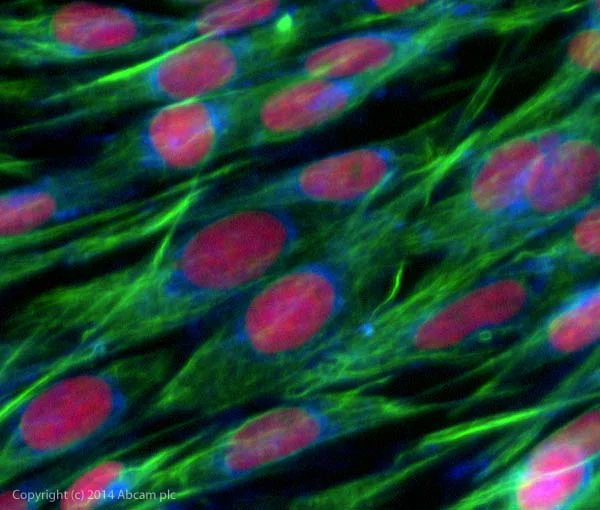
Immunocytochemistry/ Immunofluorescence - Alexa Fluor® 488 Anti-Desmin antibody [Y66] - Cytoskeleton Marker (AB185033)
  • ICC/IF

Lab

Immunocytochemistry/ Immunofluorescence - Alexa Fluor® 488 Anti-Desmin antibody [Y66] - Cytoskeleton Marker (AB185033)

ab185033 staining Desmin in SV40LT-SMC cells. The cells were fixed with 4% formaldehyde (10min) and then blocked in 1% BSA/10% normal goat serum/0.3M glycine in 0.1%PBS-Tween for 1h. The cells were then incubated with ab185033 at 1/50 dilution overnight at +4°C (shown in green). AlexaFluor®350 WGA was used at a 1/200 dilution and incubated for 1h with the cells, to label plasma membranes (shown in blue). Nuclear DNA was labelled in red with 1.25 μM DRAQ5™ (ab108410).
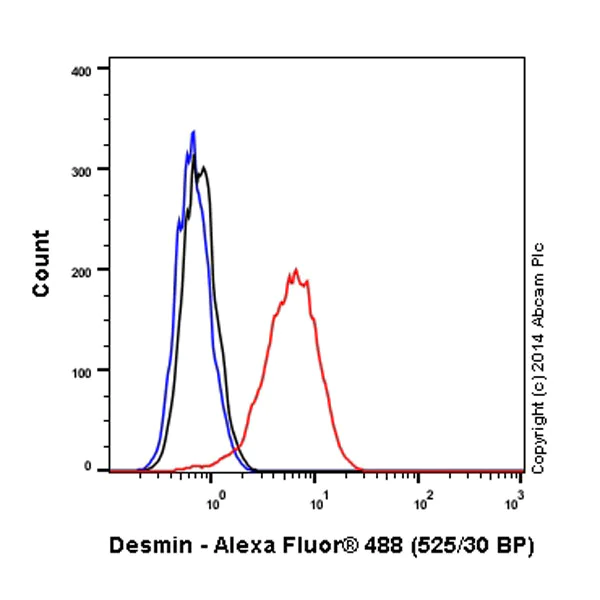
Flow Cytometry (Intracellular) - Alexa Fluor® 488 Anti-Desmin antibody [Y66] - Cytoskeleton Marker (AB185033)
  • Flow Cyt (Intra)

Unknown

Flow Cytometry (Intracellular) - Alexa Fluor® 488 Anti-Desmin antibody [Y66] - Cytoskeleton Marker (AB185033)

Overlay histogram showing SV40LT-SMC cells stained with ab185033 (red line). The cells were fixed with 4% formaldehyde (10 min) and then permeabilized with 0.1% PBS-Tween for 20 min. The cells were then incubated in 1x PBS / 10% normal goat serum / 0.3M glycine to block non-specific protein-protein interactions followed by the antibody (ab185033, 1/50 dilution) for 30 min at 22°C. Isotype control antibody (black line) was rabbit IgG (monoclonal) Alexa Fluor® 488 used at the same concentration and conditions as the primary antibody. Unlabelled sample (blue line) was also used as a control.

Acquisition of >5,000 events were collected using a 20mW Argon ion laser (488nm) and 525/30 bandpass filter.

関連する標識済み抗体及び組成の異なる製品 (10)

  • Unconjugated

    Anti-Desmin antibody [Y66] - Cytoskeleton Marker

  • Carrier free

    Anti-Desmin antibody [Y66] - BSA and Azide free

  • Carrier free

    Anti-Desmin antibody [Y66] - Low endotoxin, Azide free

  • 660 APC

    APC Anti-Desmin antibody [Y66] - Cytoskeleton Marker

  • 565 Alexa Fluor® 555

    Alexa Fluor® 555 Anti-Desmin antibody [Y66] - Cytoskeleton Marker

  • 617 Alexa Fluor® 594

    Alexa Fluor® 594 Anti-Desmin antibody [Y66] - Cytoskeleton Marker

  • 665 Alexa Fluor® 647

    Alexa Fluor® 647 Anti-Desmin antibody [Y66] - Cytoskeleton Marker

  • Biotin

    Biotin Anti-Desmin antibody [Y66] - Cytoskeleton Marker

  • HRP

    HRP Anti-Desmin antibody [Y66] - Cytoskeleton Marker

  • 578 PE

    PE Anti-Desmin antibody [Y66] - Cytoskeleton Marker

Key facts

宿主種

Rabbit

クローン性

Monoclonal

クローン番号

Y66

アイソタイプ

IgG

標識

Alexa Fluor® 488

励起波長/蛍光波長

Ex: 495nm, Em: 519nm

キャリアフリー

No

交差種

Human, Mouse, Rat

アプリケーション

ICC/IF, IHC-P, Flow Cyt (Intra)

applications

免疫原

The exact immunogen used to generate this antibody is proprietary information.

エピトープ

ab32362 reacts with an epitope located in the C terminal region of desmin.

Reactivity data

{ "title": "Reactivity Data", "filters": { "stats": ["", "Species", "Dilution Info", "Notes"], "tabs": { "all-applications": {"fullname" : "All Applications", "shortname": "All Applications"}, "ICCIF" : {"fullname" : "Immunocytochemistry/ Immunofluorescence", "shortname":"ICC/IF"}, "FlowCytIntra" : {"fullname" : "Flow Cytometry (Intracellular)", "shortname":"Flow Cyt (Intra)"}, "IHCP" : {"fullname" : "Immunohistochemistry (Formalin/PFA-fixed paraffin-embedded sections)", "shortname":"IHC-P"} }, "product-promise": { "all": "all", "testedAndGuaranteed": "tested", "guaranteed": "expected", "predicted": "predicted", "notRecommended": "not-recommended" } }, "values": { "Human": { "ICCIF-species-checked": "testedAndGuaranteed", "ICCIF-species-dilution-info": "1/50 - 1/100", "ICCIF-species-notes": "<p></p>", "FlowCytIntra-species-checked": "guaranteed", "FlowCytIntra-species-dilution-info": "", "FlowCytIntra-species-notes": "", "IHCP-species-checked": "guaranteed", "IHCP-species-dilution-info": "", "IHCP-species-notes": "<p></p>" }, "Mouse": { "ICCIF-species-checked": "guaranteed", "ICCIF-species-dilution-info": "", "ICCIF-species-notes": "<p></p>", "FlowCytIntra-species-checked": "guaranteed", "FlowCytIntra-species-dilution-info": "", "FlowCytIntra-species-notes": "<p></p>", "IHCP-species-checked": "guaranteed", "IHCP-species-dilution-info": "", "IHCP-species-notes": "<p></p>" }, "Rat": { "ICCIF-species-checked": "guaranteed", "ICCIF-species-dilution-info": "", "ICCIF-species-notes": "", "FlowCytIntra-species-checked": "testedAndGuaranteed", "FlowCytIntra-species-dilution-info": "1/50", "FlowCytIntra-species-notes": "<p><a href='/products/primary-antibodies/alexa-fluor-488-rabbit-igg-monoclonal-epr25a-isotype-control-ab199091'>ab199091</a> - Rabbit monoclonal IgG (Alexa Fluor® 488), is suitable for use as an isotype control with this antibody.</p>", "IHCP-species-checked": "guaranteed", "IHCP-species-dilution-info": "", "IHCP-species-notes": "<p></p>" }, "Guinea pig": { "ICCIF-species-checked": "predicted", "ICCIF-species-dilution-info": "", "ICCIF-species-notes": "", "FlowCytIntra-species-checked": "predicted", "FlowCytIntra-species-dilution-info": "", "FlowCytIntra-species-notes": "", "IHCP-species-checked": "predicted", "IHCP-species-dilution-info": "", "IHCP-species-notes": "" } } }

製品の詳細

Patented technology
Our RabMAb® technology is a patented hybridoma-based technology for making rabbit monoclonal antibodies. For details on our patents, please refer to RabMAb® patents.

Alexa Fluor® is a registered trademark of Molecular Probes, Inc, a Thermo Fisher Scientific Company. The Alexa Fluor® dye included in this product is provided under an intellectual property license from Life Technologies Corporation. As this product contains the Alexa Fluor® dye, the purchase of this product conveys to the buyer the non-transferable right to use the purchased product and components of the product only in research conducted by the buyer (whether the buyer is an academic or for-profit entity). As this product contains the Alexa Fluor® dye the sale of this product is expressly conditioned on the buyer not using the product or its components, or any materials made using the product or its components, in any activity to generate revenue, which may include, but is not limited to use of the product or its components: in manufacturing; (ii) to provide a service, information, or data in return for payment (iii) for therapeutic, diagnostic or prophylactic purposes; or (iv) for resale, regardless of whether they are sold for use in research. For information on purchasing a license to this product for purposes other than research, contact Life Technologies Corporation, 5781 Van Allen Way, Carlsbad, CA 92008 USA or outlicensing@thermofisher.com.

出荷温度及び保存条件

製品の状態
Liquid
精製方法
Affinity purification Protein A
バッファー組成
pH: 7.4 Preservative: 0.02% Sodium azide Constituents: PBS, 30% Glycerol (glycerin, glycerine), 1% BSA
出荷温度
Blue Ice
短期保存期間
1-2 weeks
短期保存温度
+4°C
長期保存温度
-20°C
分注に関する情報
Upon delivery aliquot
保管に関する情報
Avoid freeze / thaw cycle|Stable for 12 months at -20°C|Store in the dark

補足情報

This supplementary information is collated from multiple sources and compiled automatically.

Desmin also referred to as Desmin 20 is an intermediate filament protein with a molecular weight of approximately 53 kDa. Primarily found in muscle cells desmin provides structural integrity to cells being an important component of the cytoskeleton. Desmin expression is highly specific to cardiac skeletal and smooth muscle tissues and it can be detected using desmin marker techniques like desmin IHC (Immunohistochemistry). Desmin staining or desmin stain methods are commonly employed in diagnostic labs to visualize this protein within tissue samples.
Biological function summary

Desmin plays a significant role in maintaining cellular architecture by anchoring organelles such as nuclei and mitochondria within the cytoplasm. It associates with other proteins to form desmin intermediate filament networks which facilitate force transmission and maintain mechanical integrity. This protein does not operate in isolation but is part of a larger complex of cytoskeletal elements that reinforce muscle cell shape and resilience. Its interactions and binding with other cytoskeletal components confirm its essential role in muscle structure.

Pathways

Desmin links closely to the cell structure and function pathways providing stability during muscle contraction processes. It interacts with other proteins including actin and tubulin within the cytoskeleton network ensuring coordinated responses to mechanical stress. Specifically desmin integrates into pathways related to the maintenance of the sarcomere structure thereby connecting to additional important proteins like myosin and dystrophin which collectively uphold muscular function and integrity.

Desmin mutations can lead to myopathies such as desmin-related myopathy (DRM) or cardiomyopathy where the structural disruptions result in abnormal muscle function. These conditions typically manifest as muscle weakness or cardiac abnormalities. Furthermore its relationship to the sarcomere suggests interactions with proteins like dystrophin in muscular dystrophies where desmin integrity critically influences disease progression and severity. Understanding desmin's link to such disorders underpins its role as a diagnostic marker and a potential therapeutic target in muscle-related diseases.

製品プロトコール

For this product, it's our understanding that no specific protocols are required. You can visit:

ターゲットの情報

Muscle-specific type III intermediate filament essential for proper muscular structure and function. Plays a crucial role in maintaining the structure of sarcomeres, inter-connecting the Z-disks and forming the myofibrils, linking them not only to the sarcolemmal cytoskeleton, but also to the nucleus and mitochondria, thus providing strength for the muscle fiber during activity (PubMed : 25358400). In adult striated muscle they form a fibrous network connecting myofibrils to each other and to the plasma membrane from the periphery of the Z-line structures (PubMed : 24200904, PubMed : 25394388, PubMed : 26724190). May act as a sarcomeric microtubule-anchoring protein : specifically associates with detyrosinated tubulin-alpha chains, leading to buckled microtubules and mechanical resistance to contraction. Required for nuclear membrane integrity, via anchoring at the cell tip and nuclear envelope, resulting in maintenance of microtubule-derived intracellular mechanical forces (By similarity). Contributes to the transcriptional regulation of the NKX2-5 gene in cardiac progenitor cells during a short period of cardiomyogenesis and in cardiac side population stem cells in the adult. Plays a role in maintaining an optimal conformation of nebulette (NEB) on heart muscle sarcomeres to bind and recruit cardiac alpha-actin (By similarity).
See full target information DES

文献 (24)

Recent publications for all applications. Explore the full list and refine your search

Nature 634:243-250 PubMed39198648

2024

Sympathetic neuropeptide Y protects from obesity by sustaining thermogenic fat.

Applications

Unspecified application

Species

Unspecified reactive species

Yitao Zhu,Lu Yao,Ana L Gallo-Ferraz,Bruna Bombassaro,Marcela R Simões,Ichitaro Abe,Jing Chen,Gitalee Sarker,Alessandro Ciccarelli,Linna Zhou,Carl Lee,Davi Sidarta-Oliveira,Noelia Martínez-Sánchez,Michael L Dustin,Cheng Zhan,Tamas L Horvath,Licio A Velloso,Shingo Kajimura,Ana I Domingos

Cancer cell 42:444-463.e10 PubMed38428410

2024

Multi-omic profiling of follicular lymphoma reveals changes in tissue architecture and enhanced stromal remodeling in high-risk patients.

Applications

Unspecified application

Species

Unspecified reactive species

Andrea J Radtke,Ekaterina Postovalova,Arina Varlamova,Alexander Bagaev,Maria Sorokina,Olga Kudryashova,Mark Meerson,Margarita Polyakova,Ilia Galkin,Viktor Svekolkin,Sergey Isaev,Daniil Wiebe,Anna Sharun,Alexander Sarachakov,Grigory Perelman,Yaroslav Lozinsky,Ziv Yaniv,Bradley C Lowekamp,Emily Speranza,Li Yao,Stefania Pittaluga,Arthur L Shaffer,Danny Jonigk,James D Phelan,Theresa Davies-Hill,Da Wei Huang,Pavel Ovcharov,Krystle Nomie,Ekaterina Nuzhdina,Nikita Kotlov,Ravshan Ataullakhanov,Nathan Fowler,Michael Kelly,Jagan Muppidi,Jeremy L Davis,Jonathan M Hernandez,Wyndham H Wilson,Elaine S Jaffe,Louis M Staudt,Mark Roschewski,Ronald N Germain

International journal of molecular sciences 24: PubMed37628806

2023

Spatial Transcriptomic Analysis of Focal and Normal Areas of Myocyte Disarray in Human Hypertrophic Cardiomyopathy.

Applications

Unspecified application

Species

Unspecified reactive species

Jason Laird,Gayani Perera,Rebecca Batorsky,Hongjie Wang,Knarik Arkun,Michael T Chin

Hepatology communications 6:1574-1588 PubMed35271760

2022

FGF1 Signaling Modulates Biliary Injury and Liver Fibrosis in the Mdr2 Mouse Model of Primary Sclerosing Cholangitis.

Applications

Unspecified application

Species

Unspecified reactive species

April O'Brien,Tianhao Zhou,Tori White,Abigail Medford,Lixian Chen,Konstantina Kyritsi,Nan Wu,Jonathan Childs,Danaleigh Stiles,Ludovica Ceci,Sanjukta Chakraborty,Burcin Ekser,Leonardo Baiocchi,Guido Carpino,Eugenio Gaudio,Chaodong Wu,Lindsey Kennedy,Heather Francis,Gianfranco Alpini,Shannon Glaser

Nature protocols 17:378-401 PubMed35022622

2022

IBEX: an iterative immunolabeling and chemical bleaching method for high-content imaging of diverse tissues.

Applications

mIHC

Species

Human

Andrea J Radtke,Colin J Chu,Ziv Yaniv,Li Yao,James Marr,Rebecca T Beuschel,Hiroshi Ichise,Anita Gola,Juraj Kabat,Bradley Lowekamp,Emily Speranza,Joshua Croteau,Nishant Thakur,Danny Jonigk,Jeremy L Davis,Jonathan M Hernandez,Ronald N Germain

Proceedings of the National Academy of Sciences of the United States of America 117:33455-33465 PubMed33376221

2020

IBEX: A versatile multiplex optical imaging approach for deep phenotyping and spatial analysis of cells in complex tissues.

Applications

mIHC

Species

Human

Andrea J Radtke,Evelyn Kandov,Bradley Lowekamp,Emily Speranza,Colin J Chu,Anita Gola,Nishant Thakur,Rochelle Shih,Li Yao,Ziv Rafael Yaniv,Rebecca T Beuschel,Juraj Kabat,Joshua Croteau,Jeremy Davis,Jonathan M Hernandez,Ronald N Germain

Pharmaceutical biology 58:1229-1243 PubMed33332219

2020

Hepatoprotective effect of Xiayuxue decoction ethyl acetate fraction against carbon tetrachloride-induced liver fibrosis in mice via inducing apoptosis and suppressing activation of hepatic stellate cells.

Applications

Unspecified application

Species

Unspecified reactive species

Dingqi Zhang,Lijun Zhang,Gaofeng Chen,Ying Xu,Hailin Yang,Zhun Xiao,Jiamei Chen,Yongping Mu,Hua Zhang,Wei Liu,Ping Liu

Hepatology (Baltimore, Md.) 73:2411-2428 PubMed32964473

2020

The Apelin-Apelin Receptor Axis Triggers Cholangiocyte Proliferation and Liver Fibrosis During Mouse Models of Cholestasis.

Applications

Unspecified application

Species

Unspecified reactive species

Lixian Chen,Tianhao Zhou,Tori White,April O'Brien,Sanjukta Chakraborty,Suthat Liangpunsakul,Zhihong Yang,Lindsey Kennedy,Romil Saxena,Chaodong Wu,Fanyin Meng,Qiaobing Huang,Heather Francis,Gianfranco Alpini,Shannon Glaser

EBioMedicine 48:130-142 PubMed31522982

2019

Knockdown of vimentin reduces mesenchymal phenotype of cholangiocytes in the Mdr2 mouse model of primary sclerosing cholangitis (PSC).

Applications

Unspecified application

Species

Unspecified reactive species

Tianhao Zhou,Konstantina Kyritsi,Nan Wu,Heather Francis,Zhihong Yang,Lixian Chen,April O'Brien,Lindsey Kennedy,Ludovica Ceci,Vik Meadows,Praveen Kusumanchi,Chaodong Wu,Leonardo Baiocchi,Nicholas J Skill,Romil Saxena,Amelia Sybenga,Linglin Xie,Suthat Liangpunsakul,Fanyin Meng,Gianfranco Alpini,Shannon Glaser

Biochimica et biophysica acta. Molecular basis of 1865:1525-1539 PubMed30890428

2019

Pinealectomy or light exposure exacerbates biliary damage and liver fibrosis in cholestatic rats through decreased melatonin synthesis.

Applications

Unspecified application

Species

Unspecified reactive species

Lixian Chen,Tianhao Zhou,Nan Wu,April O'Brien,Julie Venter,Ludovica Ceci,Konstantina Kyritsi,Paolo Onori,Eugenio Gaudio,Amelia Sybenga,Linglin Xie,Chaodong Wu,Luca Fabris,Pietro Invernizzi,David Zawieja,Suthat Liangpunsakul,Fanyin Meng,Heather Francis,Gianfranco Alpini,Qiaobing Huang,Shannon Glaser
View all publications

Abcam product promise

当社は、高品質な試薬を通じてお客様の研究を力強くサポートすることをお約束いたします。ご使用いただく各段階で、常にお客様をサポートできる体制を整えております。万が一、製品が期待通りに機能しない場合は、「Abcam Product Promise」による当社保証制度に基づき、安心してご利用いただけます。
保証に関する詳細については利用規約をご確認ください。

Please note: All products are 'FOR RESEARCH USE ONLY. NOT FOR USE IN DIAGNOSTIC OR THERAPEUTIC PROCEDURES'.

For licensing inquiries, please contact partnerships@abcam.com