Anti-AHR 抗体 [HL1984] - BSA and Azide free
Anti-AHR antibody [HL1984] - BSA and Azide free
- Recombinant
- KO Validated
- 詳細を見る
Be the first to review this product! Submit a review
|
(3 Publications)
Rabbit Recombinant Monoclonal Aryl hydrocarbon Receptor antibody. Carrier free. Suitable for WB, ICC/IF and reacts with Human, Mouse samples. Cited in 3 publications. Immunogen corresponding to Recombinant Fragment Protein within Human AHR.
別名を表示する
BHLHE76, AHR, Aryl hydrocarbon receptor, Ah receptor, AhR, Class E basic helix-loop-helix protein 76, bHLHe76
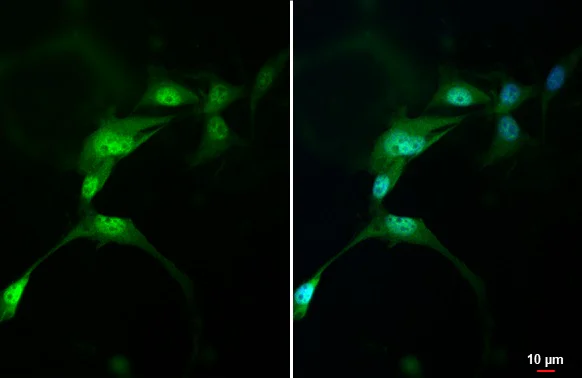
- ICC/IF
Supplier Data
Immunocytochemistry/ Immunofluorescence - Anti-AHR antibody [HL1984] - BSA and Azide free (AB308215)
Immunofluorescent analysis of 4% Paraformaldehyde-fixed U87-MG cells labelling AHR with ab308215 at 1/500 dilution at RT for 15 min.
Blue : Fluoroshield with DAPI.
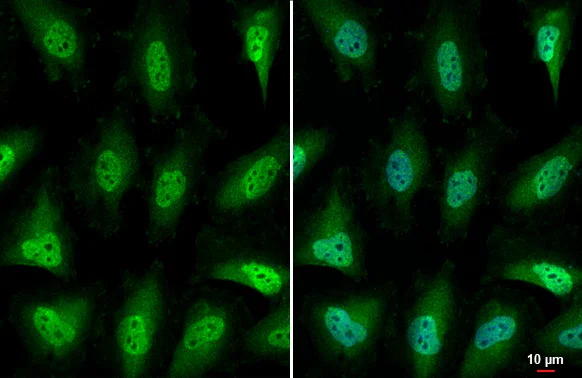
- ICC/IF
Supplier Data
Immunocytochemistry/ Immunofluorescence - Anti-AHR antibody [HL1984] - BSA and Azide free (AB308215)
Immunofluorescent analysis of 4% Paraformaldehyde-fixed HeLa cells labelling AHR with ab308215 at 1/500 dilution at RT for 15 min.
Blue : Fluoroshield with DAPI.
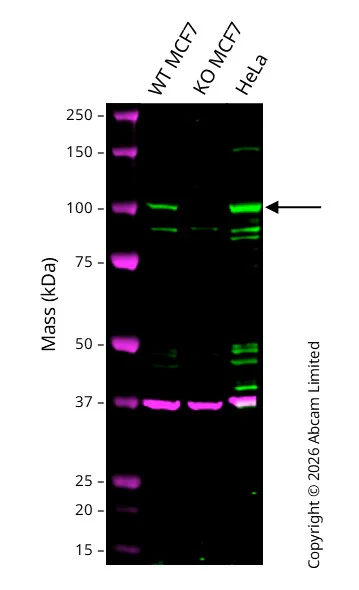
- WB
Lab
Western blot - Anti-AHR antibody [HL1984] - BSA and Azide free (AB308215)
Western blot : Anti-AHR antibody [HL1984] ab308215 staining at 1/500 dilution, shown in green; Mouse anti GAPDH ab8245 loading control staining at 1/20000 dilution, shown in magenta. A band was observed at 96 kDa in Wild-type MCF7 cell line with no signal observed at this size in AHR knockout MCF7 cell line. To generate this image, samples were run on an SDS-PAGE gel then transferred onto a nitrocellulose membrane. Membranes were blocked in 5% Milk in TBS-0.1 % Tween® 20 (TBS-T) before incubation with primary antibodies overnight at 4 °C. Blots were washed four times in TBS-T, incubated with secondary antibodies for 1 h at room temperature, washed again four times then imaged. Secondary antibodies used were Goat anti-Rabbit 800CW and Goat anti-Mouse 680RD at 1/20,000 dilution.
All lanes:
Western blot - Anti-AHR antibody [HL1984] - BSA and Azide free (ab308215) at 1/500 dilution
Lane 1:
Wild-type MCF7 cell lysates at 20 µg
Lane 2:
AHR knockout MCF7 cell lysates at 20 µg
Lane 3:
HeLa cell lysates at 20 µg
Secondary
All lanes:
Goat anti-Rabbit 800CW & Goat anti-Mouse 680RD at 1/20000 dilution
Predicted band size: 96 kDa
Observed band size: 96 kDa
false
組合せ製品

Primary Antibodies
AB32536
Anti-NF-kB p65 antibody [E379]
BOND RX™ Validated|20ul selling size|RabMAb|Recombinant|KO Validated

- 4
- 15
Primary Antibodies
AB181602
Anti-GAPDH antibody [EPR16891] - Loading Control
KD Validated|RabMAb|Recombinant|Lab Essentials|20ul selling size

- 5
- 23
Primary Antibodies
AB8227
Anti-beta Actin antibody - Loading Control
BOND RX™ Validated|Lab Essentials
- 5
- 104
Reactivity data
製品の詳細
What are the advantages of a recombinant monoclonal antibody?
This product is a recombinant monoclonal antibody, which offers several advantages including:
- - High batch-to-batch consistency and reproducibility
- - Improved sensitivity and specificity
- - Long-term security of supply
- - Animal-free batch production
For more information, read more on recombinant antibodies.
Conjugation ready
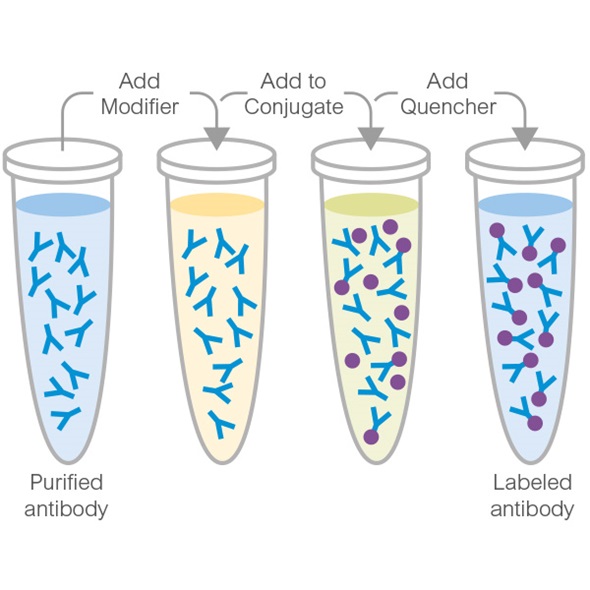
Our carrier-free antibodies are typically supplied in a PBS-only formulation, purified and free of BSA, sodium azide and glycerol. This conjugation-ready format is designed for use with fluorochromes, metal isotopes, oligonucleotides, and enzymes, which makes them ideal for antibody labelling, functional and cell-based assays, flow-based assays (e.g. mass cytometry) and Multiplex Imaging applications.
Use our conjugation kits for antibody conjugates that are ready-to-use in as little as 20 minutes with 1 minute hands-on-time and 100% antibody recovery: available for fluorescent dyes, HRP, biotin and gold.
出荷温度及び保存条件
製品の状態
精製方法
バッファー組成
出荷温度
短期保存期間
短期保存温度
長期保存温度
分注に関する情報
保管に関する情報
補足情報
This supplementary information is collated from multiple sources and compiled automatically.
Biological function summary
The AhR plays an important role in the regulation of detoxification enzymes such as cytochrome P450s. This receptor functions as a sensor for environmental toxins activating detoxification pathways once bound to ligands. It also contributes to the modulation of immune responses and development processes. The AhR often forms part of a larger protein complex to exert its effects on gene expression and cellular processes.
Pathways
The AhR significantly participates in the xenobiotic metabolism pathway and the dioxin signaling pathway. It interacts with proteins such as ARNT and cytochrome P450 enzymes to mediate the cellular response to toxins. The activity of AhR regulates the expression of phase I and phase II detoxification enzymes making it an integral part of the body’s defense against environmental chemicals.
製品プロトコール
- Visit the General protocols
- Visit the Troubleshooting
ターゲットの情報
文献 (3)
Recent publications for all applications. Explore the full list and refine your search
General physiology and biophysics 44:303-315 PubMed40567073
2025
Applications
Unspecified application
Species
Unspecified reactive species
Gut microbes 16:2377576 PubMed39068517
2024
Applications
Unspecified application
Species
Unspecified reactive species
iScience 26:107326 PubMed37529102
2023
Applications
Unspecified application
Species
Unspecified reactive species
Abcam product promise
Please note: All products are 'FOR RESEARCH USE ONLY. NOT FOR USE IN DIAGNOSTIC OR THERAPEUTIC PROCEDURES'.
For licensing inquiries, please contact partnerships@abcam.com