Anti-14-3-3 sigma/SFN 抗体 [CPTC-SFN-2]
Anti-14-3-3 sigma/SFN antibody [CPTC-SFN-2]
Be the first to review this product! Submit a review
|
(1 Publication)
Mouse Monoclonal 1433S antibody. Suitable for WB, Protein Array, IHC-P and reacts with Human, Recombinant full length protein - Human samples. Cited in 1 publication. Immunogen corresponding to Recombinant Full Length Protein corresponding to Human SFN.
別名を表示する
HME1, SFN, 14-3-3 protein sigma, Epithelial cell marker protein 1, Stratifin
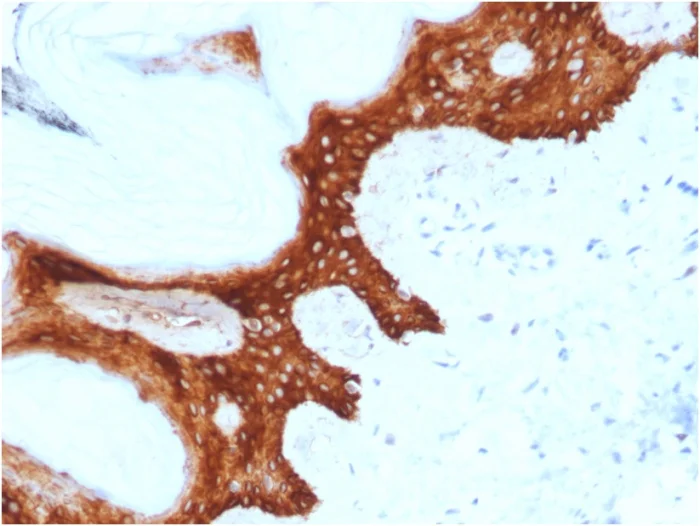
- IHC-P
Unknown
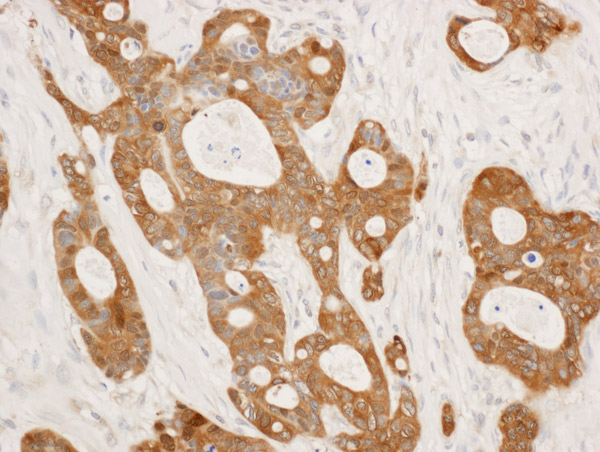
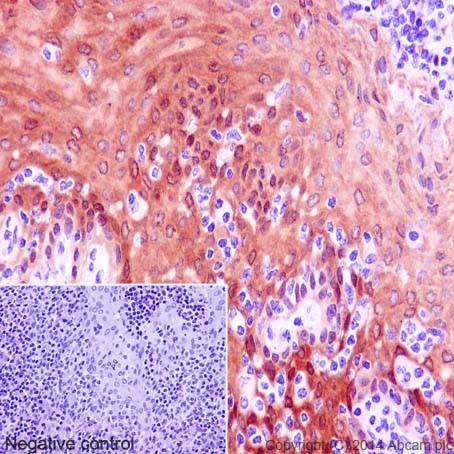
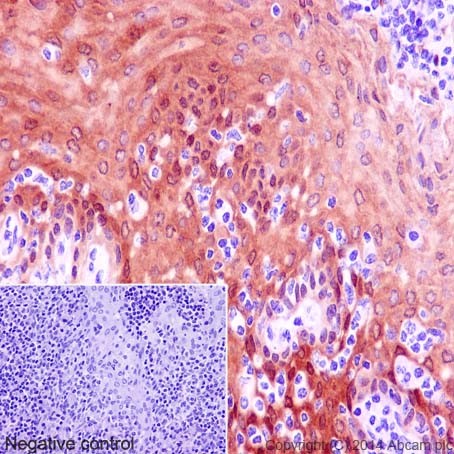
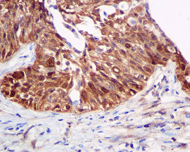
Immunohistochemistry (Formalin/PFA-fixed paraffin-embedded sections) - Anti-14-3-3 sigma/SFN antibody [CPTC-SFN-2] (AB268067)
Formalin-fixed, paraffin-embedded human Skin stained for 14-3-3 Sigma/SFN using ab268067 at 2 μg/ml in immunohistochemical analysis.
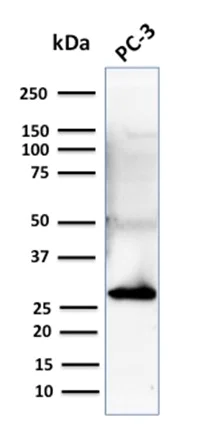
- WB
Unknown
Western blot - Anti-14-3-3 sigma/SFN antibody [CPTC-SFN-2] (AB268067)
All lanes:
Western blot - Anti-14-3-3 sigma/SFN antibody [CPTC-SFN-2] (ab268067) at 2 µg/mL
All lanes:
PC-3 (Human prostate adenocarcinoma cell line) whole cell lysate
Predicted band size: 27 kDa
false
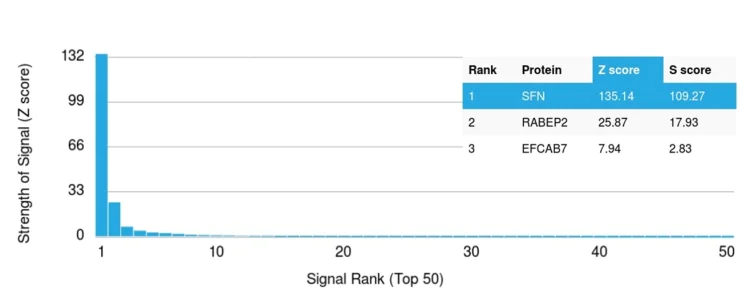
- Protein Array
Unknown
Protein Array - Anti-14-3-3 sigma/SFN antibody [CPTC-SFN-2] (AB268067)
Protein Array containing more than 19,000 full-length human proteins using ab268067. Z- and S- Score : The Z-score represents the strength of a signal that a monoclonal antibody (MAb) (in combination with a fluorescently-tagged anti-IgG secondary antibody) produces when binding to a particular protein on the HuProtTM array. Z-scores are described in units of standard deviations (SD's) above the mean value of all signals generated on that array. If targets on HuProtTM are arranged in descending order of the Z-score, the S-score is the difference (also in units of SD's) between the Z-score. S-score therefore represents the relative target specificity of a MAb to its intended target. A MAb is considered to specific to its intended target, if the MAb has an S-score of at least 2.5. For example, if a MAb binds to protein X with a Z-score of 43 and to protein Y with a Z-score of 14, then the S-score for the binding of that MAb to protein X is equal to 29.
代替製品
Primary Antibodies
AB193667
Anti-14-3-3 sigma/SFN antibody [EPR5873(2)]
20ul selling size|RabMAb|Recombinant
- 0
- 0
Primary Antibodies
AB251175
Anti-14-3-3 sigma/SFN antibody [EPR5873(2)] - BSA and Azide free
RabMAb|Recombinant
- 0
- 0
組合せ製品
Primary Antibodies
AB109494
Anti-S100 alpha 2/S100A2 antibody [EPR5392]
BOND RX™ Validated|RabMAb|Recombinant
- 0
- 0
Primary Antibodies
AB124964
Anti-alpha smooth muscle Actin antibody [EPR5368]
BOND RX™ Validated|RabMAb|Recombinant|KO Validated|20ul selling size

- 5
- 19
Primary Antibodies
AB33899
20ul selling size|RabMAb|Recombinant|KO Validated

- 4
- 12
Primary Antibodies
AB109725
Anti-Cytokeratin 17 antibody [EP1623] - Cytoskeleton Marker
RabMAb|Recombinant|Lab Essentials|20ul selling size
- 3
- 1
Reactivity data
出荷温度及び保存条件
製品の状態
精製方法
精製に関する特記事項
バッファー組成
出荷温度
短期保存期間
短期保存温度
長期保存温度
分注に関する情報
保管に関する情報
補足情報
This supplementary information is collated from multiple sources and compiled automatically.
Biological function summary
14-3-3 sigma contributes to cell cycle arrest and apoptosis. As part of a complex it interacts with other proteins to ensure proper cell division and prevent abnormal growth. It binds to phosphorylated serine/threonine residues on its target proteins influencing their activity and function. By doing this it exerts control over cell cycle checkpoints and influences DNA damage response mechanisms.
Pathways
14-3-3 sigma interacts with several pathways that are critical for maintaining cell stability and response to stress. It participates in the PI3K/AKT pathway working closely with proteins like AKT1 to facilitate cell survival and growth suppression under stress conditions. Its involvement in this pathway ties it to the regulation of cell proliferation and survival interconnecting with broader cellular networks.
製品プロトコール
- Visit the General protocols
- Visit the Troubleshooting
ターゲットの情報
文献 (1)
Recent publications for all applications. Explore the full list and refine your search
Oncology letters 28:530 PubMed39290955
2024
Applications
Unspecified application
Species
Unspecified reactive species
Abcam product promise
Please note: All products are 'FOR RESEARCH USE ONLY. NOT FOR USE IN DIAGNOSTIC OR THERAPEUTIC PROCEDURES'.
For licensing inquiries, please contact partnerships@abcam.com