Phospho-SMAD5 (S463/465) ELISA Kit
Phospho-SMAD5 (S463/465) ELISA Kit
Be the first to review this product! Submit a review
|
(0 Publication)
Phospho-SMAD5 (S463/465) ELISA Kit is a ELISA for the measurement of Phospho-SMAD5 (S463/465) in Human in Cell/Tissue Extracts samples.
別名を表示する
MADH5, SMAD5, SMAD family member 5, SMAD 5, hSmad5, JV5-1, Mothers against decapentaplegic homolog 5, MAD homolog 5, Mothers against DPP homolog 5
- sELISA
Supplier Data
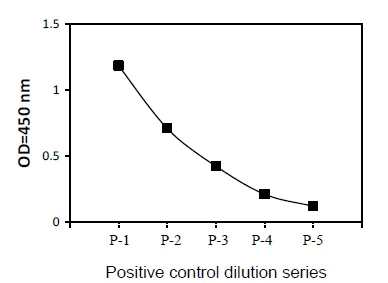
Sandwich ELISA - Phospho-SMAD5 (S463/465) ELISA Kit (AB279933)
HeLa cells were treated with BMP2.
Solubilize cells at 4 x 10⁷ cells/ml in Cell Lysate Buffer.
Serial dilutions of lysates were analyzed in this ELISA.
- sELISA
Supplier Data
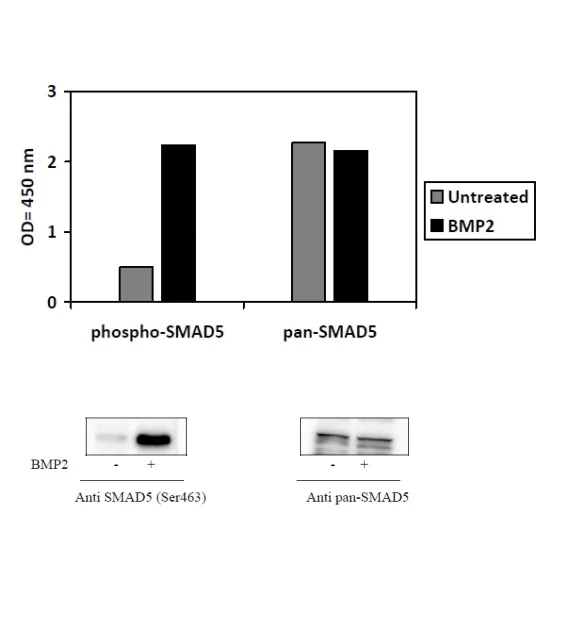
Sandwich ELISA - Phospho-SMAD5 (S463/465) ELISA Kit (AB279933)
Jurkat cells treated with/without CPT.
Jurkat cells were untreated or treated with CPT. Cell lysates were analyzed using this phosphoELISA and Western Blot.
組合せ製品
Primary Antibodies
AB40771
20ul selling size|KO Validated|RabMAb|Recombinant
- 5
- 4
Reactivity data
製品の詳細
Phospho-SMAD5 (S463/465) ELISA Kit (ab279933) is a very rapid, convenient and sensitive assay kit that can monitor the activation or function of important biological pathways in human cell lysates. By determining phosphorylated SMAD5 (protein in your experimental model system, you can verify pathway activation in your cell lysates. You can simultaneously measure numerous different cell lysates without spending excess time and effort in performing a Western Blotting analysis.
This Sandwich ELISA kit is an in vitro enzyme-linked immunosorbent assay for the measurement of human phospho-SMAD5. An anti-pan SMAD5 antibody has been coated onto a 96-well plate. Samples are pipetted into the wells and SMAD5 present in a sample is bound to the wells by the immobilized antibody. The wells are washed and rabbit anti-phospho-SMAD5 (S463/465) antibody is used to detect phosphorylated SMAD5. After washing away unbound antibody, HRP conjugated anti-rabbit IgG is pipetted into the wells. The wells are again washed, a TMB substrate solution is added to the wells and color develops in proportion to the amount of SMAD5 (S463/465) bound. The Stop Solution changes the color from blue to yellow, and the intensity of the color is measured at 450 nm.
REACH authorisation
Abcam has not and does not intend to apply for the REACH Authorisation of customers' uses of products that contain European Authorisation list (Annex XIV) substances.
It is the responsibility of our customers to check the necessity of application of REACH Authorisation, and any other relevant authorisations, for their intended uses.
製品内容
出荷温度及び保存条件
出荷温度
短期保存温度
長期保存温度
保管に関する情報
補足情報
This supplementary information is collated from multiple sources and compiled automatically.
Biological function summary
SMAD5 plays a central role in the bone morphogenetic protein (BMP) signaling pathway which is critical for embryonic development and tissue homeostasis. It forms a complex with receptor-regulated SMADs (R-SMADs) and co-SMAD (SMAD4) upon phosphorylation by BMP type I receptors. This complex then moves to the nucleus where it regulates expression of target genes. Through this mechanism SMAD5 impacts processes such as bone formation differentiation and cellular differentiation.
Pathways
Several key cellular signaling processes involve SMAD5. Primarily it contributes to the BMP pathway which is integral to skeletal development and repair. SMAD5 interacts with other SMAD proteins like SMAD1 and SMAD8 which all act downstream of the BMP receptors. Additionally SMAD5 participates in crosstalk with the TGF-beta signaling pathway enabling the fine-tuning of cellular responses to a variety of external cues. This connection places SMAD5 within a network of signaling events important for regulating different cell functions and maintaining cellular homeostasis.
ターゲットの情報
Abcam product promise
Please note: All products are 'FOR RESEARCH USE ONLY. NOT FOR USE IN DIAGNOSTIC OR THERAPEUTIC PROCEDURES'.
For licensing inquiries, please contact partnerships@abcam.com