JavaScript is disabled in your browser. Please enable JavaScript to view this website.
AB279741

Phospho-ATR (T1989) ELISA Kit

Phospho-ATR (T1989) ELISA Kit

Be the first to review this product! Submit a review

|

(0 Publication)

Phospho-ATR (T1989) ELISA Kit is a ELISA for the measurement of Phospho-ATR (T1989) in Human in Cell/Tissue Extracts samples.

別名を表示する

DPC4, MADH4, SMAD4, SMAD family member 4, SMAD 4, hSMAD4, Deletion target in pancreatic carcinoma 4, Mothers against decapentaplegic homolog 4, MAD homolog 4, Mothers against DPP homolog 4
2 Images
Sandwich ELISA - Phospho-ATR (T1989) ELISA Kit (AB279741)
  • sELISA

Supplier Data

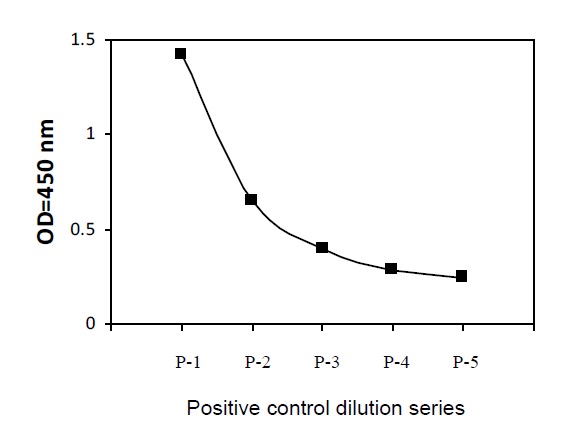
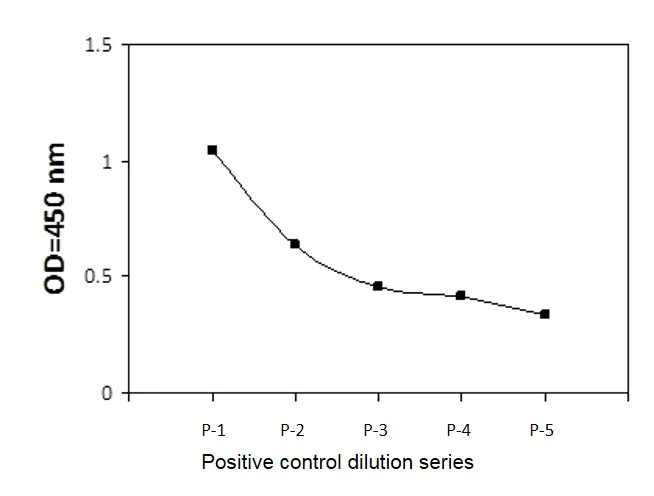
Sandwich ELISA - Phospho-ATR (T1989) ELISA Kit (AB279741)

T47D cells were exposed to 50 J/m2 of UV light followed by a 4 hours recovery period.

Cells were solubilzed at 4 x 10⁷ cells/ml in Cell Lysate Buffer.

Serial dilutions of lysates were analyzed in this ELISA.
Sandwich ELISA - Phospho-ATR (T1989) ELISA Kit (AB279741)
  • sELISA

Supplier Data

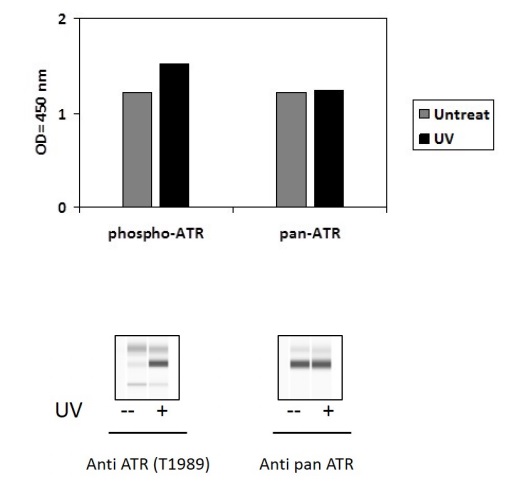
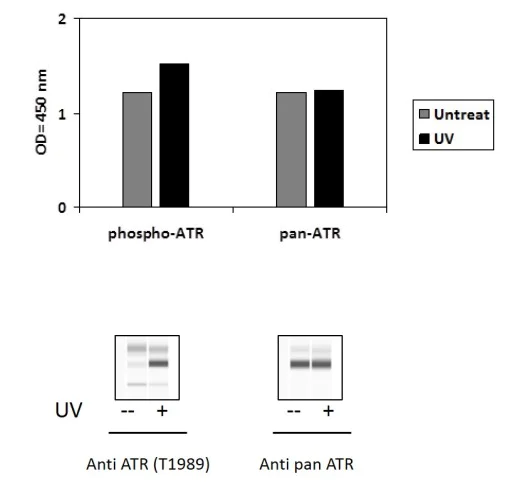
Sandwich ELISA - Phospho-ATR (T1989) ELISA Kit (AB279741)

UV treated T47D cells.

T47D cells were untreated or treated with UV.

Cell lysates were analyzed using this phosphoELISA and Western Blot.

Key facts

検出方法

Colorimetric

サンプルタイプ

Cell Lysate

交差種

Human

Semi-Quantitative
アッセイプラットフォーム

Pre-coated microplate (12 x 8 well strips)

Reactivity data

{ "title": "Reactivity Data", "filters": { "stats": ["", "Reactivity", "Dilution Info", "Notes"] }, "values": { "ELISA": { "reactivity":"TESTED_AND_REACTS", "dilution-info":"", "notes":"<p></p>" } } }

製品の詳細

Phospho-ATR (T1989) ELISA Kit (ab279741) is a very rapid, convenient, and sensitive assay kit that can monitor the activation or function of important biological pathways in human cell lysates. By determining phosphorylated ATR protein in your experimental model system, you can verify pathway activation in your cell lysates. You can simultaneously measure numerous different cell lysates without spending excess time and effort in performing a Western Blotting analysis.

This Sandwich ELISA kit is an in vitro enzyme-linked immunosorbent assay for the measurement of human phospho-ATR. An anti-pan ATR antibody has been coated onto a 96-well plate. Samples are pipetted into the wells and ATR present in a sample is bound to the wells by the immobilized antibody. The wells are washed, and rabbit anti-phospho-ATR (T1989) antibody is used to detect phosphorylated ATR. After washing away unbound antibody, HRP-conjugated anti-rabbit IgG is pipetted into the wells. The wells are again washed, a TMB substrate solution is added to the wells and color develops in proportion to the amount of ATR (T1989) bound. The Stop Solution changes the color from blue to yellow, and the intensity of the color is measured at 450 nm.

REACH authorisation
Abcam has not and does not intend to apply for the REACH Authorisation of customers' uses of products that contain European Authorisation list (Annex XIV) substances.
It is the responsibility of our customers to check the necessity of application of REACH Authorisation, and any other relevant authorisations, for their intended uses.

製品内容

{ "values": { "1x96Tests": { "sellingSize": "1 x 96 Tests", "publicAssetCode":"ab279741-1x96Tests", "assetComponentDetails": [ { "size":"1 x 8 mL", "name":"Stop Solution", "number":"AB279741-CMP06", "productcode":"" }, { "size":"1 x 5 mL", "name":"2X Cell lysate buffer", "number":"AB279741-CMP09", "productcode":"" }, { "size":"1 x 25 µL", "name":"HRP-conjugated anti-mouse IgG concentrate (1000X)", "number":"AB279741-CMP11", "productcode":"" }, { "size":"2 x 1 Vial", "name":"Mouse anti-phospho-ATR (T1989) antibody", "number":"AB279741-CMP10", "productcode":"" }, { "size":"1 x 1 Vial", "name":"Positive Control - T47D cell lysate", "number":"AB279741-CMP02", "productcode":"" }, { "size":"1 x 1 Unit", "name":"Pan-ATR Coated Microplate", "number":"AB279741-CMP05", "productcode":"" }, { "size":"1 x 12 mL", "name":"TMB One-Step Substrate Reagent", "number":"AB279741-CMP08", "productcode":"" }, { "size":"1 x 25 mL", "name":"20X Wash Buffer", "number":"AB279741-CMP03", "productcode":"" }, { "size":"1 x 15 mL", "name":"5X Assay Diluent", "number":"AB279741-CMP04", "productcode":"" } ] } } }

出荷温度及び保存条件

出荷温度
Blue Ice
短期保存温度
-20°C
長期保存温度
-20°C
保管に関する情報
-20°C

補足情報

This supplementary information is collated from multiple sources and compiled automatically.

ATR also known as Ataxia Telangiectasia and Rad3-related protein is a serine/threonine kinase with a molecular weight of approximately 301 kDa. This protein localizes mainly in the nucleus where it functions as an important component in the cellular response to DNA damage and replication stress. ATR detects DNA strand breaks and ssDNA coated with RPA and becomes activated to phosphorylate several downstream targets initiating the DNA damage response. High expression of ATR occurs in proliferative tissues emphasizing its role in cell cycle regulation.
Biological function summary

ATR plays an essential role in maintaining genomic stability. It is part of a larger protein complex that includes ATRIP (ATR-interacting protein) which helps in localizing ATR to sites of DNA damage. Once activated ATR phosphorylates various substrates including CHK1 a critical checkpoint kinase involved in cell cycle arrest during DNA repair processes. The ability of ATR to coordinate with these proteins helps cells manage DNA damage effectively and prevent genomic instability.

Pathways

ATR functions centrally in the DNA damage response and repair mechanisms particularly the ATR-Chk1 pathway. This pathway interacts closely with the ATM (Ataxia Telangiectasia Mutated) pathway which also responds to DNA damage but usually to double-strand breaks. ATR primarily acts in response to replication stress and its activation leads to the arrest of the cell cycle allowing DNA repair to occur. This cooperation between ATR and ATM highlights their complementary roles in safeguarding genomic integrity under stress.

ATR mutations and dysregulation have strong associations with cancer and Seckel syndrome. In the context of cancer ATR often works in concert with ATM to manage DNA repair and cancer cells frequently overexpress ATR to cope with high levels of replication stress. This makes ATR a potential target for cancer therapy where its inhibition could sensitize tumor cells to chemotherapy. In Seckel syndrome ATR mutations result in developmental anomalies showcasing the important role ATR plays in cellular replication and repair processes.

製品プロトコール

ターゲットの情報

In muscle physiology, plays a central role in the balance between atrophy and hypertrophy. When recruited by MSTN, promotes atrophy response via phosphorylated SMAD2/4. MSTN decrease causes SMAD4 release and subsequent recruitment by the BMP pathway to promote hypertrophy via phosphorylated SMAD1/5/8. Acts synergistically with SMAD1 and YY1 in bone morphogenetic protein (BMP)-mediated cardiac-specific gene expression. Binds to SMAD binding elements (SBEs) (5'-GTCT/AGAC-3') within BMP response element (BMPRE) of cardiac activating regions (By similarity). Common SMAD (co-SMAD) is the coactivator and mediator of signal transduction by TGF-beta (transforming growth factor). Component of the heterotrimeric SMAD2/SMAD3-SMAD4 complex that forms in the nucleus and is required for the TGF-mediated signaling (PubMed : 25514493). Promotes binding of the SMAD2/SMAD4/FAST-1 complex to DNA and provides an activation function required for SMAD1 or SMAD2 to stimulate transcription. Component of the multimeric SMAD3/SMAD4/JUN/FOS complex which forms at the AP1 promoter site; required for synergistic transcriptional activity in response to TGF-beta. May act as a tumor suppressor. Positively regulates PDPK1 kinase activity by stimulating its dissociation from the 14-3-3 protein YWHAQ which acts as a negative regulator.
See full target information SMAD4 phospho T1989
websiteProtocolBooklet
en

Abcam product promise

当社は、高品質な試薬を通じてお客様の研究を力強くサポートすることをお約束いたします。ご使用いただく各段階で、常にお客様をサポートできる体制を整えております。万が一、製品が期待通りに機能しない場合は、「Abcam Product Promise」による当社保証制度に基づき、安心してご利用いただけます。
保証に関する詳細については利用規約をご確認ください。

Please note: All products are 'FOR RESEARCH USE ONLY. NOT FOR USE IN DIAGNOSTIC OR THERAPEUTIC PROCEDURES'.

For licensing inquiries, please contact partnerships@abcam.com