JavaScript is disabled in your browser. Please enable JavaScript to view this website.
AB285350

Mouse/Rat Testosterone ELISA Kit

Mouse/Rat Testosterone ELISA Kit

Be the first to review this product! Submit a review

|

(14 Publications)

The Mouse/Rat Testosterone ELISA kit is a competitive ELISA designed to quantify testosterone with a sensitivity of 11.8 pg/mL.

- Wide dynamic range – quantifies 0.1–18 ng/mL
- Designed to measure total testosterone - includes both protein-bound and free testosterone
- Compatible with multiple sample types – works with serum and plasma
- Fast assay time – complete results in 1 hour 45 minutes

別名を表示する

17b hydroxy 4 androsten 3 one, 17鑴-hydroxyandrost-4-ene-3-one

Key facts

検出方法

Colorimetric

サンプルタイプ

Plasma, Serum

交差種

Mouse, Rat

アッセイタイプ

Competitive

Quantitative
検出範囲

0.1 - 18 ng/mL

Reactivity data

{ "title": "Reactivity Data", "filters": { "stats": ["", "Reactivity", "Dilution Info", "Notes"] }, "values": { "cELISA": { "reactivity":"TESTED_AND_REACTS", "dilution-info":"", "notes":"<p></p>" } } }

製品の詳細

Mouse/Rat Testosterone ELISA Kit ab285350 is a competitive ELISA kit to measure mouse and rat Testosterone (17β-Hydroxy-4-androstene-3-one) in serum and plasma with a sensitivity of 11.8 pg/mL.

How the assay works

Mouse/Rat Testosterone ELISA Kit ab285350 is a competitive ELISA. There are 2 types of competitive ELISAs:

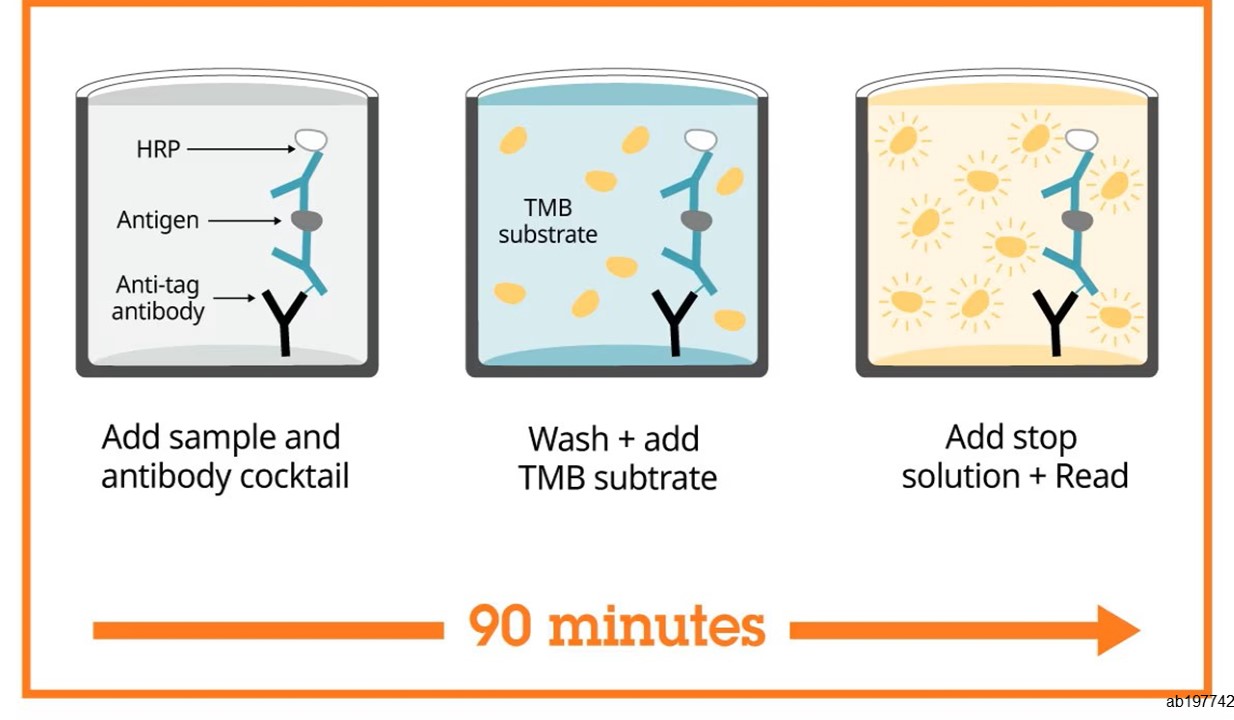
  • antigen down: The sample antigen competes with a reference antigen for binding to a specific amount of labeled antibody. The reference antigen is pre-coated on a multi-well plate. The sample is added to the plate wells with a labeled antibody. Depending on the amount of antigen in the sample, more or fewer free antibodies will be available to bind the reference antigen. This means that the more of the antigen there is in the sample, the less reference antigen will be detected and the weaker the signal will be.
  • antibody down: the labeled antigen and the sample antigen (unlabeled) compete for binding to the primary antibody, which is immobilized on the plate. The lower the amount of antigen in the sample, the stronger the signal due to more labelled antigen in the well.

Assay specificity

Our ELISA kits are rigorously validated to ensure the highest level of consistency and reproducibility.

Mouse/Rat Testosterone ELISA Kit ab285350 protocol summary

  1. Add standards or samples to the wells, incubate 2 hrs
  2. Wash, then add 50 µl of Biotinylated Antibody per well. Incubate 1 hr
  3. Wash, then add 50 µl of SP Conjugate per well. Incubate 30 min
  4. Wash, then add 50 µl of Chromogen Substrate per well. Incubate 20 min
  5. Add 50 µl of Stop Solution per well. Read at 450 nm immediately

製品内容

{ "values": { "96Test": { "sellingSize": "96 Test", "publicAssetCode":"ab285350-96Test", "assetComponentDetails": [ { "size":"1 x 12 mL", "name":"Stop Solution", "number":"AB285350-CMP08" }, { "size":"1 x 12 mL", "name":"TMB Substrate", "number":"AB285350-CMP07" }, { "size":"1 x 25 mL", "name":"20X Wash buffer", "number":"AB285350-CMP06" }, { "size":"1 x 1 Unit", "name":"Goat Anti-Rabbit IgG pre-coated Microplate", "number":"AB285350-CMP03" }, { "size":"1 x 12 mL", "name":"Assay Diluent", "number":"AB285350-CMP02" }, { "size":"1 x 7 mL", "name":"Rabbit Anti-Testosteone Reagent", "number":"AB285350-CMP01" }, { "size":"1 x 0.7 mL", "name":"Enzyme Conjugate (20X)", "number":"AB285350-CMP04" }, { "size":"6 x 1 Vial", "name":"Standard", "number":"AB285350-CMP05" }, { "size":"2 x 1 Vial", "name":"Control", "number":"AB285350-CMP09" } ] }, "96Test": { "sellingSize": "96 Test", "publicAssetCode":"ab285350-96Test", "assetComponentDetails": [ { "size":"1 x 12 mL", "name":"Stop Solution", "number":"AB285350-CMP08", "productcode":"" }, { "size":"1 x 12 mL", "name":"TMB Substrate", "number":"AB285350-CMP07", "productcode":"" }, { "size":"1 x 25 mL", "name":"20X Wash buffer", "number":"AB285350-CMP06", "productcode":"" }, { "size":"1 x 1 Unit", "name":"Goat Anti-Rabbit IgG pre-coated Microplate", "number":"AB285350-CMP03", "productcode":"" }, { "size":"1 x 12 mL", "name":"Assay Diluent", "number":"AB285350-CMP02", "productcode":"" }, { "size":"6 x 1 Vial", "name":"Standard", "number":"AB285350-CMP05", "productcode":"" }, { "size":"1 x 0.7 mL", "name":"Enzyme Conjugate (20X)", "number":"AB285350-CMP04", "productcode":"" }, { "size":"1 x 7 mL", "name":"Rabbit Anti-Testosteone Reagent", "number":"AB285350-CMP01", "productcode":"" } ] } } }

出荷温度及び保存条件

出荷温度
Blue Ice
短期保存温度
+4°C
長期保存温度
+4°C
保管に関する情報
+4°C

補足情報

This supplementary information is collated from multiple sources and compiled automatically.

Testosterone also known as 17β-hydroxyandrost-4-en-3-one is a steroid hormone with a molecular mass of approximately 288.42 Da. It is primarily synthesized in the testes but also in smaller amounts in the ovaries and adrenal glands. Mechanically testosterone operates by binding to the androgen receptor a member of the nuclear receptor family which then modulates gene expression. Its synthesis is stimulated by luteinizing hormone (LH) which is released from the anterior pituitary gland.
Biological function summary

Testosterone plays an important role in the development of male secondary sexual characteristics such as increased muscle and bone mass and the growth of body hair. It's also part of the steroid hormone biosynthesis pathway influencing the production of estradiol through the aromatase enzyme. Testosterone contributes to the maintenance of reproductive tissues and is important for the modulation of mood and cognitive functions.

Pathways

Testosterone is integral to the HPG (hypothalamic-pituitary-gonadal) axis where it exerts feedback control by inhibiting the secretion of gonadotropin-releasing hormone (GnRH) and LH. Moreover testosterone is essential in the androgen receptor signaling pathway. This pathway involves other proteins like dihydrotestosterone (DHT) a potent androgen converted from testosterone via the 5α-reductase enzyme.

Low levels of testosterone commonly known as 'Low T' are linked to conditions like hypogonadism and certain metabolic syndromes. Testosterone levels can influence the risk of osteoporosis as sustained low levels reduce bone density. Additionally increased or decreased testosterone levels can pose risks to cardiovascular health with the target interacting with proteins such as sex hormone-binding globulin (SHBG) in these contexts.

製品プロトコール

ターゲットの情報

See full target information Testosterone

文献 (14)

Recent publications for all applications. Explore the full list and refine your search

European journal of medical research 30:459 PubMed40481542

2025

CBL-mediated AQP1 ubiquitination aggravates kidney-yang deficiency syndrome by promoting lipid metabolism dysregulation.

Applications

Unspecified application

Species

Unspecified reactive species

Yifei Wang,Jun Yuan,Wenfang He,Nan Yang,Lanjun Fu,Juan Jin

Journal of biochemical and molecular toxicology 39:e70279 PubMed40293820

2025

Effects of PM2.5 Metal Components Derived From Porcine Farm Exposure on Sperm Function in Mice.

Applications

Unspecified application

Species

Unspecified reactive species

Chae Yeon Kim,Chae Rim Kim,Eungyung Kim,Kanghyun Park,Hyeonjin Kim,Lei Ma,Ke Huang,Zhibin Liu,Junsu Park,Minwoong Jung,Shengqing Li,Weihong Wen,Sangsik Kim,Sijun Park,Zae Young Ryoo,Junkoo Yi,Myoung Ok Kim

Basic and clinical andrology 35:9 PubMed40055615

2025

Pelvic vasectomy and its protective effects on rat testis function.

Applications

Unspecified application

Species

Unspecified reactive species

Heng Yang,Yujun Chen,Xiaofeng Cheng,Jingxin Wu,Ruohui Huang,Biao Qian,Gongxian Wang

JCI insight 10: PubMed40036079

2025

In vitro fertilization induces reproductive changes in male mouse offspring and has multigenerational effects.

Applications

Unspecified application

Species

Unspecified reactive species

Eric A Rhon-Calderon,Cassidy N Hemphill,Alexandra J Savage,Laren Riesche,Richard M Schultz,Marisa S Bartolomei

Nature cancer 5:1641-1659 PubMed39394434

2024

The neuroendocrine transition in prostate cancer is dynamic and dependent on ASCL1.

Applications

Unspecified application

Species

Unspecified reactive species

Rodrigo Romero,Tinyi Chu,Tania J González Robles,Perianne Smith,Yubin Xie,Harmanpreet Kaur,Sara Yoder,Huiyong Zhao,Chenyi Mao,Wenfei Kang,Maria V Pulina,Kayla E Lawrence,Anuradha Gopalan,Samir Zaidi,Kwangmin Yoo,Jungmin Choi,Ning Fan,Olivia Gerstner,Wouter R Karthaus,Elisa DeStanchina,Kelly V Ruggles,Peter M K Westcott,Ronan Chaligné,Dana Pe'er,Charles L Sawyers

Brain, behavior, and immunity 120:391-402 PubMed38897330

2024

Intrauterine position effects in a mouse model of maternal immune activation.

Applications

Unspecified application

Species

Unspecified reactive species

Ron Schaer,Flavia S Mueller,Tina Notter,Ulrike Weber-Stadlbauer,Urs Meyer

International journal of molecular sciences 25: PubMed38673900

2024

Therapeutic Potential of 4-Hexylresorcinol in Preserving Testicular Function in Streptozotocin-Induced Diabetic Rats.

Applications

Unspecified application

Species

Unspecified reactive species

Ji-Hyeon Oh,Je-Yong Choi,Dae-Won Kim,Seong-Gon Kim,Umberto Garagiola

Cell communication and signaling : CCS 22:235 PubMed38643161

2024

GDF9 and GDF9 bi-allelic variants caused female subfertility with defective follicle enlargement.

Applications

Unspecified application

Species

Unspecified reactive species

Yuwei Duan,Bing Cai,Jing Guo,Chen Wang,Qingyun Mai,Yan Xu,Yang Zeng,Yue Shi,Boyan Wang,Chenhui Ding,Minghui Chen,Canquan Zhou,Yanwen Xu

Heliyon 10:e24577 PubMed38312691

2024

Taste receptor type 1 member 3 is required for the fertility of male mice.

Applications

Unspecified application

Species

Unspecified reactive species

Woo-Jeong Shon,Hobin Seong,Jae Won Song,Dong-Mi Shin

Journal of ovarian research 17:29 PubMed38302986

2024

Bushenhuoluo Decoction improves polycystic ovary syndrome by regulating exosomal miR-30a-5p/ SOCS3/mTOR/NLRP3 signaling-mediated autophagy and pyroptosis.

Applications

Unspecified application

Species

Unspecified reactive species

Qun Huang,Yuanbin Li,Zhuang Chen,Huiping Ou,Yanjiao Tan,Hui Lin
View all publications
websiteProtocolBooklet
en

Abcam product promise

当社は、高品質な試薬を通じてお客様の研究を力強くサポートすることをお約束いたします。ご使用いただく各段階で、常にお客様をサポートできる体制を整えております。万が一、製品が期待通りに機能しない場合は、「Abcam Product Promise」による当社保証制度に基づき、安心してご利用いただけます。
保証に関する詳細については利用規約をご確認ください。

Please note: All products are 'FOR RESEARCH USE ONLY. NOT FOR USE IN DIAGNOSTIC OR THERAPEUTIC PROCEDURES'.

For licensing inquiries, please contact partnerships@abcam.com