JavaScript is disabled in your browser. Please enable JavaScript to view this website.
AB190530

Horse IgA ELISA Kit

Horse IgA ELISA Kit

Be the first to review this product! Submit a review

|

(3 Publications)

Horse IgA ELISA Kit is a sandwich ELISA designed to quantify Horse IgA with a sensitivity of 3.654 ng/mL.

- Colorimetric sandwich ELISA - 450 nm readout - works on any plate reader
- Wide dynamic range - quantifies 15.63 - 500 ng/mL
1 Images
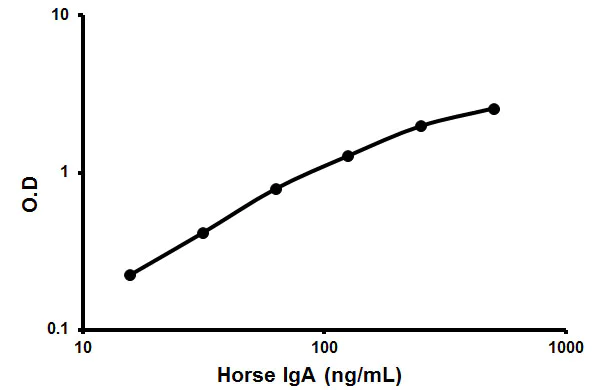
Sandwich ELISA - Horse IgA ELISA Kit (AB190530)
  • sELISA

Supplier Data

Sandwich ELISA - Horse IgA ELISA Kit (AB190530)

Representative standard curve using ab190530 IgA Horse ELISA Kit.

Key facts

検出方法

Colorimetric

サンプルタイプ

Plasma, Serum

交差種

Horse

アッセイタイプ

Sandwich

Quantitative
検出感度

= 3.654 ng/mL

検出範囲

15.63 - 500 ng/mL

アッセイプラットフォーム

Microplate

Reactivity data

{ "title": "Reactivity Data", "filters": { "stats": ["", "Reactivity", "Dilution Info", "Notes"] }, "values": { "sELISA": { "reactivity":"TESTED_AND_REACTS", "dilution-info":"", "notes":"<p></p>" } } }

製品の詳細

Horse IgA ELISA Kit ab190530 is a sandwich ELISA to measure Horse IgA in serum, plasma with a sensitivity of 3.654 ng/ml.

How the assay works

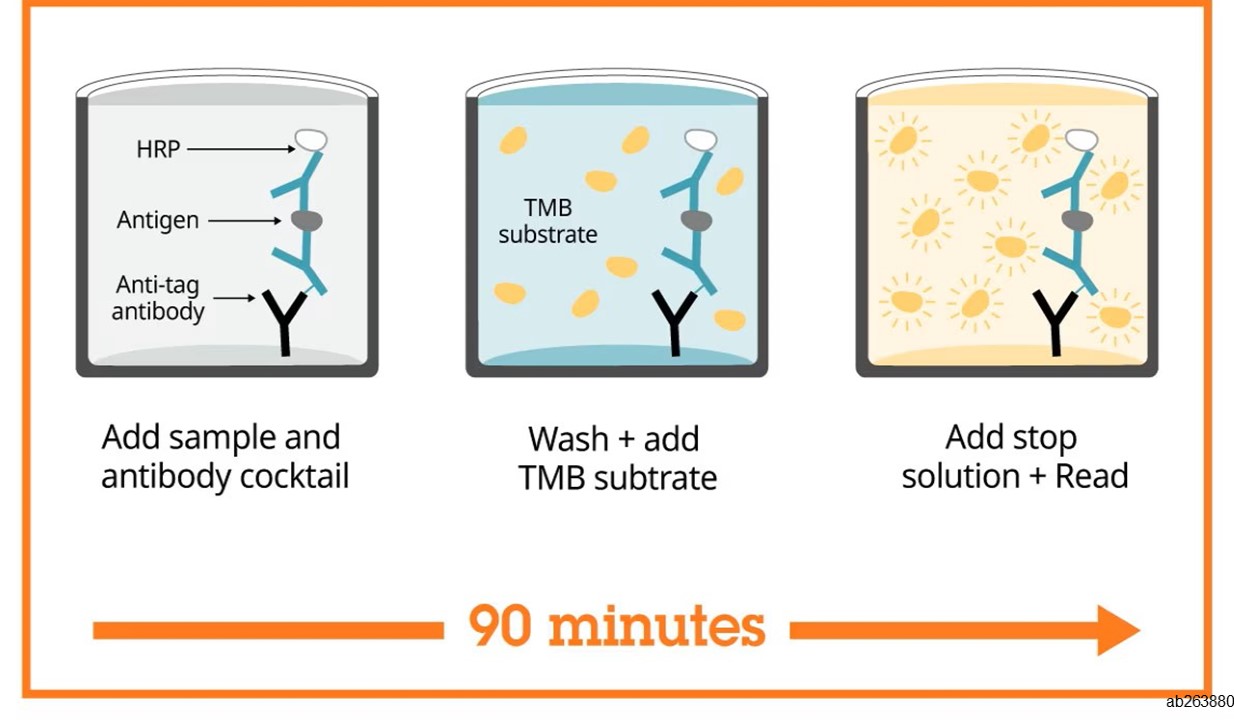
In this assay the IgA present in samples reacts with the anti-IgA antibodies which have been adsorbed to the surface of polystyrene microtitre wells. After the removal of unbound proteins by washing, anti-IgA antibodies conjugated with horseradish peroxidase (HRP) are added. These enzyme-labeled antibodies form complexes with the previously bound IgA. Following another washing step, the enzyme bound to the immunosorbent is assayed by the addition of a chromogenic substrate, 3,3',5,5'-tetramethylbenzidine (TMB). The quantity of bound enzyme varies directly with the concentration of IgA in the sample tested; thus, the absorbance, at 450 nm, is a measure of the concentration of IgA in the test sample. The quantity of IgA in the test sample can be interpolated from the standard curve constructed from the standards, and corrected for sample dilution.

Assay Specificity

Our ELISA kits are rigorously validated to ensure the highest level of consistency and reproducibility. Please check the protocol booklet for more details

Horse IgA ELISA Kit ab190530 protocol summary

1. Add standard or sample to each well used. Incubate at room temperature.
2. Aspirate and wash each well.
3. Add prepared HRP labeled secondary detector antibody. Incubate at room temperature
4. Aspirate and wash each well.
5. Add Chromogen Substrate Solution to each well.
6. Immediately begin recording the color development

精度

[ { "reproducibilityType": "Intra", "sample": "Overall", "replicates": 0, "mean": null, "standardDeviation": null, "coefficientOfVariability": "< 10" }, { "reproducibilityType": "Inter", "sample": "Overall", "replicates": 0, "mean": null, "standardDeviation": null, "coefficientOfVariability": "< 10" } ]

回収率

[ { "sample": "Serum", "range": null, "average": "> 85" } ]

製品内容

{ "values": { "1x96Tests": { "sellingSize": "1 x 96 Tests", "publicAssetCode":"ab190530-1x96Tests", "assetComponentDetails": [ { "size":"1 x 50 mL", "name":"5X Diluent Concentrate", "number":"AB190530-CMP07", "productcode":"" }, { "size":"1 x 50 mL", "name":"20X Wash Buffer Concentrate", "number":"AB190530-CMP06", "productcode":"" }, { "size":"1 x 12 mL", "name":"Chromogen Substrate Solution", "number":"AB190530-CMP02", "productcode":"" }, { "size":"1 x 12 mL", "name":"Stop Solution", "number":"AB190530-CMP01", "productcode":"" }, { "size":"1 x 1 Vial", "name":"IgA Horse Calibrator (Lyophilized)", "number":"AB190530-CMP04", "productcode":"" }, { "size":"1 x 1 Unit", "name":"IgA Horse Antibody coated microwells", "number":"AB190530-CMP03", "productcode":"" }, { "size":"1 x 1 Vial", "name":"IgA Horse HRP Conjugate", "number":"AB190530-CMP05", "productcode":"" } ] } } }

出荷温度及び保存条件

出荷温度
Blue Ice
短期保存温度
+4°C
長期保存温度
Multi
保管に関する情報
Please refer to protocols

補足情報

This supplementary information is collated from multiple sources and compiled automatically.

Immunoglobulin A (IgA) also known as sIgA in its secretory form is an important component of the immune system. With a molecular weight of approximately 160 kDa IgA exists as a monomeric or dimeric structure. It is primarily expressed in mucosal areas such as the respiratory tract gastrointestinal tract and urogenital tract while also being present in secretions like saliva tears and breast milk. In its dimeric form IgA associates with a joining (J) chain and a secretory component which facilitates its transport across mucosal barriers.
Biological function summary

IgA functions as a first line of defense in immune responses occurring at mucosal surfaces. Its primary role is to neutralize pathogens toxins and prevent their attachment and penetration through epithelial cells. This antibody does not form part of a larger complex but plays an important role in immune exclusion by trapping antigens in the mucus layer. Additionally IgA can mediate antibody-dependent cellular cytotoxicity and engage with specific receptors like FcαRI (CD89) on immune cells further enhancing its protective capabilities.

Pathways

IgA participates in the mucosal immune response which is a sub-component of the broader immune system pathways. It is closely associated with the polymeric immunoglobulin receptor (pIgR) which transports IgA to the mucosal surfaces. The pathway involves recombination activation proteins (RAG) during its class-switching process in B cells differentiating from IgM-producing cells to those secreting IgA. These pathways are integral to maintaining the mucosal environment and protecting against pathogens.

Alterations or deficiencies in IgA can lead to increased susceptibility to infections and disorders like IgA nephropathy and celiac disease. In IgA nephropathy IgA deposits in the kidneys result in inflammation and damage to renal tissues. Celiac disease involves an immune reaction to gluten where IgA antibodies against tissue transglutaminase (tTG) contribute to intestinal damage. Both conditions illustrate the importance of IgA in maintaining immune balance and its connection with disease pathologies.

製品プロトコール

ターゲットの情報

文献 (3)

Recent publications for all applications. Explore the full list and refine your search

Frontiers in immunology 15:1487664 PubMed39906737

2025

Investigating the potential immunomodulatory effects of commercial oral probiotic supplements on equine gastrointestinal tract barrier function.

Applications

Unspecified application

Species

Unspecified reactive species

Agnieszka Żak-Bochenek,Paulina Żebrowska-Różańska,Joanna Bajzert,Łukasz Łaczmański,Bogumiła Szponar,Natalia Siwińska,Klaudia Gładysz,Katarzyna Sikorska,Anna Chełmońska-Soyta

Veterinary research communications 48:3605-3620 PubMed39180603

2024

Comparison and characterization of the bacterial microbiota and SIgA production in different gastrointestinal segments in horses.

Applications

Unspecified application

Species

Unspecified reactive species

Agnieszka Żak-Bochenek,P Żebrowska-Różańska,J Bajzert,N Siwińska,J P Madej,K Kaleta-Kuratewicz,P Bochen,Ł Łaczmański,A Chełmońska-Soyta

Animals : an open access journal from MDPI 12: PubMed36428322

2022

Homeostasis of the Intestinal Mucosa in Healthy Horses-Correlation between the Fecal Microbiome, Secretory Immunoglobulin A and Fecal Egg Count.

Applications

sELISA

Species

Horse

Agnieszka Żak-Bochenek,Joanna Bajzert,Dominika Sambor,Natalia Siwińska,Bogumiła Szponar,Łukasz Łaczmański,Paulina Żebrowska,Aleksandra Czajkowska,Maciej Karczewski,Anna Chełmońska-Soyta
View all publications
websiteProtocolBooklet
en

Abcam product promise

当社は、高品質な試薬を通じてお客様の研究を力強くサポートすることをお約束いたします。ご使用いただく各段階で、常にお客様をサポートできる体制を整えております。万が一、製品が期待通りに機能しない場合は、「Abcam Product Promise」による当社保証制度に基づき、安心してご利用いただけます。
保証に関する詳細については利用規約をご確認ください。

Please note: All products are 'FOR RESEARCH USE ONLY. NOT FOR USE IN DIAGNOSTIC OR THERAPEUTIC PROCEDURES'.

For licensing inquiries, please contact partnerships@abcam.com