Human CAT (Catalase) knockout HeLa cell lysate
Human CAT (Catalase) knockout HeLa cell lysate
Be the first to review this product! Submit a review
|
(0 Publication)
- WB
Lab
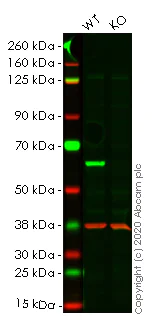
Western blot - Human CAT (Catalase) knockout HeLa cell lysate (AB256859)
Lane 1 : Wild-type HeLa cell lysate (20 μg)
Lane 2 : CAT knockout HeLa cell lysate (20 μg)
Lanes 1-2 : Merged signal (red and green). Green - ab209211 observed at 60 kDa. Red - loading control ab8245 observed at 37 kDa.
ab209211 Anti-Catalase antibody [EPR20198] was shown to specifically react with Catalase in wild-type HeLa cells. Loss of signal was observed when knockout cell line ab265250 (knockout cell lysate ab256859) was used. Wild-type and Catalase knockout samples were subjected to SDS-PAGE. ab209211 and Anti-GAPDH antibody [6C5] - Loading Control (ab8245) were incubated overnight at 4°C at 1 in 2000 and 1 in 20000 dilution respectively. Blots were developed with Goat anti-Rabbit IgG H&L (IRDye® 800CW) preadsorbed (ab216773) and Goat anti-Mouse IgG H&L (IRDye® 680RD) preadsorbed (ab216776) secondary antibodies at 1 in 20000 dilution for 1 hour at room temperature before imaging.
All lanes:
Western blot - Anti-Catalase antibody [EPR20198] - Peroxisome Marker (<a href='/products/primary-antibodies/catalase-antibody-epr20198-peroxisome-marker-ab209211'>ab209211</a>) at 1/2000 dilution
Lane 1:
Wild-type HeLa cell lysate at 20 µg
Lane 2:
CAT knockout HeLa cell lysate at 20 µg
Lane 2:
Western blot - Human CAT (Catalase) knockout HeLa cell line (<a href='/products/cell-lines/human-cat-catalase-knockout-hela-cell-line-ab265250'>ab265250</a>)
Predicted band size: 60 kDa
Observed band size: 60 kDa
false
- WB
Lab
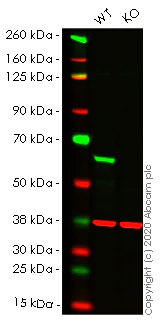
Western blot - Human CAT (Catalase) knockout HeLa cell lysate (AB256859)
Lane 1 : Wild-type HeLa cell lysate (20 μg)
Lane 2 : CAT knockout HeLa cell lysate (20 μg)
Lanes 1-2 : Merged signal (red and green). Green - ab76024 observed at 60 kDa. Red - loading control ab8245 observed at 37 kDa.
ab76024 Anti-Catalase antibody [EP1929Y] - Peroxisome Marker was shown to specifically react with Catalase in wild-type HeLa cells. Loss of signal was observed when knockout cell line ab265250 (knockout cell lysate ab256859) was used. Wild-type and Catalase knockout samples were subjected to SDS-PAGE. ab76024 and Anti-GAPDH antibody [6C5] - Loading Control (ab8245) were incubated overnight at 4°C at 1 in 10000 and 1 in 20000 dilution respectively. Blots were developed with Goat anti-Rabbit IgG H&L (IRDye® 800CW) preadsorbed (ab216773) and Goat anti-Mouse IgG H&L (IRDye® 680RD) preadsorbed (ab216776) secondary antibodies at 1 in 20000 dilution for 1 hour at room temperature before imaging.
All lanes:
Western blot - Anti-Catalase antibody [EP1929Y] - Peroxisome Marker (<a href='/products/primary-antibodies/catalase-antibody-ep1929y-peroxisome-marker-ab76024'>ab76024</a>) at 1/10000 dilution
Lane 1:
Wild-type HeLa cell lysate at 20 µg
Lane 2:
CAT knockout HeLa cell lysate at 20 µg
Lane 2:
Western blot - Human CAT (Catalase) knockout HeLa cell line (<a href='/products/cell-lines/human-cat-catalase-knockout-hela-cell-line-ab265250'>ab265250</a>)
Predicted band size: 60 kDa
Observed band size: 60 kDa
false

- Sanger seq
Unknown
Sanger Sequencing - Human CAT (Catalase) knockout HeLa cell lysate (AB256859)
Allele-1 : 4 bp deletion in exon1

- Sanger seq
Unknown
Sanger Sequencing - Human CAT (Catalase) knockout HeLa cell lysate (AB256859)
Allele-3 : Insertion of the selection cassette in exon1

- Sanger seq
Unknown
Sanger Sequencing - Human CAT (Catalase) knockout HeLa cell lysate (AB256859)
Allele-2 : 1 bp deletion in exon1
組合せ製品
Primary Antibodies
AB213511
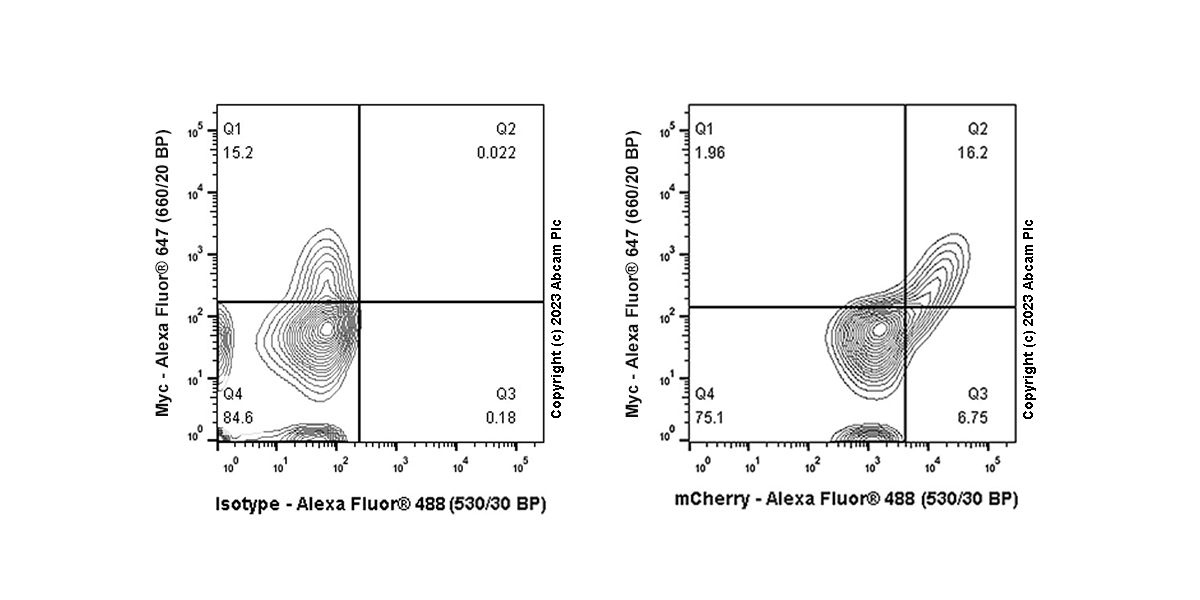
Anti-mCherry antibody [EPR20579]
20ul selling size|BOND RX™ Validated|RabMAb|Recombinant|Lab Essentials
- 4
- 6

Reactivity data
製品の詳細
Knockout cell lysate achieved by CRISPR/Cas9.
REACH authorisation
Abcam has not and does not intend to apply for the REACH Authorisation of customers' uses of products that contain European Authorisation list (Annex XIV) substances.
It is the responsibility of our customers to check the necessity of application of REACH Authorisation, and any other relevant authorisations, for their intended uses.
Lysate preparation: Our lysates are made using RIPA buffer to which we add a protease inhibitor cocktail and phosphatase inhibitor cocktail (ratio: 300:100:10). This means that the protein of interest is denatured. If you require a native form of the protein please use the live cell version. Please refer to our lysis protocol for further details on how our lysates are prepared.
User storage instructions: Lyophilizate may be stored at 4°C. After reconstitution, store at -20°C for short-term storage or -80°C for long-term storage.
This product is subject to limited use licenses from The Broad Institute, ERS Genomics Limited and Sigma-Aldrich Co. LLC, and is developed with patented technology. For full details of the licenses and patents please refer to our limited use license and patent pages.
製品内容
出荷温度及び保存条件
遺伝子名
遺伝子編集のタイプ
遺伝子編集の方法
ノックアウト検証方法
出荷温度
短期保存温度
長期保存温度
補足情報
This supplementary information is collated from multiple sources and compiled automatically.
Biological function summary
Catalase contributes to antioxidant defense by breaking down hydrogen peroxide preventing cellular damage. In peroxisomes it works alongside other peroxisomal enzymes to maintain cell health and metabolic regulation. Catalase does not form a complex but interacts closely with other enzymes like superoxide dismutase which dismutates superoxide radicals into less harmful substances. Increased Catalase activity levels can be measured using Catalase activity kits and activity assays allowing us to learn about peroxisome function.
Pathways
Hydrogen peroxide removal by Catalase is vital in the reactive oxygen species (ROS) metabolic process and plays a part in the cellular response to oxidative stress. Catalase interacts with the glutathione peroxidase pathway safeguarding cells from oxidative stress-related damage. Superoxide dismutase works synergistically with Catalase transforming superoxide anions into hydrogen peroxide before its decomposition by Catalase. These activities highlight the essential role Catalase plays in protecting cells from oxidative stress damage.
Quality control
STR analysis
CSF1PO, D13S317, D7S820, D5S818, TH01, D16S539, TPOX
Cell culture
Biosafety level
EU: 2 US: 2
Adherent/suspension
Adherent
Gender
Female
Abcam product promise
Please note: All products are 'FOR RESEARCH USE ONLY. NOT FOR USE IN DIAGNOSTIC OR THERAPEUTIC PROCEDURES'.
For licensing inquiries, please contact partnerships@abcam.com