Human RAB13 knockout HEK-293T cell line
Human RAB13 knockout HEK-293T cell line
- Advanced Validation
- 詳細を見る
Be the first to review this product! Submit a review
|
(0 Publication)
RAB13 KO cell line available to order. KO validated by Western blot. Free of charge wild type control available. Knockout achieved by using CRISPR/Cas9, Homozygous: 7 bp deletion in exon 1. To order both knockout and wild-type control cells: select '2 x 1000000 Cells/vial'. To order only knockout cells: select '1000000 Cells/vial'.
別名を表示する
RAB13, Ras-related protein Rab-13, Cell growth-inhibiting gene 4 protein, GIG4
- WB
Lab
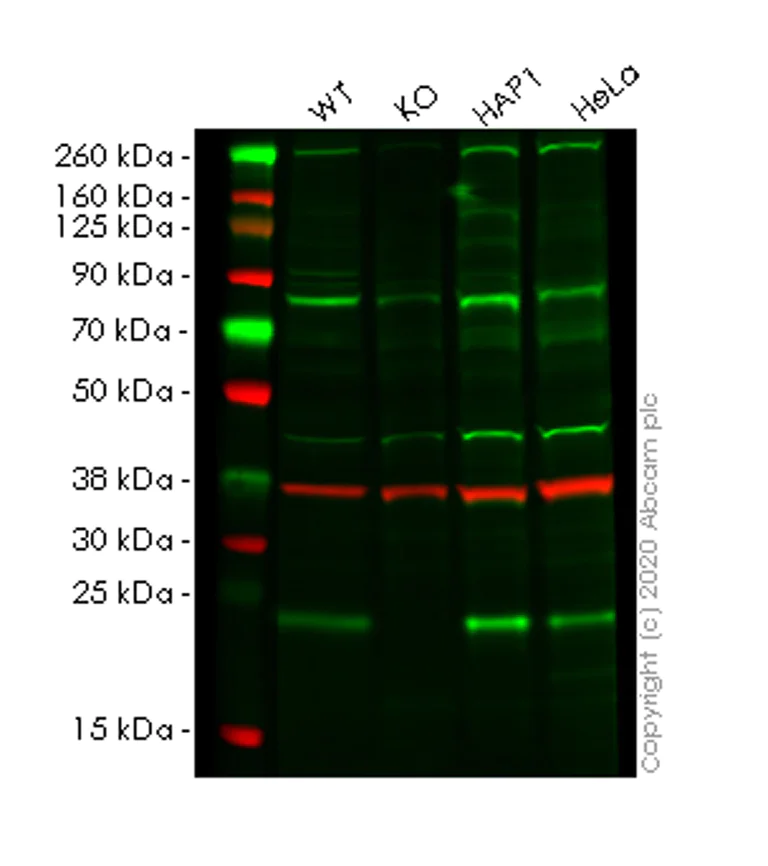
Western blot - Human RAB13 knockout HEK-293T cell line (AB266843)
Lanes 1-4 : Merged signal (red and green). Green - ab205528 observed at 24 kDa. Red - loading control ab8245 observed at 36 kDa.
ab205528 Anti-Rab13 antibody [EPR14110(2)] was shown to specifically react with Rab13 in wild-type HEK-293T cells. Loss of signal was observed when knockout cell line ab266843 (knockout cell lysate ab258159) was used. Wild-type and Rab13 knockout samples were subjected to SDS-PAGE. ab205528 and Anti-GAPDH antibody [6C5] - Loading Control (ab8245) were incubated overnight at 4° at 1 in 1000 dilution and 1 in 20000 dilution respectively. Blots were developed with Goat anti-Rabbit IgG H&L (IRDye® 800CW) preadsorbed (ab216773) and Goat anti-Mouse IgG H&L (IRDye® 680RD) preadsorbed (ab216776) secondary antibodies at 1 in 20000 dilution for 1 hour at room temperature before imaging.
All lanes:
Western blot - Anti-RAB13 antibody [EPR14110(2)] (<a href='/products/primary-antibodies/rab13-antibody-epr141102-ab205528'>ab205528</a>) at 1/1000 dilution
Lane 1:
Wild-type HEK-293T (Human epithelial cell line from embryonic kidney transformed with large T antigen) whole cell lysate at 20 µg
Lane 2:
Western blot - Human RAB13 knockout HEK-293T cell lysate (<a href='/products/cell-lysates/human-rab13-knockout-hek-293t-cell-lysate-ab258159'>ab258159</a>) at 20 µg
Lane 3:
HAP1 whole cell lyate at 20 µg
Lane 4:
HeLa (Human epithelial cell line from cervix adenocarcinoma) whole cell lysate at 20 µg
Secondary
All lanes:
Western blot - Goat anti-Rabbit IgG H&L (IRDye® 800CW) preadsorbed (<a href='/products/secondary-antibodies/goat-rabbit-igg-h-l-irdye-800cw-preadsorbed-ab216773'>ab216773</a>) at 1/10000 dilution
Predicted band size: 23 kDa
Observed band size: 24 kDa
false
- Cell Culture
Lab
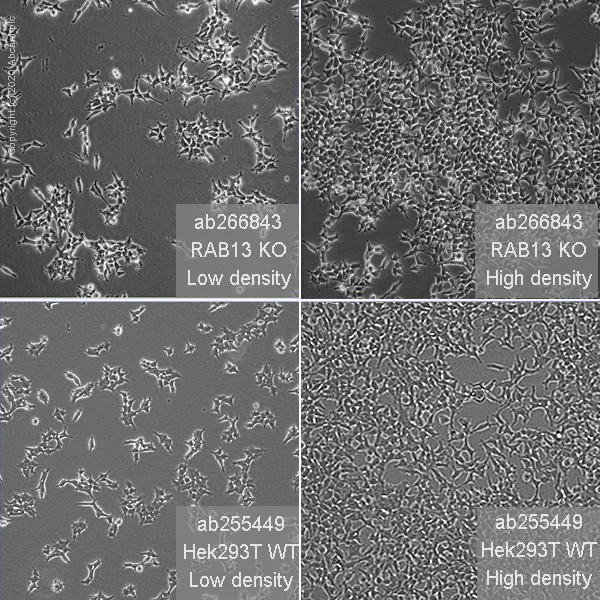
Cell Culture - Human RAB13 knockout HEK-293T cell line (AB266843)
Representative images RAB13 knockout HEK293T cells, low and high confluency examples (top left and right respectively) and wild-type HEK293T cells, low and high confluency (bottom left and right respectively) showing typical adherent, epithelial-like morphology. Images were captured at 10X magnification using a EVOS M5000 microscope.

- Sanger seq
Unknown
Sanger Sequencing - Human RAB13 knockout HEK-293T cell line (AB266843)
Homozygous : 7 bp deletion in exon1
組合せ製品
Primary Antibodies
AB76128
BOND RX™ Validated|20ul selling size|RabMAb|Recombinant

- 5
- 1
Primary Antibodies
AB151559
Anti-Tau (phospho T231) antibody [EPR2488]
BOND RX™ Validated|20ul selling size|RabMAb|Recombinant

- 5
- 6
Primary Antibodies
AB109390
Anti-Tau (phospho S396) antibody [EPR2731]
BOND RX™ Validated|20ul selling size|RabMAb|Recombinant

- 4
- 14
Primary Antibodies
AB210703
Anti-Tau (phospho S202 + T205) antibody [EPR20390]
20ul selling size|RabMAb|Recombinant|Trial Size

- 3
- 3
Reactivity data
製品の詳細
We will provide viable cells that proliferate on revival.
This product is subject to limited use licenses from The Broad Institute and ERS Genomics Limited, and is developed with patented technology. For full details of the limited use licenses and relevant patents please refer to our limited use license and patent pages.
製品内容
出荷温度及び保存条件
遺伝子名
遺伝子編集のタイプ
遺伝子編集の方法
ノックアウト検証方法
接合型
出荷温度
短期保存温度
長期保存温度
補足情報
This supplementary information is collated from multiple sources and compiled automatically.
Biological function summary
RAB13 influences cell surface dynamics by controlling the trafficking of proteins to the plasma membrane. It participates in forming complexes with other RAB proteins ensuring precise membrane delivery and recycling. As a result RAB13 assists in cell junction maintenance and tight junction stability enabling proper cell polarization and epithelial barrier function. This function is essential for processes like cell migration and tissue integrity.
Pathways
The role of RAB13 in intracellular trafficking links it to essential biological pathways such as the actin cytoskeleton regulation and the signaling of the epithelial-to-mesenchymal transition (EMT). In the actin regulation pathway RAB13 closely interacts with proteins like RHOA and CDC42 which assist in reorganizing the cytoskeleton essential for cell movement. For the EMT process RAB13 plays a part in modulating the cellular adherence and motility pathways which are critical during development and repair mechanisms.
Quality control
STR analysis
CSF1PO, D13S317, D7S820, D5S818, TH01, D16S539, TPOX
Cell culture
Biosafety level
EU: 2 US: 2
Adherent/suspension
Adherent
Gender
Female
初回取り扱いガイドライン
Upon arrival, the vial should be stored in liquid nitrogen vapor phase and not at -80°C. Storage at -80°C may result in loss of viability. <p>1. Thaw the vial in 37°C water bath for approximately 1-2 minutes.<br>2. Transfer the cell suspension (0.8 mL) to a 15 mL/50 mL conical sterile polypropylene centrifuge tube containing 8.4 mL pre-warmed culture medium, wash vial with an additional 0.8 mL culture medium (total volume 10 mL) to collect remaining cells, and centrifuge at 201 x g (rcf) for 5 minutes at room temperature. 10 mL represents minimum recommended dilution. 20 mL represents maximum recommended dilution.<br>3. Resuspend the cell pellet in 5 mL pre-warmed culture medium and count using a haemocytometer or alternative cell counting method seed all remaining cells into a T25.<br>4. Incubate the culture at 37°C incubator with 5% CO<sub>2</sub>. Check the culture one day after revival and continue to check until 80% confluent. Media change can be given if needed.<br>5. Once confluent passage into an appropriate flask at a density of 2x10<sup>4</sup> cells/cm<sup>2</sup>. Seeding density is given as a guide only and should be scaled to align with individual lab schedules. Cultures should be monitored daily.</p>
継代培養ガイドライン
- All seeding densities should be based on cell counts gained by established methods.
- A guide seeding density of 2x10⁴ cells/cm2 is recommended.
- Cells should be passaged when they have achieved 80-90% confluence.
培養培地
DMEM (High Glucose) + 10% FBS
凍結保存培地
Cell Freezing Medium-DMSO Serum free media, contains 8.7% DMSO in MEM supplemented with methyl cellulose.
ターゲットの情報
Abcam product promise
Please note: All products are 'FOR RESEARCH USE ONLY. NOT FOR USE IN DIAGNOSTIC OR THERAPEUTIC PROCEDURES'.
For licensing inquiries, please contact partnerships@abcam.com