Human LDLR (LDL Receptor) knockout HeLa cell line
Human LDLR (LDL Receptor) knockout HeLa cell line
- Advanced Validation
- 詳細を見る
Be the first to review this product! Submit a review
|
(0 Publication)
- WB
Lab
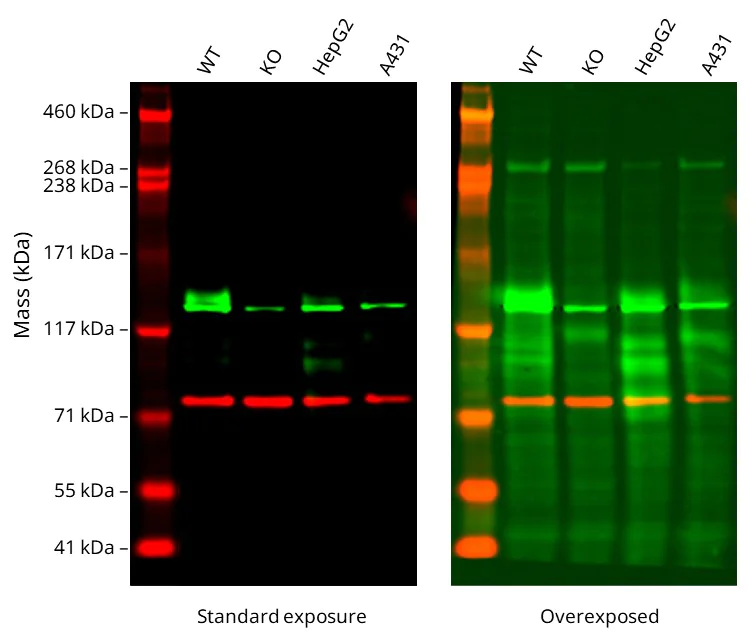
Western blot - Human LDLR (LDL Receptor) knockout HeLa cell line (AB273838)
Anti-LDLR antibody [EPR24874-56] (ab271189) staining at 1/1000 dilution, shown in green; Mouse anti-CANX [CANX/1543] (ab238078) loading control staining at 1/20000 dilution, shown in red. In Western blot, ab271189 was shown to bind specifically to LDLR. A band was observed at 120, 150 kDa in wild-type HeLa cell lysates with no signal observed at this size in LDLR CRISPR-Cas9 edited cell line ab273838 (CRISPR-Cas9 edited cell lysate ab273792). The band observed in the CRISPR-Cas9 edited lysate lane below 120, 150 kDa is likely to represent a possible truncated form of LDLR. This has not been investigated further and the functional properties of the gene product have not been determined. To generate this image, wild-type and LDLR CRISPR-Cas9 edited HeLa cell lysates were analysed. First, samples were run on an SDS-PAGE gel then transferred onto a nitrocellulose membrane. Membranes were blocked in 5 % milk in TBS-0.1 % Tween®20 (TBS-T) before incubation with primary antibodies overnight at 4 °C. Blots were washed four times in TBS-T, incubated with secondary antibodies for 1 h at room temperature, washed again four times then imaged. Secondary antibodies used were Goat anti-Rabbit IgG H&L 800CW and Goat anti-Mouse IgG H&L 680RD at 1/20000 dilution.
All lanes:
Western blot - Anti-LDL Receptor antibody [EPR24874-56] (<a href='/products/primary-antibodies/ldl-receptor-antibody-epr24874-56-ab271189'>ab271189</a>) at 1/1000 dilution
Lane 1:
Wild-type HeLa cell lysate at 20 µg
Lane 2:
LDLR CRISPR-Cas9 edited HeLa cell lysate at 20 µg
Lane 3:
HepG2 cell lysate at 20 µg
Lane 4:
A431 cell lysate at 20 µg
Secondary
All lanes:
Goat anti-Rabbit IgG H&L 800CW and Goat anti-Mouse IgG H&L 680RD at 1/20000 dilution
Predicted band size: 95 kDa
Observed band size: 120 kDa,150 kDa
false
- NGS
Supplier Data
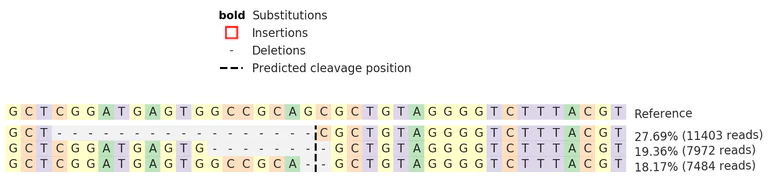
Next Generation Sequencing - Human LDLR (LDL Receptor) knockout HeLa cell line (AB273838)
Knockout achieved by CRISPR/Cas9; X = 17 bp deletion, 8 bp deletion, 2 bp deletion; Frameshift : 99%
組合せ製品

Primary Antibodies
AB52818
Anti-LDL Receptor antibody [EP1553Y]
20ul selling size|RabMAb|KO Validated|Recombinant
- 4
- 16

Reactivity data
製品の詳細
We will provide viable cells that proliferate on revival.
This product is subject to limited use licenses from The Broad Institute and ERS Genomics Limited, and is developed with patented technology. For full details of the limited use licenses and relevant patents please refer to our limited use license and patent pages.
製品内容
出荷温度及び保存条件
遺伝子名
遺伝子編集のタイプ
遺伝子編集の方法
ノックアウト検証方法
出荷温度
短期保存期間
短期保存温度
長期保存温度
補足情報
This supplementary information is collated from multiple sources and compiled automatically.
Biological function summary
The LDL receptor interacts with LDL particles to regulate cholesterol levels in the body. It is part of a cell surface complex that recognizes and binds to apolipoprotein B-100 or apolipoprotein E present on LDL. This interaction initiates internalization of LDL leading to its degradation in lysosomes where cholesterol can be released and used by the cell. Mutations in the gene encoding LDLR can lead to inefficient cholesterol uptake influencing various metabolic processes.
Pathways
LDL receptor activities are integral to lipid metabolism and cholesterol homeostasis. Two important biological pathways that involve LDLR include the cholesterol biosynthesis pathway and the lipoprotein clearance pathway. Within these pathways LDLR collaborates closely with proteins like PCSK9 which modulates its expression and degradation and HMG-CoA reductase an important enzyme in cholesterol synthesis to balance cholesterol levels in the body.
Quality control
STR analysis
CSF1PO, D13S317, D7S820, D5S818, TH01, D16S539, TPOX
Cell culture
Biosafety level
EU: 2 US: 2
Adherent/suspension
Adherent
Gender
Female
初回取り扱いガイドライン
Upon arrival, the vial should be stored in liquid nitrogen vapor phase and not at -80°C. Storage at -80°C may result in loss of viability. <p>1. Thaw the vial in 37°C water bath for approximately 1-2 minutes.<br>2. Transfer the cell suspension (0.8 mL) to a 15 mL/50 mL conical sterile polypropylene centrifuge tube containing 8.4 mL pre-warmed culture medium, wash vial with an additional 0.8 mL culture medium (total volume 10 mL) to collect remaining cells, and centrifuge at 201 x g (rcf) for 5 minutes at room temperature. 10 mL represents minimum recommended dilution. 20 mL represents maximum recommended dilution.<br>3. Resuspend the cell pellet in 5 mL pre-warmed culture medium and count using a haemocytometer or alternative cell counting method seed all remaining cells into a T25.<br>4. Incubate the culture at 37°C incubator with 5% CO<sub>2</sub>. Check the culture one day after revival and continue to check until 80% confluent. Media change can be given if needed.<br>5. Once confluent passage into an appropriate flask at a density of 2x10<sup>4</sup> cells/cm<sup>2</sup>. Seeding density is given as a guide only and should be scaled to align with individual lab schedules. Cultures should be monitored daily.</p>
継代培養ガイドライン
- All seeding densities should be based on cell counts gained by established methods.
- A guide seeding density of 2x10⁴ cells/cm2 is recommended.
- Cells should be passaged when they have achieved 80-90% confluence.
培養培地
DMEM (High Glucose) + 10% FBS
凍結保存培地
Cell Freezing Medium-DMSO Serum free media, contains 8.7% DMSO in MEM supplemented with methyl cellulose.
Abcam product promise
Please note: All products are 'FOR RESEARCH USE ONLY. NOT FOR USE IN DIAGNOSTIC OR THERAPEUTIC PROCEDURES'.
For licensing inquiries, please contact partnerships@abcam.com