Human ATP1B3 knockout A549 cell line
Human ATP1B3 knockout A549 cell line
Be the first to review this product! Submit a review
|
(0 Publication)
ATP1B3 KO cell line available to order. KO validated by Next Generation Sequencing. Free of charge wild type control available. To order both knockout and wild-type control cells: select '2 x 1000000 Cells/vial'. To order only knockout cells: select '1000000 Cells/vial'.
別名を表示する
ATPB-3, CD298, Sodium/potassium-transporting ATPase subunit beta-3, ATP1B3, Sodium/potassium-dependent ATPase subunit beta-3
- Mass Spec
Lab
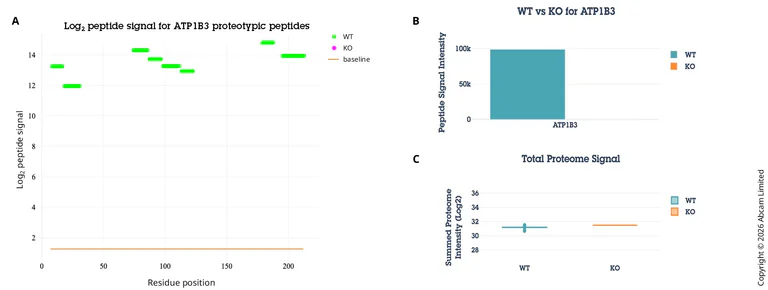
Mass Spectrometry - Human ATP1B3 knockout A549 cell line (AB300855)
Mass spectrometry of wild-type and knockout ATP1B3 A549 (ab300855) cell lysates.
A) Peptide signal intensities are mapped to their position in the protein sequence. Wild-type peptide intensity (green) represents the median of two wild-type and 45 unrelated A549 knockout cell lines, excluding zero values. Across these 47 samples, 91% of values were non-zero, showing good coverage of the protein. No proteotypic peptides for ATP1B3 were detected in the knockout ATP1B3 A549 sample (magenta). The baseline (orange) shows 80% of the smallest peptide intensity, excluding zero.
B) Comparison of ATP1B3 proteotypic peptide signal intensity between wild-type (blue) and ATP1B3 knockout A549 (orange).
C) Total proteome signal, showing the sum of log2 peptide intensities of all proteins. Wild-type (blue) displays the average and variability of the 2 wild-type and 45 unrelated knockout A549 cell lines for comparison with ATP1B3 knockout A549 (orange).
- NGS
Lab
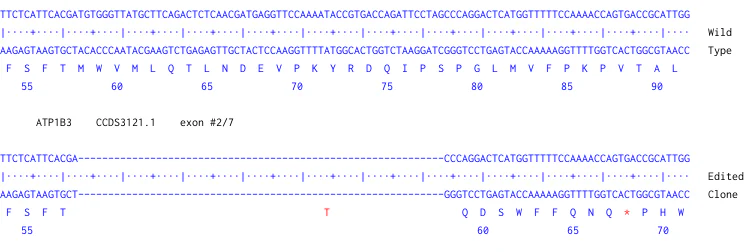
Next Generation Sequencing - Human ATP1B3 knockout A549 cell line (AB300855)
61 bp deletion after Thr56
- NGS
Lab
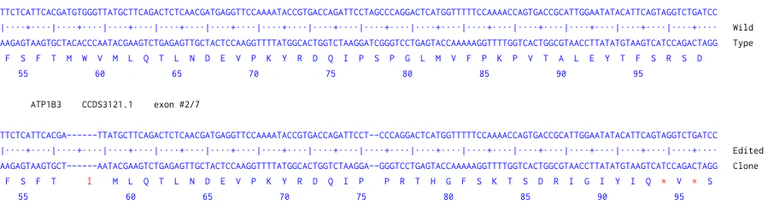
Next Generation Sequencing - Human ATP1B3 knockout A549 cell line (AB300855)
6 bp deletion after Thr 57 (maintains frame) and 2bp deletion after P77
組合せ製品

Reactivity data
製品の詳細
Although we aim to provide customers with a homozygous clone, feasibility will be dependent on the biology of the protein. Should only heterozygous edits be achieved, you will be notified of the outcome and be asked to confirm whether the cell line is acceptable. All clones will be accompanied with DNA sequencing data, and the mutation description.
Recommended control: Human wild-type A549 cell line (ab288558). Please note a wild-type cell line is not automatically included with a knockout cell line order, if required please add recommended wild-type cell line at no additional cost using the code WILDTYPE-TMTK1.
We will provide viable cells that proliferate on revival.
This product is subject to limited use licenses from The Broad Institute and ERS Genomics Limited, and is developed with patented technology. For full details of the limited use licenses and relevant patents please refer to our limited use license and patent pages.
製品内容
出荷温度及び保存条件
遺伝子名
遺伝子編集のタイプ
遺伝子編集の方法
ノックアウト検証方法
出荷温度
短期保存温度
長期保存温度
補足情報
This supplementary information is collated from multiple sources and compiled automatically.
Biological function summary
ATP1B3 supports the proper functioning of the Na+/K+ ATPase by influencing the conformation and activity of the enzyme complex. The protein ensures that the ion gradients needed for basic cellular activities such as electrical excitability and nutrient uptake are preserved. It along with alpha subunits forms heterodimeric complexes required for ion exchange. Its presence ensures that the complex works effectively supporting various physiological functions across multiple organ systems.
Pathways
It aligns with the ion transport and signal transduction pathways related to maintaining cellular homeostasis. ATP1B3 interacts with other proteins like the alpha-1 subunit of the Na+/K+ ATPase important for regulating membrane potentials. The protein plays a role in the Wnt signaling pathway influencing processes such as cell proliferation and migration. Understanding ATP1B3 in these pathways helps unveil its broad functional implications.
Cell culture
Biosafety level
EU: 1 US: 1
Adherent/suspension
Adherent
Gender
Male
初回取り扱いガイドライン
Upon arrival, the vial should be stored in liquid nitrogen vapor phase and not at -80°C. Storage at -80°C may result in loss of viability. <p>1. Thaw the vial in 37°C water bath for approximately 1-2 minutes.<br>2. Transfer the cell suspension (0.8 mL) to a 15 mL/50 mL conical sterile polypropylene centrifuge tube containing 8.4 mL pre-warmed culture medium, wash vial with an additional 0.8 mL culture medium (total volume 10 mL) to collect remaining cells, and centrifuge at 201 x g (rcf) for 5 minutes at room temperature. 10 mL represents minimum recommended dilution. 20 mL represents maximum recommended dilution.<br>3. Resuspend the cell pellet in 5 mL pre-warmed culture medium and count using a haemocytometer or alternative cell counting method seed all remaining cells into a T25.<br>4. Incubate the culture at 37°C incubator with 5% CO<sub>2</sub>. Check the culture one day after revival and continue to check until 80% confluent. Media change can be given if needed.<br>5. Once confluent passage into an appropriate flask at a density of 2x10<sup>4</sup> cells/cm<sup>2</sup>. Seeding density is given as a guide only and should be scaled to align with individual lab schedules. Cultures should be monitored daily.</p>
継代培養ガイドライン
- All seeding densities should be based on cell counts gained by established methods.
- A guide seeding density of 2x10⁴ cells/cm2 is recommended.
- Cells should be passaged when they have achieved 80-90% confluence.
- Do not allow the cell density to exceed 7x10⁴ cells/cm2.
培養培地
F-12K + 10% FBS
凍結保存培地
Cell Freezing Medium-DMSO Serum free media, contains 8.7% DMSO in MEM supplemented with methyl cellulose.
Abcam product promise
Please note: All products are 'FOR RESEARCH USE ONLY. NOT FOR USE IN DIAGNOSTIC OR THERAPEUTIC PROCEDURES'.
For licensing inquiries, please contact partnerships@abcam.com