TUNEL Assay Kit - HRP-DAB
TUNEL Assay Kit - HRP-DAB
4
(3 Reviews)
|
(285 Publications)
- Cited in over 200 publications
- IHC
PubMed
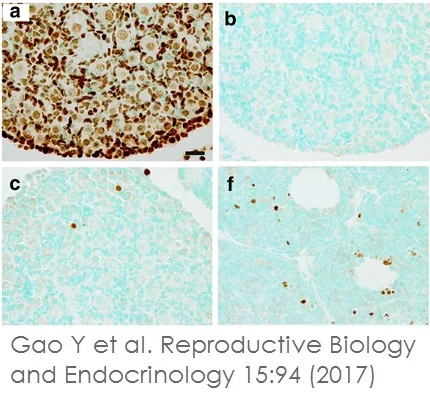
Immunohistochemistry - TUNEL Assay Kit - HRP-DAB (AB206386)
TUNEL assay staining.
Gao Y et al used In situ Apoptosis Detection Kit / TUNEL assay ab206386 to analyze tissue sections from mouse ovaries.
a. Section treated with DNase I as positive control
b. Negative control without TdT enzyme
c and f. representative experimental images.
Nuclei stained with the TUNEL assay are brown. Sections were counter-stained with Methyl Green.
Gao Y et al. Reproductive Biology and Endocrinology 15:94 (2017) Reproduced under the Creative Commons license https://creativecommons.org/licenses/by/4.0/
- ICC
Supplier Data
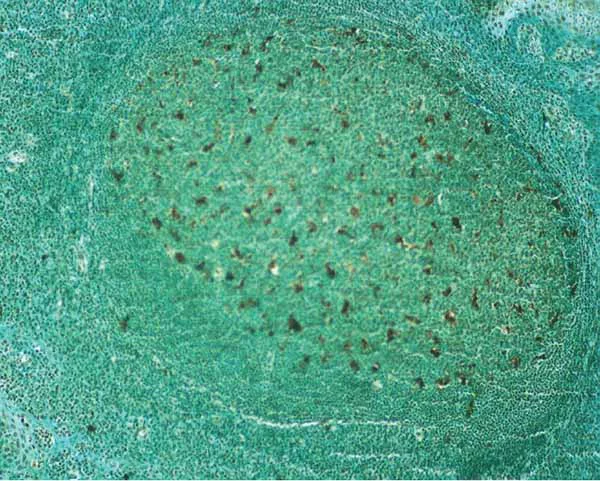
Immunocytochemistry - TUNEL Assay Kit - HRP-DAB (AB206386)
Using paraffin fixed human tonsil tissue, 10 μm sections (1000X)
- IHC
Supplier Data
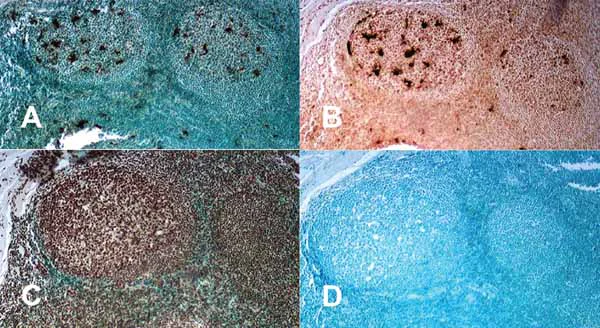
Immunohistochemistry - TUNEL Assay Kit - HRP-DAB (AB206386)
Using paraffin fixed human tonsil tissue,10 μm sections (1000X). A] Section processed and counter-stained with methyl green according to the manual. B] Counter-stain step was eliminated to more clearly illustrate the level of positive staining in the germinal centres of tonsil tissue. C] Section treated with DNase I in order to generate a positive control slide. Note all nuclei stain positive. The use of DNase I generates free 3'-OH groups on cellular DNA, these free 3'-OH groups are then labelled with biotin-nucleotide by the TdT in the kit. D] Negative control, the TdT enzyme step was eliminated thereby generating a negative slide.
組合せ製品


製品の詳細
TUNEL Assay Kit ab206386 is used to detect DNA fragmentation, such as in apoptosis. TUNEL assay kits are sometimes also called In Situ Cell Death Detection Kits.
How the TUNEL assay works
The TUNEL assay exploits the fact that apoptotic endonucleases not only affect cellular DNA by producing the classical DNA ladder, but also generate free 3’-OH groups at the ends of these DNA fragments. These free 3’-OH groups are end-labeled in the TUNEL assay allowing for the detection of apoptotic cells using a molecular biology-based, end labeling technique.
The TUNEL assays uses terminal deoxynucleotidyl transferase (TdT) to catalyze the incorporation of deoxynucleotides at the free 3'-hydroxyl ends of fragmented DNA. The deoxynucleotides are then labeled in a variety of ways for detection of the degree of DNA fragmentation.
TUNEL assay protocol summary
In this TUNEL assay protocol:
- - Terminal deoxynucleotidyl Transferase (TdT) binds to exposed 3'-OH ends of DNA fragments generated in response to apoptotic signals and catalyzes the addition of biotin-labeled deoxynucleotides.
- - Biotinylated nucleotides are bound with a streptavidin-horseradish peroxidase (HRP) conjugate.
- - Diaminobenzidine (DAB) reacts with the HRP labeled sample to generate an insoluble colored (brown) substrate at the site of DNA fragmentation.
- - Counterstaining with methyl green aids in the evaluation of normal and apoptotic cells.
Related TUNEL assay products
This kit is designed for chromogenic TUNEL staining with HRP and DAB. To use FITC (Ex/Em = 495/519 nm) as a label, we recommend ab66108 . To use BrdU-Red (Ex/Em = 488/576nm) as a label, we recommend ab66110.
How other researchers are using TUNEL assay kit ab206386
This TUNEL assay kit has been cited in several publications in a variety of sample types, including:
- - Human: Precision-cut intestinal slices (hPCIS)1 (paraffin-embedded sections), human gastric cancer cell culture2 (single cell suspension)
- - Mouse: abdominal aortic aneurysm lesion3, thyroid gland4, lung5, heart6, pancreas7, ovary8, skin9, liver10 (paraffin-embedded sections), brain11 (frozen sections)
- - Rat: heart12, brain13 (paraffin-embedded sections)
- - Other: human xenograft tumours in mice14, tissue from nude mice injected with human pancreatic cancer cell line 15, pig heart16 (paraffin-embedded sections)
References: 1- PMID: 35428896; 2- PMID: 34440988; 3- PMID: 30651000; 4- PMID: 30952933; 5- PMID: 40084179; 6- PMID: 31886717; 7- PMID: 36458554; 8- PMID: 29379893, PMID: 39469582; 9- PMID: 33690222; 10- PMID: 36911196; PMID: 35970323; PMID: 35763355; 11- PMID: 34518549; 12- PMID: 34543287; PMID: 32536996; 13- PMID: 38413663; 14- PMID: 35265825; 15- PMID: 30755605; 16- PMID: 32784904
製品内容
出荷温度及び保存条件
出荷温度
短期保存温度
長期保存温度
保管に関する情報
製品プロトコール
- Visit the General protocols
- Visit the Troubleshooting
- Download websiteProtocolBooklet|en
This is a protocol summary; please use the downloadable protocol booklet for full instructions.
TUNEL assay protocol for HRP-DAB TUNEL staining
Use for paraffin-embedded tissue sections, frozen tissue sections, or cell preparations.
Notes
- to contain small reagent volumes, encircle specimens using a hydrophobic slide marker
- after most protocol steps carefully remove excess liquid and dry around the specimen
- pulse-spin reagents in a microcentrifuge prior to opening
- during TdT enzyme labelling, ensure temperature is >22 ºC and use a humidified chamber (for example place slides on moist paper towel and then cover)
- warm the Stop Buffer to 37ºC before use to remove precipitate
- keep enzymes and enzyme reagent mixes on ice
- 100 μL of solution is generally enough to cover a specimen on a slide
- always prepare fresh DAB working solution from the 2 reagents, just before use
- to avoid loss of sample from glass slides during washing steps, dip slides 2-3 times into TBS instead of rinsing with a wash bottle
- do not let the specimen dry out during or between any steps. If necessary, cover or immerse the specimen in TBS.
Paraffin embedded tissue sections
Rehydrate slides in xylene, and decreasing ethanol (100%,90%,80%,70%), and then TBS.
Permeabilize tissue by incubation for 20mins with Proteinase K, then wash with TBS. (Incubate frozen sections for 10mins and cell preps for 5mins.)
Quench and inactivate endogenous peroxidases by incubation in 3% H2O2 in methanol for 5 min, then wash with TBS.
Equilibrate with TdT Equilibration Buffer for 30 minutes.
For labelling, incubate with TdT enzyme mix for 1.5 hours, using a coverslip to prevent drying.
To terminate labeling, submerge the slide in TBS and allow the coverslip to slide off, wash with TBS, incubate with stop buffer for 5 min, and wash again with TBS.
Block with Blocking Buffer for 10 min, and then incubate with Conjugate in blocking buffer for 30 min (use a humidified chamber), then wash with TBS.
Incubate in DAB working solution for 15 min, counterstain with Methyl Green solution for 1-3 min.
Finally dehydrate slides in 100% ethanol and xylene, and mount with organic mounting media.
Frozen tissue sections and cell preparations
Fix slides with frozen tissue sections in 4% formaldehyde in PBS for 15 minutes, and wash in TBS.
Fix cell preparations in 4% formaldehyde in PBS at 10^6 cells/mL for 10 minutes. Then pellet cells and re-suspend in 80% ethanol. Air-dry cells onto glass slides or use a cyto-spin. Rehydrate in TBS for 15 mins.
Then follow protocol for paraffin embedded sections.
Analysis
Apoptosis is represented by a dark brown (DAB) signal in light microscopy. Lighter shades of brown and/or shades of blue-green to green—brown indicate a nonreactive/negative cell.
For a positive control, fragment DNA in a specimen by generating free 3’OH groups identical to those generated during apoptosis, through treatment with DNase I.
For a negative control, omit the TdT enzyme in the reaction mix.
ターゲットの情報
文献 (285)
Recent publications for all applications. Explore the full list and refine your search
Molecular therapy : the journal of the American Society of Gene Therapy 34:4621-4634 PubMed42198846
2026
Applications
Unspecified application
Species
Unspecified reactive species
Cell death & disease 16:490 PubMed40610400
2025
Applications
Unspecified application
Species
Unspecified reactive species
European journal of medical research 30:567 PubMed40611188
2025
Applications
Unspecified application
Species
Unspecified reactive species
International journal of molecular sciences 26: PubMed40429699
2025
Applications
Unspecified application
Species
Unspecified reactive species
Cardiovascular diabetology 24:223 PubMed40399937
2025
Applications
Unspecified application
Species
Unspecified reactive species
Annals of surgical oncology 32:6050-6057 PubMed40279057
2025
Applications
Unspecified application
Species
Unspecified reactive species
Communications biology 8:622 PubMed40247121
2025
Applications
Unspecified application
Species
Unspecified reactive species
Science advances 11:eadp8093 PubMed40215293
2025
Applications
Unspecified application
Species
Unspecified reactive species
Life (Basel, Switzerland) 15: PubMed40141806
2025
Applications
Unspecified application
Species
Unspecified reactive species
Frontiers in physiology 16:1513703 PubMed40084179
2025
Applications
Unspecified application
Species
Unspecified reactive species
Abcam product promise
Please note: All products are 'FOR RESEARCH USE ONLY. NOT FOR USE IN DIAGNOSTIC OR THERAPEUTIC PROCEDURES'.
For licensing inquiries, please contact partnerships@abcam.com