Reticulum Stain Kit (Connective Tissue Stain)
Reticulum Stain Kit (Connective Tissue Stain)
Be the first to review this product! Submit a review
|
(4 Publications)
- Staining
Supplier Data
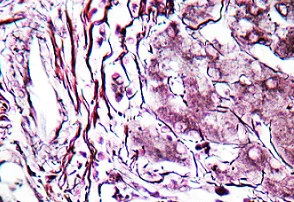
Staining - Reticulum Stain Kit (Connective Tissue Stain) (AB150684)
Staining in Liver using ab150684 - Reticulum Stain Kit.
組合せ製品



製品の詳細
The Reticulum Stain Kit (Connective Tissue Stain) is intended for use in histological demonstration of reticular fibers. The main function of reticular fibers is to provide support. They are normally found throughout the body, particularly in liver, lymph node, spleen and kidney. Ammoniacal silver stains are the most commonly used methods for demonstration of reticular fibers.
Other products for staining tissue sections
Find more kits and reagents in the special stains guide, or products for antigen retrieval, blocking, signal amplification, visualization, counterstaining, and mounting in the IHC kits and reagents guide.
Staining Interpretation
| Reticulum | Black |
| Nuclei | Red |
Control Tissue: Liver, Kidney, Lymph Node, Spleen
製品内容
出荷温度及び保存条件
出荷温度
短期保存温度
長期保存温度
保管に関する情報
補足情報
This supplementary information is collated from multiple sources and compiled automatically.
Biological function summary
The structural framework provided by reticular fibers supports cellular organization in connective tissue environments. These fibers often associate with other extracellular matrix components such as glycoproteins and proteoglycans to form a complex that enhances the maintenance and resilience of connective tissue. They play an important role in filtering bodily fluids due to presence in lymphoid tissues like the spleen and lymph nodes where they aid in trapping particulates and pathogens.
Pathways
Type III collagen in reticular fibers functions within the complex processes of tissue organization and repair. Specifically they are part of the extracellular matrix pathway which includes interactions with other collagens and matrix metalloproteinases. Another related pathway is the wound healing pathway where type III collagen collaborates with fibronectin and type I collagen to facilitate tissue repair and regeneration.
ターゲットの情報
文献 (4)
Recent publications for all applications. Explore the full list and refine your search
Cancers 13: PubMed34203215
2021
Applications
Unspecified application
Species
Unspecified reactive species
Cells 10: PubMed33801626
2021
Applications
Unspecified application
Species
Unspecified reactive species
Cell reports 31:107475 PubMed32268085
2020
Applications
Unspecified application
Species
Unspecified reactive species
Journal of the Endocrine Society 3:181-200 PubMed30620005
2019
Applications
Unspecified application
Species
Unspecified reactive species
Abcam product promise
Please note: All products are 'FOR RESEARCH USE ONLY. NOT FOR USE IN DIAGNOSTIC OR THERAPEUTIC PROCEDURES'.
For licensing inquiries, please contact partnerships@abcam.com