Phenolic Compounds Assay Kit (Colorimetric)
Phenolic Compounds Assay Kit (Colorimetric)
Be the first to review this product! Submit a review
|
(2 Publications)
- FuncS
Supplier Data
Functional Studies - Phenolic Compounds Assay Kit (Colorimetric) (AB273293)
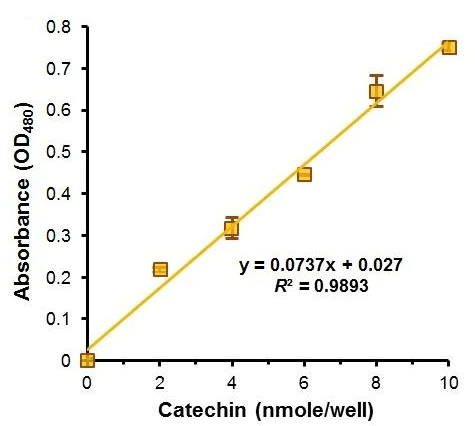
Catechin standard curve.
Typical standard curve – data provided for demonstration purposes only. A new standard curve must be generated for each assay performed.
- FuncS
Supplier Data
Functional Studies - Phenolic Compounds Assay Kit (Colorimetric) (AB273293)
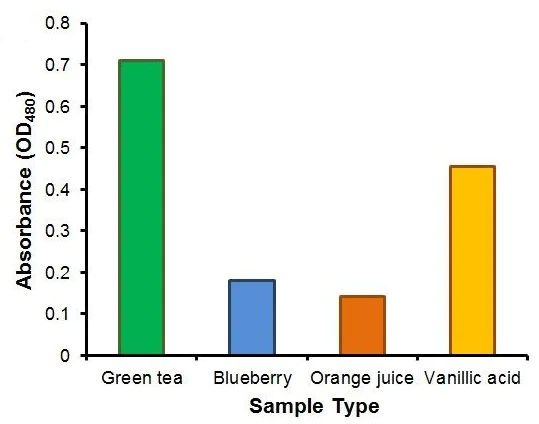
Absorbance readings for green tea, blueberries, orange juice and vanillic acid positive control.
Absorbance readings for 50 μL diluted solutions of green tea (brewed for 5 minutes and diluted 1 : 20 fold with ddH2O), blueberry methanolic extract (extract made from 50 mg of freeze-dried blueberries in 5 mL of MeOH/ddH2O/HCl extraction solvent and diluted 1 : 5 fold with ddH2O), orange juice (centrifuged to remove pulp and supernatant used without dilution) and 50 μL positive control (vanillic acid 50 mM solution).
- FuncS
Supplier Data
Functional Studies - Phenolic Compounds Assay Kit (Colorimetric) (AB273293)
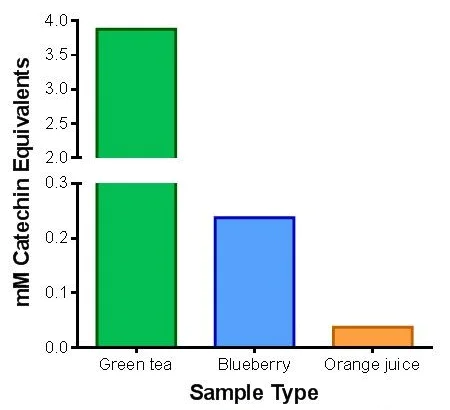
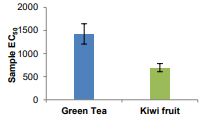
Catechin equivalents (in mM) of green tea, blueberries and orange juice.
Catechin equivalency is defined as nmoles of phenolic compounds per μl of solution, equivalent to nmoles of catechin per μl of solution, as calculated from the Catechin Standard curve. Assays were performed following the kit protocol.
組合せ製品

製品の詳細
Phenolic Compounds Assay Kit (Colorimetric) (ab273293) provides a quick, sensitive and selective method for measuring the total amount of phenolic compounds in various biological samples. In this assay, phenolic compounds couple with diazonium salts under alkaline conditions to form a stable diazo chromophore, detectable by absorbance at 480 nm. Unlike the classical Folin-Ciocalteu (FC) protocol for measuring phenolic compounds, our assay is not affected by non-phenolic reducing substances such as sulfites, reducing sugars or ascorbic acid. The assay is high-throughput adaptable and can detect concentrations of phenolic compounds as low as 0.02 mM catechin equivalents (CEs) from a variety of plant and food-based samples.
Other Notes
This product was previously called K527 Biovision Phenolic Compounds Assay Kit (Colorimetric). Biovision was acquired by Abcam in 2021.
The Safety Datasheet for this product has been updated for certain countries. Please check the current version in the Support and downloads section.
製品内容
出荷温度及び保存条件
出荷温度
短期保存温度
長期保存温度
保管に関する情報
補足情報
This supplementary information is collated from multiple sources and compiled automatically.
Biological function summary
Phenolic compounds contribute significantly to the plant defense system. They act as antioxidants neutralizing free radicals and reducing oxidative stress. This antioxidative function is important in protecting cells from oxidative damage. Phenolic compounds such as flavonoids and tannins usually operate within complexes interacting with proteins and other biomolecules to strengthen plant defenses. These interactions affect various biological functions from growth regulation to response against pathogens.
Pathways
Phenolic compounds participate actively in the shikimic acid and phenylpropanoid pathways. The shikimic acid pathway is essential for producing aromatic amino acids serving as precursors for diverse phenolic compounds. The phenylpropanoid pathway branches into the flavonoid biosynthesis pathway which generates compounds involved in UV protection and pigmentation. These pathways also feature enzymes like phenylalanine ammonia-lyase which transforms phenylalanine into trans-cinnamic acid a critical phenolic compound precursor.
ターゲットの情報
文献 (2)
Recent publications for all applications. Explore the full list and refine your search
Frontiers in genetics 15:1505839 PubMed39845189
2025
Applications
Unspecified application
Species
Unspecified reactive species
Antioxidants (Basel, Switzerland) 13: PubMed39594422
2024
Applications
Unspecified application
Species
Unspecified reactive species
Abcam product promise
Please note: All products are 'FOR RESEARCH USE ONLY. NOT FOR USE IN DIAGNOSTIC OR THERAPEUTIC PROCEDURES'.
For licensing inquiries, please contact partnerships@abcam.com