JavaScript is disabled in your browser. Please enable JavaScript to view this website.
AB236208

LDL Uptake Assay Kit (Flow cytometry)

LDL Uptake Assay Kit (Flow cytometry)

Be the first to review this product! Submit a review

|

(3 Publications)
The LDL Uptake Assay Kit (Flow cytometry) (ab236208) employs human LDL conjugated to DyLightTM 488 as a convenient tool for studying the uptake of LDL in cultured cells.
2 Images
Functional Studies - LDL Uptake Assay Kit (Flow cytometry) (AB236208)
  • FuncS

Supplier Data

Functional Studies - LDL Uptake Assay Kit (Flow cytometry) (AB236208)

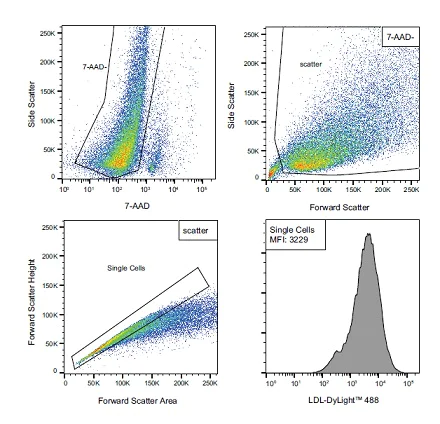
Example flow cytometric analysis.

HepG2 cells were plated at 2 x 10⁵ cells/well in a 24 well plate approximately 48 hours before addition of LDL-DyLightTM 488. After a four hour incubation with the LDL probe, cells were trypsinized, washed and stained with 7-AAD prior to flow cytometry. In this example analysis, after digital compensation, 7-AAD negative live cells are gated first, followed by scatter. Single cells are gated using an area versus height dot plot, and the geometric mean fluorescence intensity (MFI) of the resulting cells in the LDL-DyLightTM 488 channel is determined.
Functional Studies - LDL Uptake Assay Kit (Flow cytometry) (AB236208)
  • FuncS

Supplier Data

Functional Studies - LDL Uptake Assay Kit (Flow cytometry) (AB236208)

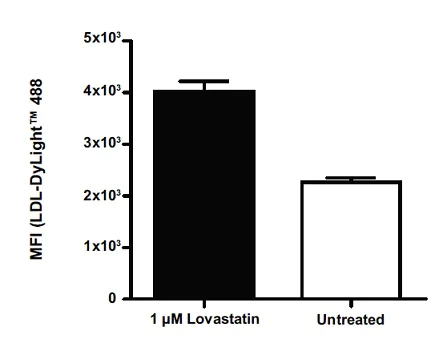
Lovastatin increases uptake of LDL.

HepG2 cells were plated at 2 x 10⁵ cells/well in a 24 well plate and allowed to adhere overnight, before being treated with 1 μM Lovastatin or left untreated for 24 hours in MEM + 2% FBS. The final four hours of treatment included the probe LDL-DyLightTM 488. Cells were processed as described in the kit booklet and the flow cytometric data were analyzed as described in Figure 1. Average geometric mean fluorescence intestities (MFI) for each group are plotted.

Key facts

検出方法

Flow cytometry-fluorescent

サンプルタイプ

Adherent cells

アッセイプラットフォーム

Flow cytometer

製品の詳細

The LDL Uptake Assay Kit (Flow cytometry) (ab236208) employs human LDL conjugated to DyLightTM 488 as a convenient tool for studying the uptake of LDL in cultured cells. Flow cytometry provides the advantage of assessing the uptake of LDL at the single-cell level. In addition, multiplexing with other markers, such as LDLR expression, is possible to gain more information from a single experiment. The reagents provided in this kit are sufficient to test 48 samples by flow cytometry.

製品内容

{ "values": { "1x48Tests": { "sellingSize": "1 x 48 Tests", "publicAssetCode":"ab236208-1x48Tests", "assetComponentDetails": [ { "size":"1 x 1 Tablet", "name":"Cell-Based Assay Buffer Tablet", "number":"AB236208-CMP02", "productcode":"" }, { "size":"1 x 120 µL", "name":"LDL-DyLightTM 488 Assay Reagent", "number":"AB236208-CMP03", "productcode":"" }, { "size":"1 x 50 µL", "name":"Cell-Based Assay 7-AAD Staining Stock Solution (1000X)", "number":"AB236208-CMP01", "productcode":"" }, { "size":"1 x 0.1 mg", "name":"Lovastatin Control", "number":"AB236208-CMP04", "productcode":"" } ] } } }

出荷温度及び保存条件

出荷温度
Blue Ice
短期保存温度
+4°C
長期保存温度
Multi
保管に関する情報
Please refer to protocols

補足情報

This supplementary information is collated from multiple sources and compiled automatically.

Low-density lipoprotein often referred to as LDL or "bad cholesterol" serves as a carrier for lipids in the bloodstream. LDL particles are spherical and contain an apolipoprotein B-100 shell with a core mostly filled with cholesterol esters. It has an approximate molecular weight of 2536 kDa. LDL is mainly expressed in the liver where it is released into the circulation to deliver cholesterol to various tissues. It is an essential component that transports cholesterol and other lipids through the body for structural and metabolic functions.
Biological function summary

LDL plays an important role by supplying cholesterol to cells which is critical for membrane structure and hormone synthesis. LDL binds to specific receptors on the cell surface prompting its cellular uptake through the LDL uptake assay mechanisms including receptor-mediated endocytosis. This process involves the LDL protein engaging with a receptor complex facilitating the internalization of cholesterol for cell usage or storage. Native LDL can be distinguished from oxidized forms which have different roles in health and disease.

Pathways

LDL is vital in cholesterol homeostasis and lipid metabolism pathways. One notable pathway includes its interaction in the mevalonate pathway essential for cholesterol biosynthesis. The interaction with the insulin signaling pathway also highlights the significance of LDL in energy homeostasis. Related proteins such as high-density lipoprotein (HDL) and very low-density lipoprotein (VLDL) work in tandem with LDL forming a complex system for managing lipid transport and affecting cholesterol levels.

LDL is closely associated with atherosclerosis and cardiovascular disease. High LDL levels lead to cholesterol accumulation in arterial walls promoting the formation of plaques and increasing the risk of heart disease. Apolipoprotein B-100 part of the LDL structure is often investigated in the context of these diseases because it mediates LDL's attachment to arterial walls. Understanding LDL's relationship with these disorders highlights the importance of controlling its levels through medical and lifestyle interventions therefore minimizing disease risk.

製品プロトコール

ターゲットの情報

文献 (3)

Recent publications for all applications. Explore the full list and refine your search

Scientific reports 13:19725 PubMed37957262

2023

Induced alternative splicing an opportunity to study PCSK9 protein isoforms at physiologically relevant concentrations.

Applications

Unspecified application

Species

Unspecified reactive species

Jessica M Cale,Kristin A Ham,Dunhui Li,Craig S McIntosh,Gerald F Watts,Steve D Wilton,May T Aung-Htut

ACS omega 8:30906-30916 PubMed37663489

2023

Triterpenoids from Exhibit Hypocholesterolemic Potential via Regulation of Cholesterol Biosynthesis and Stimulation of Low-Density Lipoprotein Uptake in HepG2 Cells.

Applications

Unspecified application

Species

Unspecified reactive species

Musawenkosi Ndlovu,June C Serem,Mamoalosi A Selepe,Andrew R Opoku,Megan J Bester,Zeno Apostolides,Rebamang A Mosa

iScience 24:103180 PubMed34667945

2021

NRF3 upregulates gene expression in SREBP2-dependent mevalonate pathway with cholesterol uptake and lipogenesis inhibition.

Applications

Unspecified application

Species

Unspecified reactive species

Tsuyoshi Waku,Toru Hagiwara,Natsuko Tamura,Yuri Atsumi,Yasuomi Urano,Mikiko Suzuki,Takuya Iwami,Katsuya Sato,Masayuki Yamamoto,Noriko Noguchi,Akira Kobayashi
View all publications
websiteProtocolBooklet
en

Abcam product promise

当社は、高品質な試薬を通じてお客様の研究を力強くサポートすることをお約束いたします。ご使用いただく各段階で、常にお客様をサポートできる体制を整えております。万が一、製品が期待通りに機能しない場合は、「Abcam Product Promise」による当社保証制度に基づき、安心してご利用いただけます。
保証に関する詳細については利用規約をご確認ください。

Please note: All products are 'FOR RESEARCH USE ONLY. NOT FOR USE IN DIAGNOSTIC OR THERAPEUTIC PROCEDURES'.

For licensing inquiries, please contact partnerships@abcam.com