Ethanol Assay Kit
Ethanol Assay Kit
Be the first to review this product! Submit a review
|
(3 Publications)
- FuncS
Supplier Data
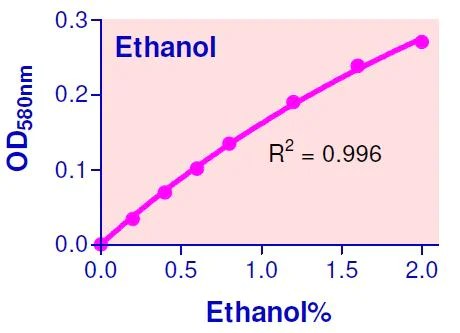
Functional Studies - Ethanol Assay Kit (AB272531)
Ethanol Assay Kit standard curve in 96-well plate.
Typical standard curve – data provided for demonstration purposes only. A new standard curve must be generated for each assay performed.
組合せ製品


製品の詳細
Ethanol Assay Kit (ab272531) is a simple, direct and automation-ready procedure for measuring ethanol concentration. This assay kit is based on an improved dichromate method, in which dichromate is reduced by ethanol to a bluish chromic (Cr3+) product. The intensity of color, measured at 580 nm, is a direct measure of the alcohol concentration in the sample. The optimized formulation substantially reduces interference by substances in the raw samples and exhibits high sensitivity.
Sensitive and accurate: Detection range 0.04 – 2% alcohol in 96-well plate assay.
Convenient and high-throughput: The procedure involves adding a single working reagent, incubation for 8 min, adding a Stop Reagent, and reading the optical density. Can be readily automated as a highthroughput 96-well plate assay for thousands of samples per day.
Versatility: Assays can be executed in 96-well plate or cuvet.
REACH authorisation
Abcam has not and does not intend to apply for the REACH Authorisation of customers' uses of products that contain European Authorisation list (Annex XIV) substances.
It is the responsibility of our customers to check the necessity of application of REACH Authorisation, and any other relevant authorisations, for their intended uses.
製品内容
出荷温度及び保存条件
出荷温度
短期保存温度
長期保存温度
保管に関する情報
補足情報
This supplementary information is collated from multiple sources and compiled automatically.
Biological function summary
Ethanol plays a significant role in central nervous system modulation and energy metabolism. It is not a part of a complex but affects neurotransmitter systems by interacting with ion channels and receptors such as GABA and NMDA receptors. The presence of ethanol in biological systems can disrupt normal neural signaling leading to altered mood and cognitive function which is often observed in alcohol consumption.
Pathways
Ethanol impacts several critical biological processes including the central nervous system and metabolic pathways. It influences the gamma-aminobutyric acid (GABA) pathway by enhancing inhibitory neurotransmission leading to sedative effects. Ethanol also participates in the metabolic pathways related to the conversion of alcohol to acetaldehyde and then to acetic acid involving enzymes such as alcohol dehydrogenase and aldehyde dehydrogenase. This metabolic process connects ethanol to energy production and lipid metabolism.
ターゲットの情報
文献 (3)
Recent publications for all applications. Explore the full list and refine your search
Cell reports 42:113561 PubMed38096056
2023
Applications
Unspecified application
Species
Unspecified reactive species
Cell reports 42:113020 PubMed37610874
2023
Applications
Unspecified application
Species
Unspecified reactive species
Frontiers in microbiology 14:1238737 PubMed37649635
2023
Applications
Unspecified application
Species
Unspecified reactive species
Abcam product promise
Please note: All products are 'FOR RESEARCH USE ONLY. NOT FOR USE IN DIAGNOSTIC OR THERAPEUTIC PROCEDURES'.
For licensing inquiries, please contact partnerships@abcam.com